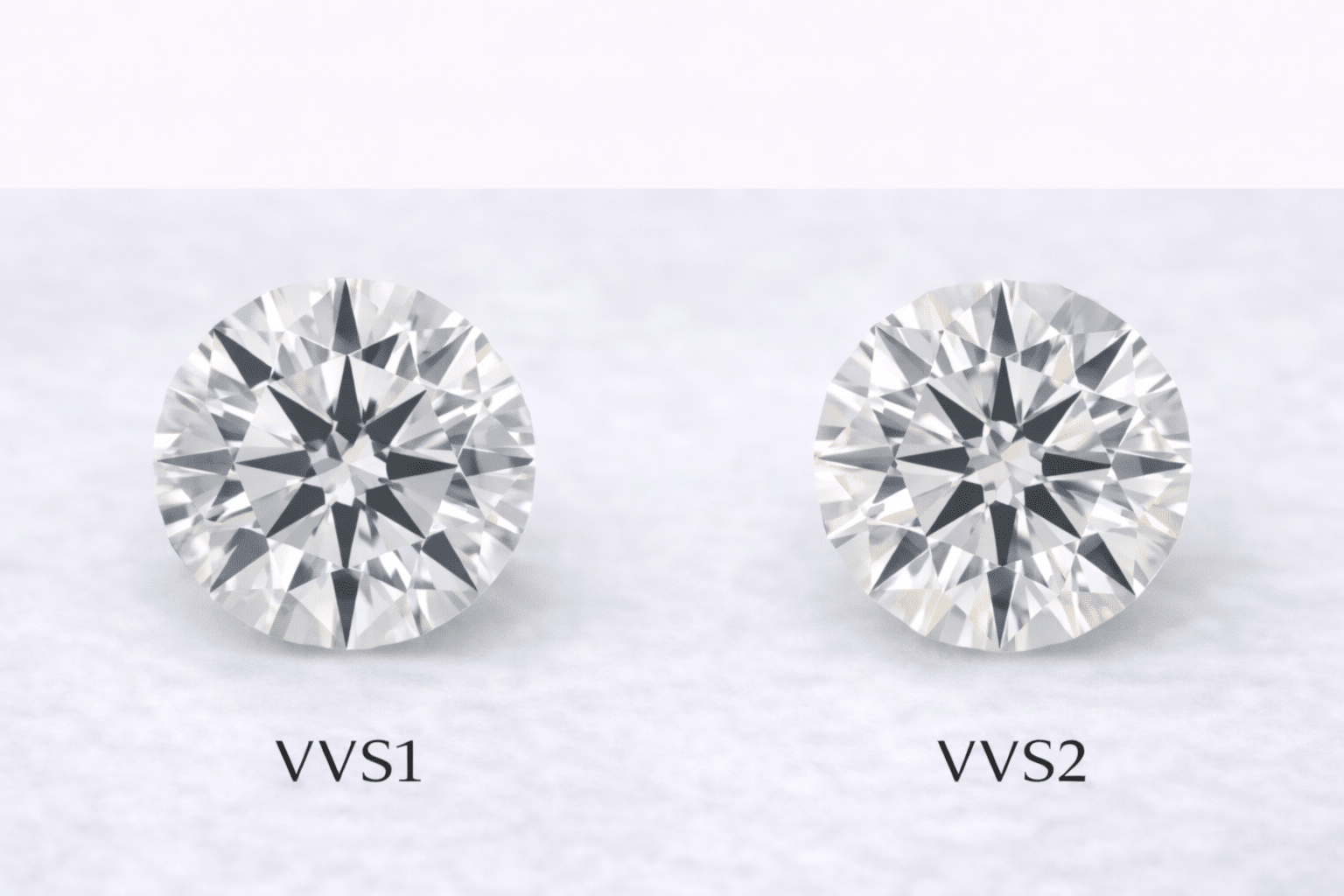
VVS1 and VVS2 diamonds both appear completely flawless to the naked eye; the only distinction between them exists under 10x magnification, where trained graders locate different inclusion positions on the stone. VVS1 inclusions sit on the pavilion side and are nearly impossible to detect even under a loupe. VVS2 inclusions may appear on the crown side, slightly more locatable with careful examination. For round brilliant diamonds under 2 carats, VVS2 delivers an identical real-world appearance to VVS1 at 10–25% lower cost. The only buyers who benefit from VVS1 over VVS2 are purchasing step-cut diamonds above 2 carats, building investment-grade stones, or buying for specific documentation reasons.
Juli Church spent six years at Kay and Zales watching staff upsell VVS1 to buyers who had no practical use for the grade distinction. What follows is what she learned and what it costs buyers who don’t know it.
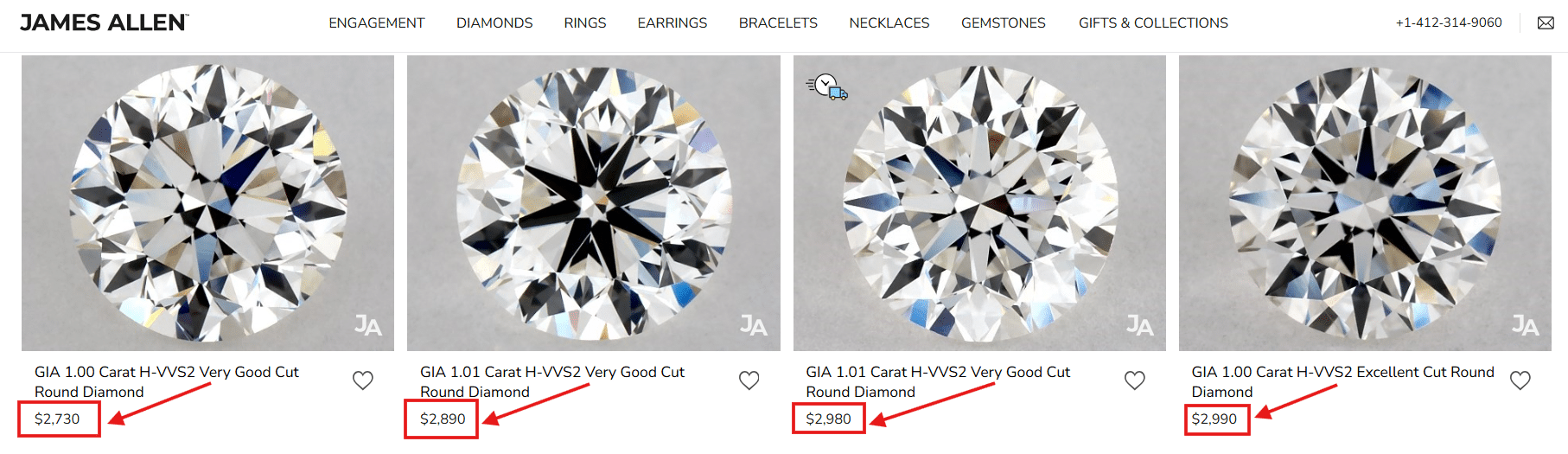
Same specs, different sparkle—cut quality makes the real difference.
What VVS Clarity Actually Means on a GIA Report
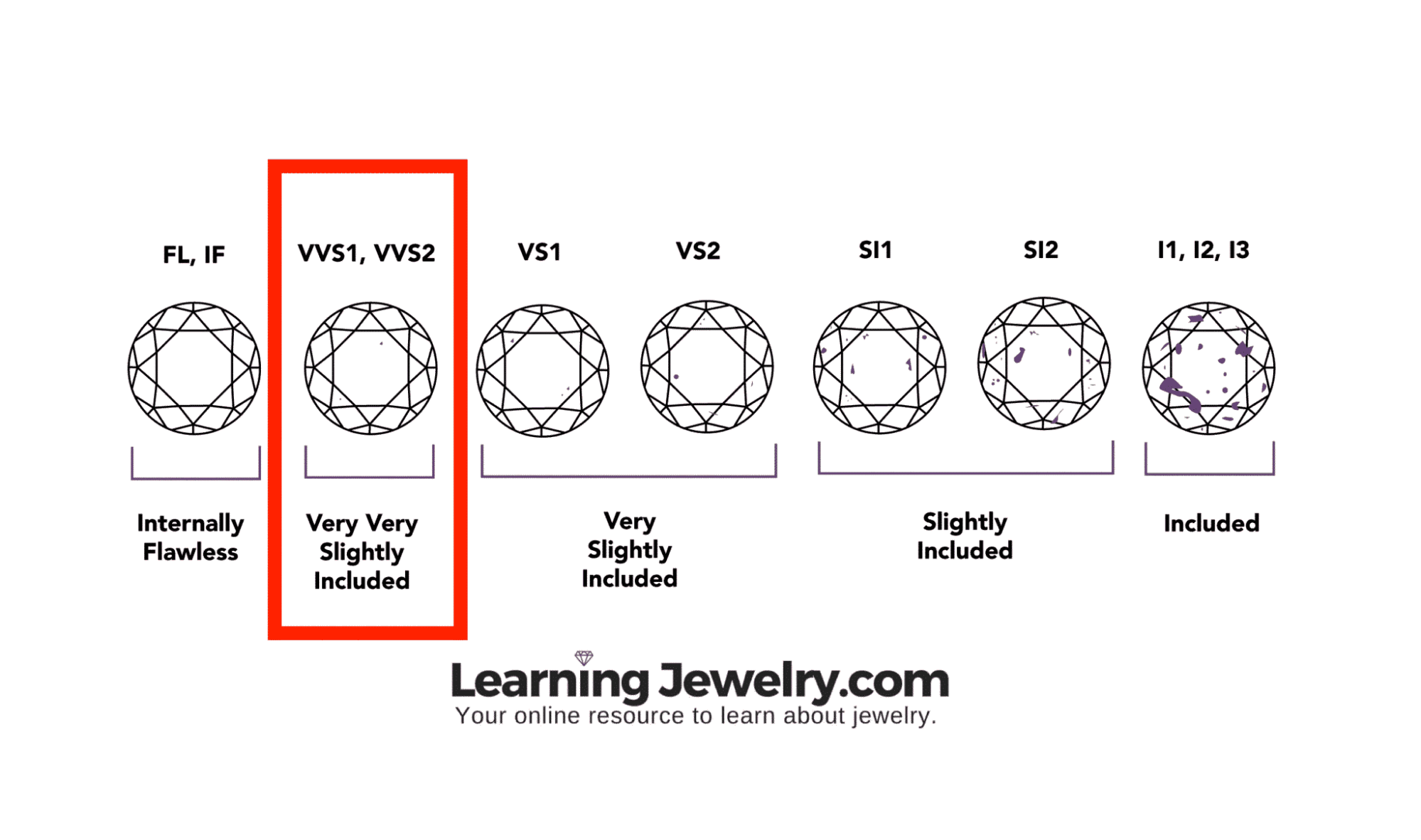
VVS Very Very Slightly Included is the second-highest clarity tier on the GIA scale, containing inclusions so minute that even trained graders struggle to locate them under standard 10x magnification.
The full GIA clarity scale runs: FL → IF → VVS1 → VVS2 → VS1 → VS2 → SI1 → SI2 → I1–I3.
VVS inclusion types include pinpoints (single tiny crystals), needles, internal graining, feathers, tiny clouds, and naturals. All are microscopic. All are undetectable without a loupe.
The 10x magnification standard means a jeweler’s loupe, not a laboratory microscope. That’s the tool graders use at the point of evaluation.
One fact applies to both VVS1 and VVS2 without exception: both grades are always eye-clean. No visible inclusions in normal wear. No exceptions at either grade.

The full diamond clarity chart from FL to I3 shows where each grade sits and what buyers typically pay at each level.
The GIA’s own explanation of how VVS clarity grades are assigned under standard 10x magnification documents the grading methodology directly.
What Actually Separates VVS1 from VVS2
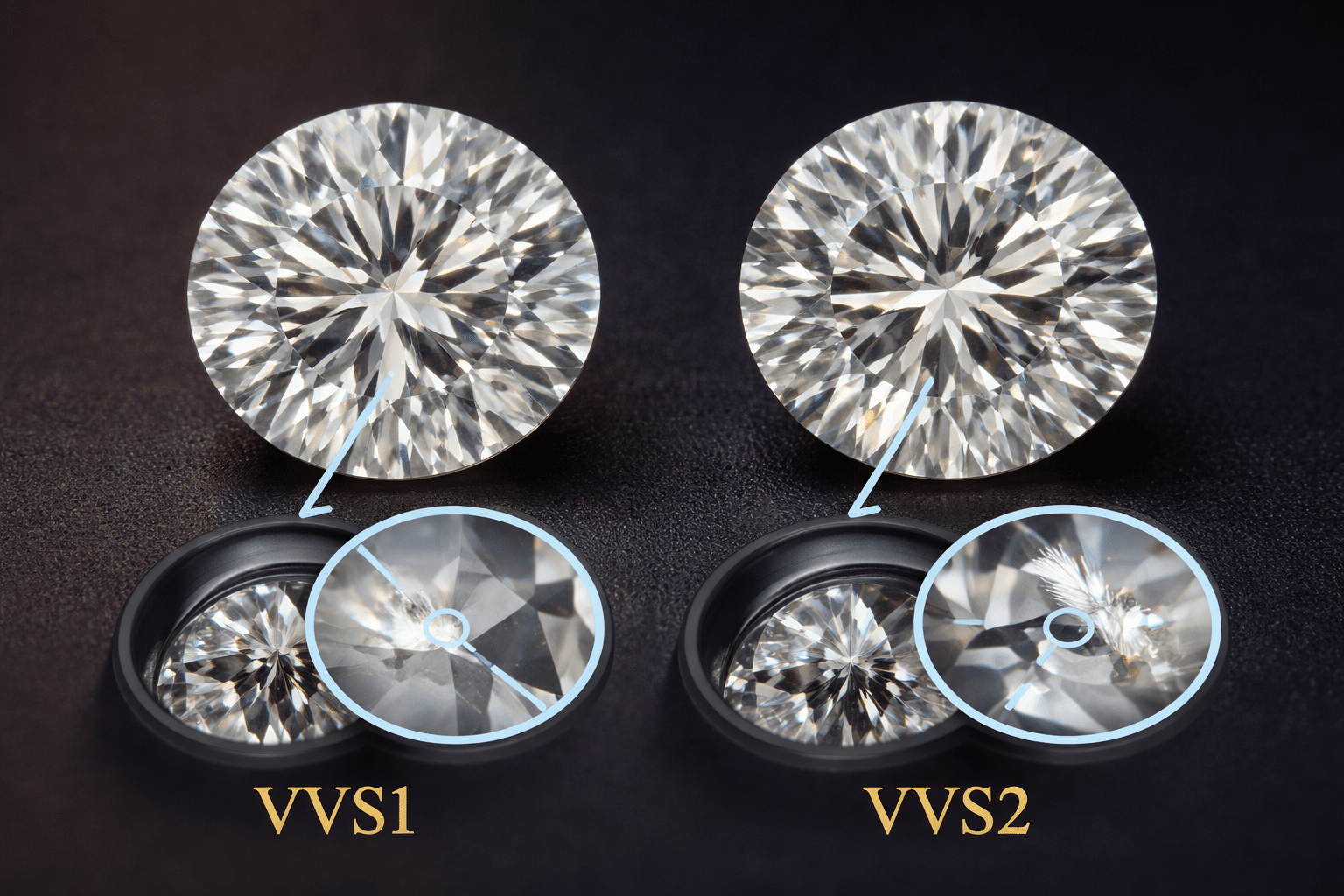
The only technical distinction between VVS1 and VVS2 is inclusion location. VVS1 inclusions sit on the pavilion side, making them nearly impossible to find even under magnification, while VVS2 inclusions may appear on the crown side, slightly more locatable under careful examination.
Feature | VVS1 | VVS2 |
Inclusion location | Pavilion (bottom) side | May appear crown (top) side |
Visibility at 10x | Extremely difficult | Very difficult |
Inclusion types | Single pinpoint or natural | Several pinpoints, small clouds, feathers |
Eye-clean status | Always | Always |
Rarity (GIA-graded) | Top 1–2% | Top 3–5% |
Price vs. VVS2 | +10–25% | Baseline |
Real-world appearance | Flawless to all observers | Flawless to all observers |
The GIA maintains master comparison stone sets specifically because VVS1 and VVS2 are difficult to differentiate. The people who created the grading system need reference stones to tell them apart. Buyers examining a mounted ring in normal lighting will never.
Reddit r/Diamonds (top-voted answer, 27 upvotes): “Functionally, no difference. At least not to the vast, vast majority of lay people.”
Juli’s call: “I had customers pay $1,200 more for VVS1 over VVS2 because they thought ‘cleaner’ meant something you could see. It didn’t. That’s the entire point of the VVS grade; neither inclusion is visible. The distinction only exists on the certificate.”
For a full breakdown of what VVS1 looks like on an actual GIA grading report, the VVS1 clarity guide with grading report examples covers every detail. For VVS2 specifically, inclusion types, how to read the certificate, and what to look for, see the complete VVS2 clarity guide.
The Question Every Buyer Should Ask First: Do You Even Need VVS?
VS2 diamonds are eye-clean in most cases and cost 30–45% less than VVS2. The VVS premium buys certificate documentation, not visible quality, for round brilliant diamonds under 2 carats. This is the question Kay and Zales staff were trained not to ask on your behalf.
The clarity floor by diamond shape:
Diamond Shape | Practical Eye-Clean Floor | Is VVS2 Justified? | Is VVS1 Justified? |
Round brilliant | VS2 | Rarely | Almost never |
Oval / Cushion | VS1 | Large stones only | No |
Princess | VS1 | Rarely | No |
Emerald cut | VVS2 (1.5ct+, white metal) | Yes, above 1.5ct | 2ct+ only |
Asscher cut | VVS2 (1.5ct+, white metal) | Yes, above 1.5ct | 2ct+ only |
Radiant | VS1 | Rarely | No |
Price comparison at 1ct G Excellent, 2026:
Clarity Grade | Natural Price Range | vs. VVS2 |
VS2 | $3,800–$5,200 | −30 to −40% |
VS1 | $4,500–$6,000 | −20 to −30% |
VVS2 | $5,500–$7,500 | Baseline |
VVS1 | $6,500–$9,500 | +15 to +25% |
Google’s AI Overview for “is VVS2 worth it” states directly: “often overkill compared to VS1/VS2, which are also eye-clean.”
The top Reddit answer in r/Diamonds: “I have a VS1, and it looks flawless. Why spend more for VVS when no one can tell?”

A closer look at brilliance—where setting meets sparkle.
Choosing VS2 over VVS2 at 1 carat saves $1,500–$2,300. That’s enough for a 0.15–0.25ct size increase at the same budget or a cut upgrade from Very Good to Excellent. Both changes are visible. The VVS clarity upgrade is not.
Juli’s call: “At Kay and Zales, staff were trained to introduce VVS1 as ‘our highest clarity available today.’ Never by comparing it to VS2. That framing stopped buyers from asking whether they needed VVS at all. Most didn’t. The ones who found out after felt cheated.”

Design your perfect ring—your diamond, your setting, your way.
The full VVS diamond guide including when VVS clarity is worth purchasing vs. when VS2 is sufficient, covers the grade-by-grade breakdown in detail.
VVS1 vs VVS2 by Diamond Shape, Where the Distinction Actually Changes
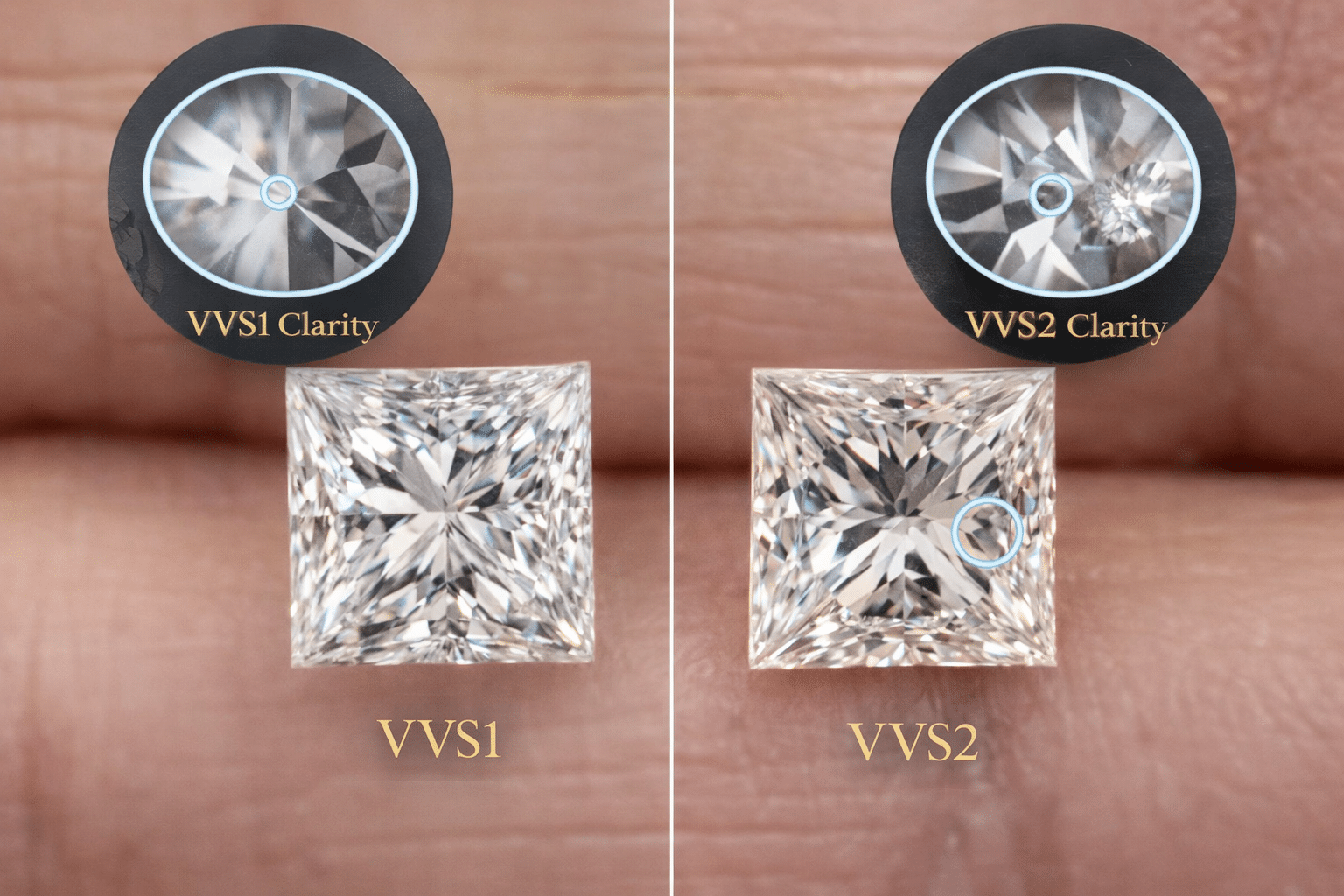
Shape determines whether VVS1 or VVS2 has any real-world relevance. Round brilliant cuts scatter light through 58 facets, making inclusions nearly invisible at VS2, while step cuts like emerald and Asscher expose clarity through large open facets that function as windows into the stone.
Round brilliant diamonds have 58 facets. Light breaks into thousands of reflections. Inclusions scatter into that light return and disappear. VS2 in a round brilliant is almost always eye-clean. VVS in a round brilliant purchase documentation only.
Step-cut diamonds, emeralds, and Asscher are different. Large flat facets create long, unbroken light paths. Inclusions have nowhere to scatter. You can look straight through the stone. VVS2 becomes a genuine quality consideration above 1.5 carats in white gold or platinum settings.
White metal matters here. Yellow gold and rose gold warm the stone visually, reducing apparent inclusion visibility. White metal, white gold, and platinum provide no color masking. A step cut in white metal above 1.5 carats is the one combination where clarity grade affects what you actually see.
Halo and pavé settings are different again. Surrounding diamonds physically obscure the center stone’s lower crown. In a halo setting, VS2 clarity is almost always sufficient regardless of shape.
Juli’s shape-specific call: “Buyers with emerald cuts who stepped down to VS2 at Kay sometimes came back. Not always, but enough that I remembered. Open facets in step cuts are a clarity window. That’s one of the very few times I’d tell someone VVS2 is genuinely worth considering.”

VVS1 vs VVS2 Price Comparison 2026 Data
A 1-carat VVS2 diamond with G color and Excellent cut costs $5,500–$7,500 at major online retailers in 2026, while the same stone graded VVS1 runs $6,500–$9,500 a $1,000–$2,000 premium for a distinction invisible outside a gemological laboratory.

Small changes in color, cut, and certification can noticeably affect diamond pricing.
Natural diamond pricing (G color, Excellent cut, 2026):
Carat | VVS2 Price | VVS1 Price | VVS1 Premium |
0.50ct | $1,500–$2,600 | $2,000–$4,500 | $500–$1,900 |
1.00ct | $5,500–$7,500 | $6,500–$9,500 | $1,000–$2,000 |
1.50ct | $10,000–$18,000 | $12,000–$22,000 | $2,000–$4,000 |
2.00ct | $18,000–$32,000 | $22,000–$40,000 | $4,000–$8,000 |
Lab-grown pricing (IGI certified, G color, Excellent cut, 2026):
Carat | Lab VVS2 | Lab VVS1 | Natural VVS2 | Lab Savings |
1.00ct | $800–$1,400 | $900–$1,600 | $5,500–$7,500 | ~75–80% |
1.50ct | $1,300–$2,200 | $1,500–$2,600 | $10,000–$18,000 | ~80–85% |
Lab-grown diamonds achieve VVS clarity more frequently than natural stones. Controlled growth conditions produce fewer contaminating elements. The rarity argument for VVS1, which barely holds for natural stones, disappears entirely for lab-grown.
Budget reallocation matters here. $1,500 saved from VVS2 over VVS1 buys a 0.15ct size increase or a cut quality upgrade from Very Good to Excellent. Both create visible differences. The VVS1 certificate does not.

See how a classic solitaire looks at today’s price
When VVS1 Is Actually Worth the Premium
VVS1 justifies its premium in three specific scenarios: investment-grade stones above 3 carats, step-cut diamonds above 2 carats in white metal settings, and documentation-driven purchases where the certificate grade carries specific personal or transactional significance.
Investment stones (3ct+): At auction-house scale, secondary market buyers evaluate all four grades simultaneously. VVS1 on a 3ct+ GIA certificate signals the highest possible clarity documentation. Below 3ct, this has no meaningful resale impact.
Step cuts above 2ct in white metal: The size threshold where VVS2 crown-side inclusions could theoretically become relevant under specific lighting conditions. This is the one narrow scenario where the grade distinction has any real-world dimension.

Documentation-driven personal reasons: Some buyers want the top-tier designation. This is valid. But buyers should understand they are purchasing a certificate upgrade not a visual one.
When VVS1 is never worth it:
- Round brilliants under 2ct in any color
- Any lab-grown stone
- Any purchase where stretching to VVS1 compromises cut quality
The complete VVS1 clarity buying guide with specific use cases covers the investment and step-cut scenarios in full detail.

Where to Buy VVS Diamonds and How to Verify What You’re Getting
James Allen provides per-stone 360° HD video for every VVS diamond in their inventory, the only reliable method to confirm that a specific VVS2 stone’s inclusion is genuinely undetectable before purchase.
VVS2 is a grade range, not a fixed inclusion size. Two VVS2 stones on paper may look very different at 40x magnification. A certificate alone doesn’t tell you which one you’re buying. James Allen’s viewer does.
James Allen: 360° HD video at up to 40x zoom. Buyers verify that the VVS2 inclusion in their specific stone is genuinely invisible, not just technically within the grade range. This is the tool for confirming real-world appearance per stone before committing.
Ritani: Displays wholesale cost plus margin per stone. The only major online retailer showing buyers exactly how much of the VVS1 premium reflects market rarity versus retailer markup. A direct price transparency tool that chain stores don’t offer.
Brilliant Earth: Natural and lab-grown VVS inventory side-by-side. Useful for buyers comparing both options at the same budget.

See the true size and brilliance before you buy.
Blue Nile: Large VVS inventory. Useful for price comparison across a wider selection of carat weights and color grades.
Kay, Zales, Jared: Carry VVS1 stones without per-stone video. Buyers pay VVS1 premium without verifying the actual stone beyond its certificate and without comparison pricing to gauge whether that premium reflects market value or markup.
The diamond buying guide, including how to use James Allen’s viewer to compare VVS1 and VVS2 stones side-by-side walks through the full evaluation process.
VVS1 vs VVS2 in Lab-Grown Diamonds
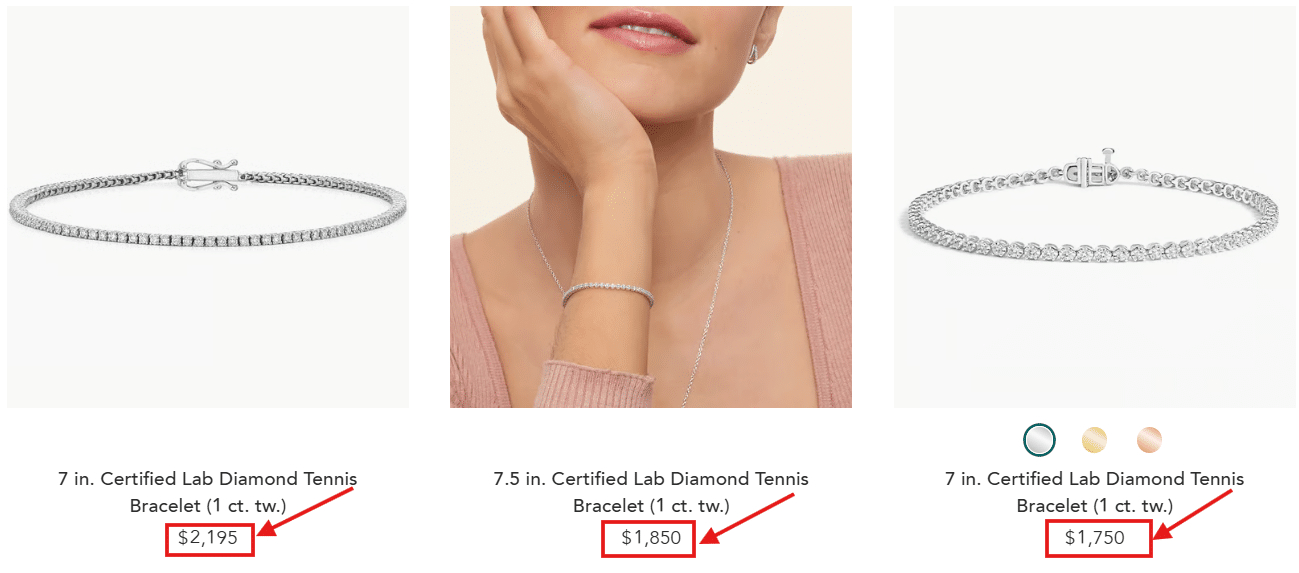
Lab-grown diamonds achieve VVS clarity far more frequently than natural diamonds, making VVS2 lab-grown stones widely available and eliminating most of the rarity justification that drives the VVS1 premium in natural stones.

Compare bold carat sizes and see the price gap
IGI grades lab-grown VVS diamonds using the same D-Z scale and the same VVS1/VVS2 distinction as GIA grades natural stones.
A 1ct lab-grown VVS2 G Excellent costs $800–$1,400 at James Allen. The natural equivalent costs $5,500–$7,500.
For lab-grown buyers, the VVS1 vs VVS2 distinction matters even less than for natural stone buyers. The price gap is smaller in absolute dollars. The visual difference remains zero. Lab-grown VS1 at Excellent cut is indistinguishable from lab-grown VVS2 in any mounted setting.

A Real Buyer Decision at James Allen
A buyer who examined VVS1 and VVS2 stones side-by-side using James Allen’s 360° viewer at 40x magnification could not identify which stone carried which grade and redirected $700 in savings toward a larger carat weight.
Three stones were compared using James Allen’s viewer:
- 1.15ct G Excellent VVS1: $8,900
- 1.18ct G Excellent VVS2: $8,200
- 1.25ct G Excellent VVS2: $8,800
At 40x zoom, inclusions in both VVS2 stones were genuinely undetectable. Not just technically within grade standards. Actually invisible in the specific stones viewed.
The practical outcome: 1.15ct VVS1 vs. 1.25ct VVS2 at the same budget. Both appeared identical. One was 0.10ct larger.
James Allen’s viewer makes this comparison available to every buyer before spending a dollar. The full buyer evaluation process, including how to use the 360° viewer for clarity verification, is covered in LearningJewelry’s buying guide.
What Juli Church Would Tell You to Buy
For most buyers, VVS2 is the rational choice over VVS1, and VS2 is worth evaluating seriously before paying for VVS at all.

The decision breaks down simply:
- Round brilliant under 2ct → VS2 is eye-clean, saves 30–40%
- Step cut above 1.5ct in white metal → VVS2 is justified
- Investment stone above 3ct → VVS1 documentation may matter
Juli’s closing call: “If you’re asking me what I’d buy VS1 in a round brilliant, Excellent cut, G color, confirmed eye-clean using James Allen’s 360° viewer. That’s where the money actually goes to work.”
LearningJewelry.com exists to give you the retail floor knowledge that jewelry salespeople don’t have.
The complete diamond buying decision, every 4C explained with the same insider framework, is the next step before purchasing.
For the full VVS clarity picture across both grades, the VVS diamond clarity guide includes inclusion examples and price analysis.
Frequently Asked Questions About VVS1 and VVS2 Diamonds
Can a jeweler tell VVS1 from VVS2 without laboratory equipment?\
Most jewelers cannot. Even experienced graders struggle to distinguish VVS1 from VVS2 without GIA master comparison stones as a reference. A standard loupe is not sufficient. If a jeweler claims to identify VVS1 vs VVS2 on sight without reference stones, that identification isn’t reliable.
Does VVS clarity affect a diamond’s sparkle or fire?
No. Clarity grade has no impact on light performance, brilliance, or fire. A well-cut VS2 outperforms a poorly cut VVS1 in every lighting condition. Cut quality drives light return. Budget directed toward cuts generates a visible return. Budget directed toward VVS over VS does not.
Is a D-VVS2 diamond combination worth it?
D color with VVS2 clarity is a premium combination where neither quality is visible in a mounted ring under normal conditions. D color is indistinguishable from E and F in mounted stones. VVS2 is indistinguishable from VS1 in round brilliants. The D-VVS2 combination makes practical sense for step-cut stones above 2 carats in white metal. For standard round brilliant engagement rings, the D-VVS2 premium buys documentation, not visible differences.
How does fluorescence interact with VVS1 vs VVS2?
Fluorescence is entirely independent of clarity grade. A VVS1 stone with strong blue fluorescence may appear hazy in sunlight. When evaluating VVS stones, always check the fluorescence level alongside clarity grade. Medium blue fluorescence on a VVS2 is preferable to strong fluorescence on a VVS1, both for real-world appearance and price efficiency.
Is VVS clarity graded the same way by GIA and IGI?
Both use the D-Z scale with identical grade labels, but grading isn’t perfectly calibrated between labs. GIA grades slightly more conservatively. A GIA VVS2 and an IGI VVS2 on the same stone may reflect different actual inclusion levels. For natural diamonds, GIA is the reliability standard. For lab-grown, IGI VVS grading is the accepted benchmark.
Does VVS1 vs VVS2 matter more for colorless (D–F) diamonds?
Marginally, and only above 2 carats. D–F colorless stones in large step cuts attract secondary market buyers who evaluate all four grades simultaneously. For D–F round brilliants under 2 carats, the same principle applies: VVS2 and VS1 appear identical in wear.
Should VVS clarity be a priority on a tight budget?
No. Cut quality is the non-negotiable priority on any budget. A poorly cut VVS1 loses to a well-cut VS2 in every lighting condition. The recommended sequence: lock Excellent cut first, choose G or H color, select VS1 or VS2 clarity, then use the remaining budget for carat size. VVS clarity is the last factor to optimize and only justifies spending when all other priorities are already satisfied.
How does VVS2 compare to VS1 as a practical clarity choice?
VS1 is one grade below VVS2. In round brilliants under 2 carats, VS1 and VVS2 appear identical in wear. VS1 costs 20–30% less than VVS2 at the same carat weight, color, and cut. For most engagement ring buyers, VS1 represents the better value, as it reaches the practical ceiling of visible clarity improvement without the VVS price premium.