
Last Updated on March 2, 2026 by Muhammad Sikandar


Same specs, different sparkle—cut quality makes the real difference.
VVS diamonds sit near the top of the clarity scale, just below Flawless and Internally Flawless grades. The “Very Very Slightly Included” designation means these diamonds contain minute inclusions that challenge even trained gemologists to locate under 10x magnification. But does VVS clarity actually matter for your engagement ring? Should you pay premium prices for characteristics invisible to the naked eye? Understanding what VVS truly means helps you decide whether this grade deserves your budget or whether lower grades deliver identical visual results at better prices.
Tap to compare styles, sparkle, and price
Juli “Jewels” Church, Certified Diamondologist at LearningJewelry.com, provides perspective: “VVS diamonds represent exceptional clarity, no question. But exceptional and necessary are different things. Most buyers cannot distinguish VVS from VS clarity without laboratory equipment. The premium you pay purchases invisible perfection rather than visible beauty.”What Is VVS Diamond Clarity?

Click to compare sparkle, settings, and value
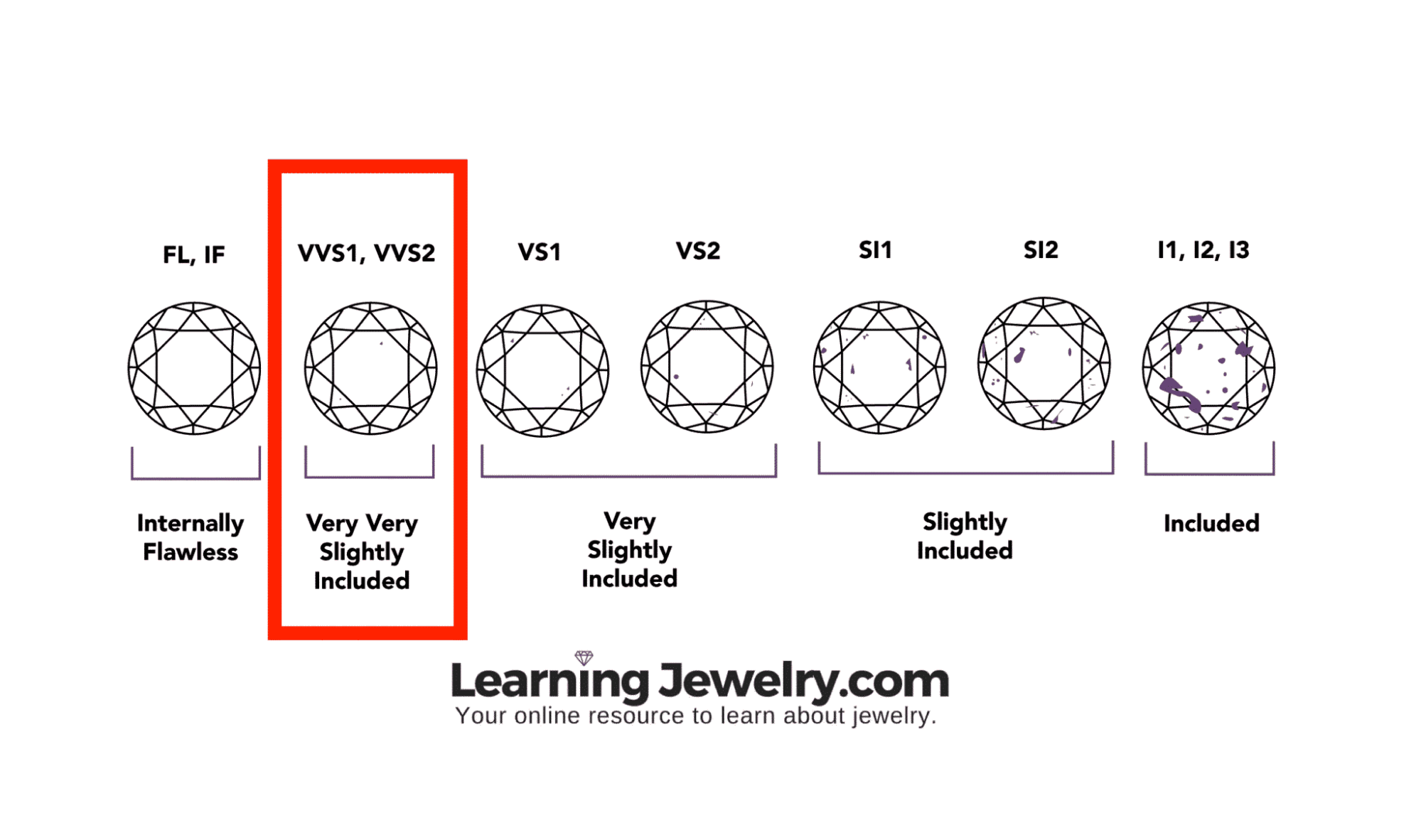
The complete GIA clarity scale includes:| Grade | Name | Description |
| FL | Flawless | No inclusions or blemishes at 10x magnification |
| IF | Internally Flawless | No inclusions, minor surface blemishes only |
| VVS1-VVS2 | Very Very Slightly Included | Minute inclusions are extremely difficult to see at 10x |
| VS1-VS2 | Very Slightly Included | Minor inclusions are difficult to see at 10x |
| SI1-SI2 | Slightly Included | Noticeable inclusions at 10x may be visible to the eye |
| I1-I2-I3 | Included | Obvious inclusions visible to the naked eye |

Understanding VVS Inclusions
When gemologists grade diamond clarity, they assess inclusions and blemishes based on size, number, position, nature, and relief (how visible they appear against the diamond background). VVS diamonds contain inclusions so minute that they prove difficult to locate even under standard 10x magnification. Common VVS inclusion types include:- Pinpoints: Microscopic crystals appearing as tiny specks
- Needles: Thin, elongated crystal inclusions
- Internal graining: Subtle growth irregularities
- Minor feathers: Tiny internal fractures

VVS1 vs VVS2: The Two VVS Grades
VVS1 Diamonds
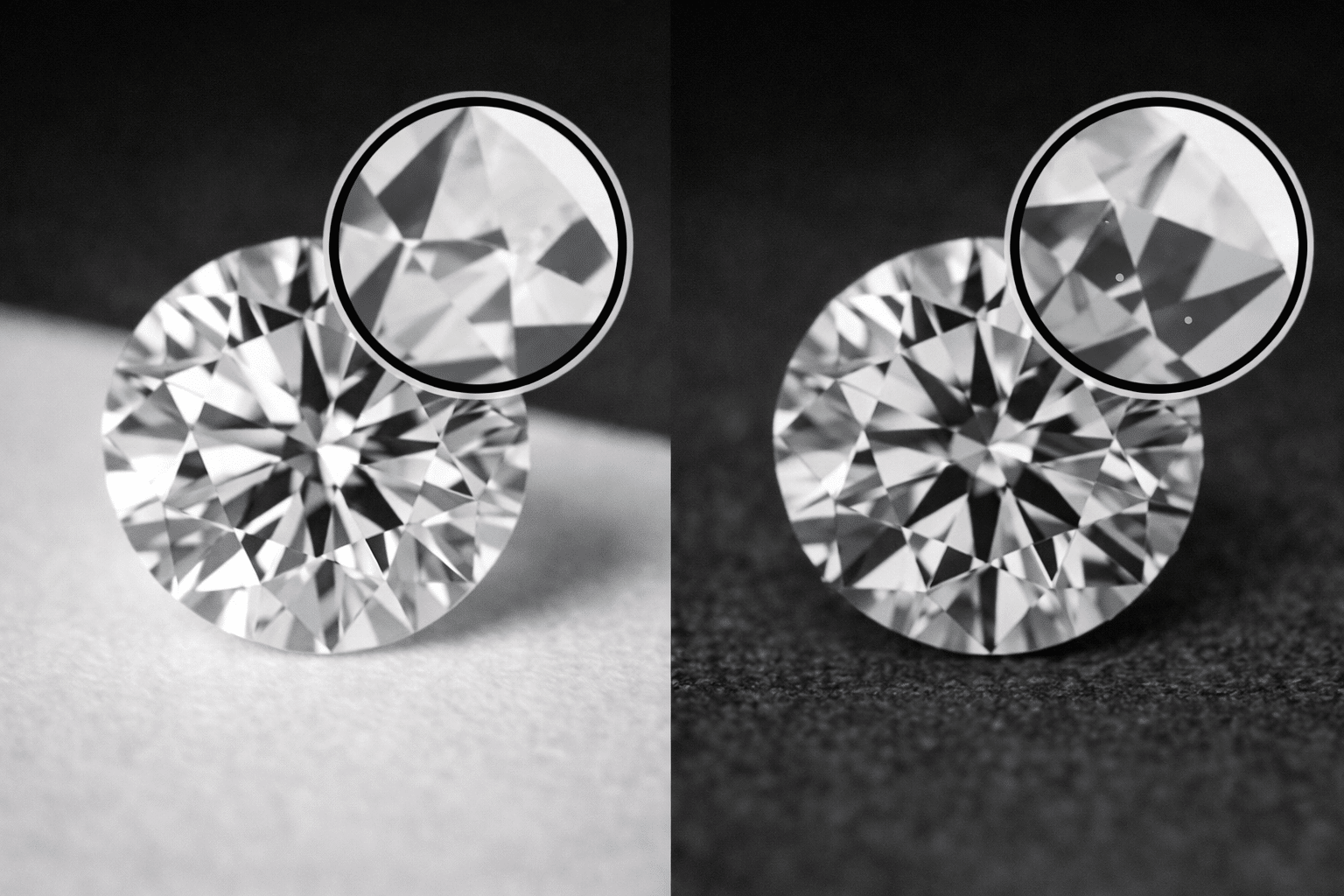
VVS1 diamonds represent the higher VVS grade. Inclusions in VVS1 stones prove extremely difficult to locate even under 10x magnification, often requiring examination from the pavilion (bottom) side rather than the crown (top). Many gemologists need extended time and multiple viewing angles to identify VVS1 inclusions. Some VVS1 diamonds appear virtually flawless under standard examination.
VVS2 Diamonds
VVS2 diamonds contain slightly more visible inclusions than VVS1, though still extremely minor. A trained grader can typically locate VVS2 inclusions under 10x magnification from the crown side, though average observers would still struggle.Comparing VVS1 and VVS2
| Factor | VVS1 | VVS2 |
| Inclusion Visibility at 10x | Extremely difficult to see | Very difficult to see |
| Typical Inclusion Location | Often pavilion-side only | Maybe crown-side visible |
| Eye-Clean Status | Always | Always |
| Relative Rarity | More rare | Slightly less rare |
| Price Premium | Higher | Lower |
| Practical Difference | None visible | None visible |
VVS Diamonds vs VS Diamonds
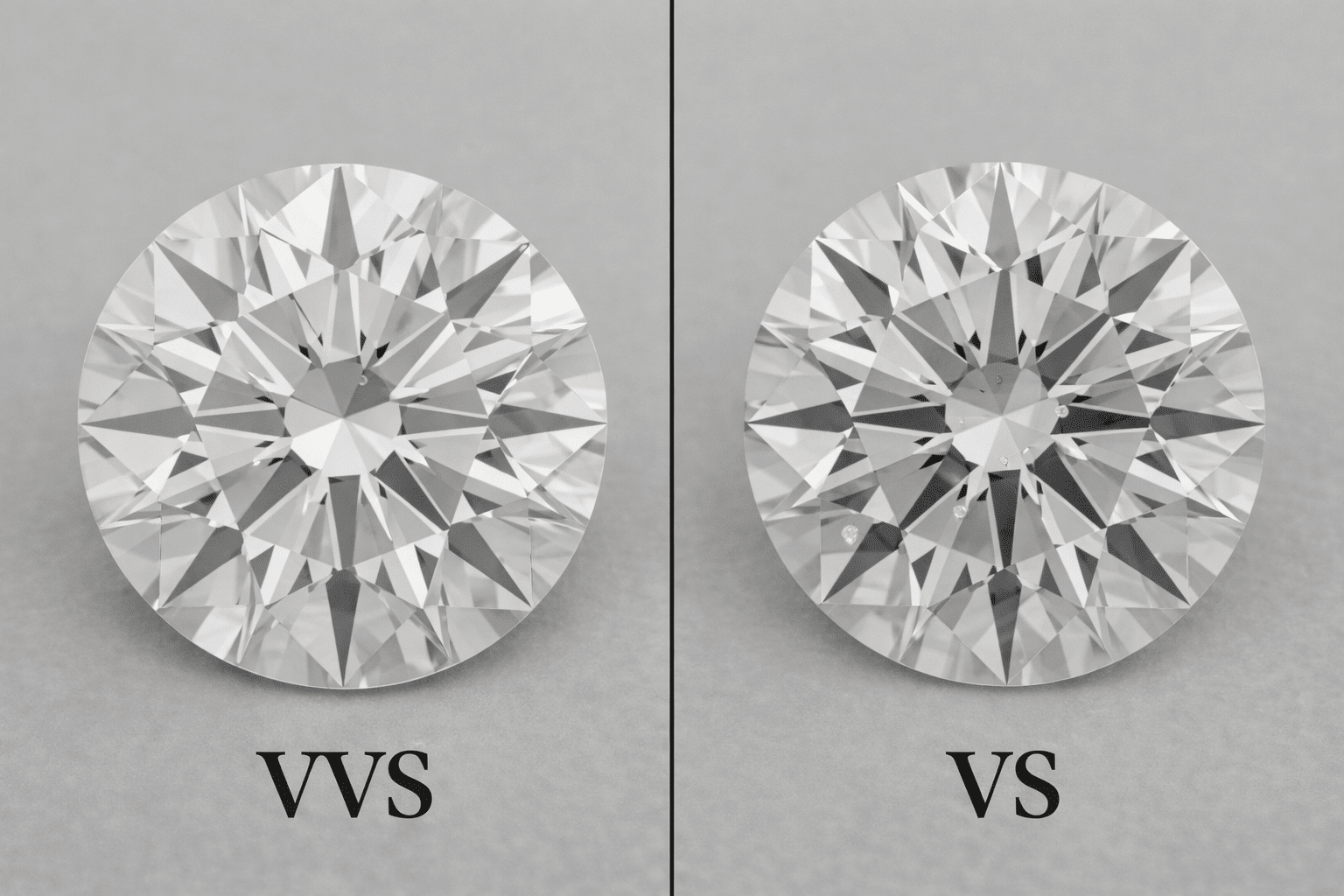
| Factor | VVS Clarity | VS Clarity |
| Eye-Clean | Always | Always (VS2 guaranteed) |
| Inclusions at 10x | Very difficult to find | Somewhat easy to find |
| Inclusion Types | Pinpoints, minor features | Small crystals, feathers |
| Price Range (1ct) | $5,000-$15,000+ | $3,500-$10,000+ |
| Value Proposition | Premium for rarity | Excellent balance |
| Practical Appearance | Flawless to the eye | Flawless to the eye |

A closer look at brilliance—where setting meets sparkle.
The price difference between comparable VVS and VS diamonds often reaches $1,000-$3,000 or more. That budget could upgrade carat weight, cut quality, or color grade, characteristics that actually affect visible appearance.VVS vs Flawless and Internally Flawless
VVS diamonds rank just below the top clarity grades, with meaningful price implications.| Grade | GIA Frequency | Price Premium vs VVS |
| Flawless (FL) | Less than 0.1% | +30-50% or more |
| Internally Flawless (IF) | Less than 1% | +15-25% |
| VVS1 | ~2% | Baseline comparison |
| VVS2 | ~3% | -5-10% vs VVS1 |

How Much Do VVS Diamonds Cost?
VVS diamond pricing depends on the complete quality picture, cut, color, carat weight, and specific clarity grade, all contribute.General VVS Price Ranges
| Carat Weight | VVS2 Range | VVS1 Range |
| 0.50ct | $1,200-$2,500 | $1,400-$3,000 |
| 1.00ct | $4,500-$9,000 | $5,500-$12,000 |
| 1.50ct | $8,000-$18,000 | $10,000-$22,000 |
| 2.00ct | $15,000-$35,000 | $18,000-$45,000 |
Lab Grown VVS Diamonds
Lab-grown VVS diamonds offer 60-80% savings versus mined equivalents. A 1-carat lab-grown VVS diamond might cost $1,500-$3,000 compared to $5,000-$12,000 for a natural. Lab diamonds possess identical optical, chemical, and physical properties to mined diamonds. The VVS clarity grade means the same thing regardless of origin; minute inclusions are difficult to detect under magnification.
Is VVS Clarity Necessary?
VVS clarity represents excellent quality, that fact stands undisputed. The question is whether excellent translates to necessary for your purchase.When VVS Makes Sense
- Budget comfortably accommodates VVS without sacrificing other qualities
- Top-tier documentation matters for investment or resale purposes
- Personal satisfaction from knowing you own a near-flawless quality
- Purchasing very large diamonds where any inclusion might become more visible
- Budget constraints require trade-offs between quality factors
- Practical appearance matters more than laboratory specifications
- The maximum carat weight within budget represents your priority
- The ring setting will hide potential inclusions anyway

Case Study: David’s VVS Decision
David, a 34-year-old attorney from Boston, carefully evaluated his clarity options: “My initial budget was $15,000 for the center diamond. I assumed higher clarity meant better, so I started looking at VVS1 options around 1.10 carats with G color. Then I spent time actually comparing diamonds at James Allen. I examined VVS1 and VS2 stones side by side using their 360° imaging at 40x magnification. Even under extreme magnification, both diamonds looked beautiful. Here was my actual comparison: VVS1 Option: 1.08ct, G color, Excellent cut, $14,200 VS2 Option: 1.31ct, G color, Excellent cut, $13,800 The VS2 diamond showed a tiny inclusion under magnification that I could barely locate, even when actively searching. At normal viewing? Completely invisible. I chose the 1.31ct VS2. The size difference between 1.08ct and 1.31ct is immediately noticeable. The clarity difference between VVS1 and VS2 is not noticeable at all without magnification. My fiancée constantly receives compliments on her ring. Nobody has ever asked about clarity grade. Everyone notices the impressive size. Choosing VS2 over VVS1 saved money while delivering a larger, more impressive diamond.”
Design your perfect ring—your diamond, your setting, your way.