White gemstones, also known as clear gemstones or colorless gemstones have many meanings.
Most often…
They are associated with healing, cleansing, and purifying. They are a pure crystal.
In this article, you’ll learn:
- What white gemstones are
- Where to buy them
- And the different types of white and clear gemstones when it comes to fine jewelry!
What Are White Gemstones?
The term “white gemstones” can refer to opaque white or colorless gemstones. Some gemstones are a milky white, while others are clear or colorless. Clear, colorless, and white gemstones are interchangeable terms for the most part. Gemstones that are opaque white shouldn’t be called colorless or clear.
White colorless gemstones are very popular as diamond simulants. A diamond simulant is any colorless alternative to a colorless diamond. Some diamond simulants are manmade and some are natural gemstones that look similar to diamonds.
What’s the Best Metal for a White Gemstone?
According to fashion, some colored gemstones look better in different colored metals. Some colors are said to look better against one skin tone more than another.
The general rule is cooler colors look better against silver and white metals. The most popular in jewelry are white gold, sterling silver, and platinum. Warmer colors are said to look better in a yellow gold ring setting. They can also look great in rose gold too.
Read also: Platinum vs White Gold
White gemstones can look good in either. The color white is neither warm nor cold. Personally, I think the white gemstones look best in yellow gold. Opaque white stones. For colorless gemstones, I like them in white gold or platinum.
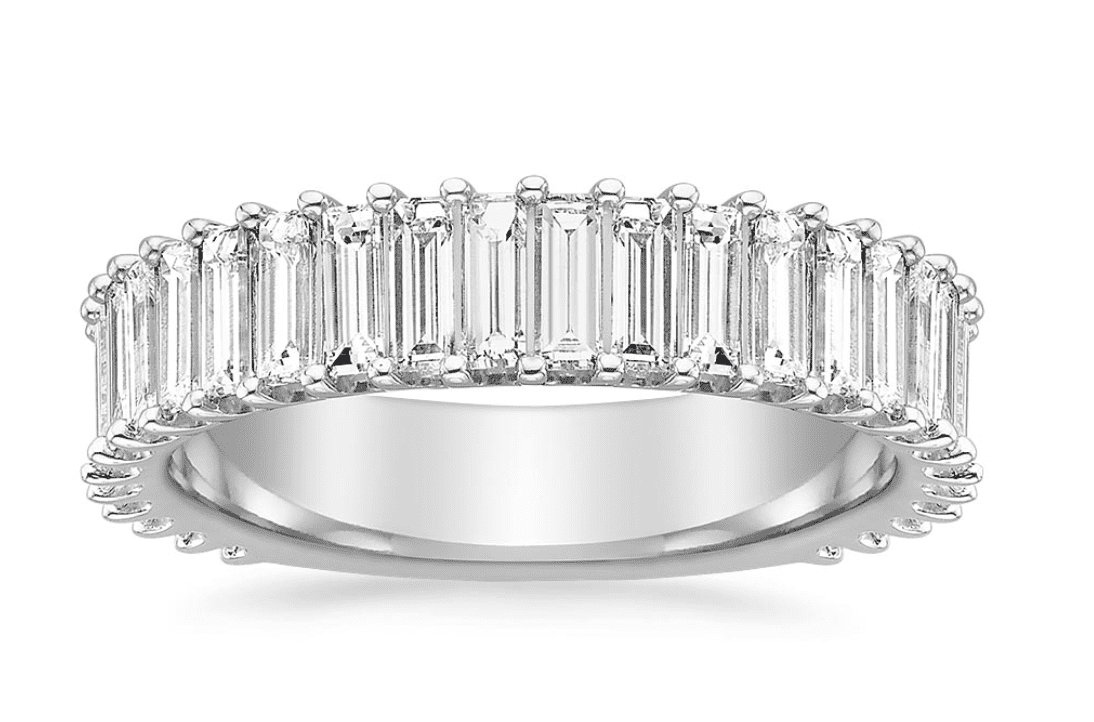

Despite this “color science”, I just pick what I like. That’s the great thing about buying gemstone jewelry. You should always pick what reflects your self confidence and taste. But it’s good to know if you’re at a loss on where to start.
21 Most Popular White or Colorless Gemstones
1. Natural Colorless Diamonds

Colorless diamonds are the most popular clear gemstones. I’m sure you’re not surprised by this. Still, it’s important to add them to the list. Colorless diamonds are often referred to as white diamonds or colorless diamonds.
Natural colorless diamonds are mined from the earth. There are many different places to mine diamonds. The quality of a natural diamond depends on the 4Cs: cut, color, clarity, and carat weight. These factors also determine the cost.
There’s a lot that goes into choosing a colorless diamond for an engagement ring. There are good quality and bad quality diamonds. There are also good quality diamonds being charged more than they’re worth.
Diamonds have an excellent resistance to daily dirt and dust. They are the most scratch resistant minerals in the world. However, the crystal structure is brittle. If hit hard enough, a diamond can crack, split, or chip.
2. Lab Created Colorless Diamonds

Lab created diamonds fall under a number of names. They have been called man made diamonds, synthetic diamonds, created diamonds, and lab grown diamonds.
They’ve also been mistakenly referred to as diamond substitutes or simulated diamonds. Colorless lab grown diamonds have the same chemical, optical, and physical properties as natural colorless diamonds. Simulated diamonds and diamond substitutes are other colorless gemstones with different properties.
Read also: Lab Created Diamonds vs Simulated Diamonds
The main difference between the two is origin. Scientists replicate the conditions needed for mined diamonds to form. They’re able to control the formation better, which produces higher quality stones for an affordable price.
Lab grown diamonds can be between 20-60% less than a mined diamond of the same quality. They are also ethical. Diamond ethics and conflict diamonds have been a huge concern and argument against natural diamonds. Lab diamonds neutralizes that suspicion.
3. Fancy White Diamonds

A lot of people don’t know fancy white diamonds exist. Most natural fancy colored diamonds are very rare and can cost 10s to hundreds of thousands of dollars. Lab grown fancy colored diamonds are more affordable, but you won’t find lab grown fancy white diamonds.
Colorless diamonds are often called white diamonds. Fancy white diamonds have a cloudy white color throughout the stone.
4. Cubic Zirconia

credited to: maicos
Cubic zirconia is the most popular diamond substitute on the market. It comes in a range of different qualities, depending on how the company does its process. It is a man made stone.
Most companies that use cubic zirconia are producing affordable simulated diamond jewelry. The stone is very affordable at around $5 per carat. Maybe less. Often times, the ring metal outweighs the value of the stone.
Read also: Lab Diamonds vs Cubic Zirconia
Cubic zirconia stones are colorless like diamonds, but the brilliance is much different. They have a high dispersion, which is what gives them they’re rainbow flashing demeanor.
Cubic zirconia has an 8.5 hardness. Despite this, the stone still scratches and clouds due to oxygen in the air, other minerals, etc. You won’t see the results immediately. If you wear it every day, it’ll eventually become cloudy.
It can chip too. It doesn’t have gem cleavage, but it can fracture. It’s considered a brittle stone.
5. Moissanite

Moissanite has increased in popularity alongside lab created diamonds. They’re not the cheapest diamond alternatives, but more affordable than diamonds of any form.
They also have a similar dispersion to cubic zirconia’s rainbow flashes. Moissanite brilliance has always been described as a disco ball effect. For some, it’s overwhelming.
Read also: Where to Buy Moissanite Online
Moissanite is classified as colorless gemstone, but they aren’t always colorless. In different lighting, even the highest quality stone can still look tinted.
Moissanite engagement rings are extremely popular. Many are able obtain them in large carat weights for less than a high quality 1 carat diamond.
6. White Sapphire

Majority of white sapphires you’ll find at local retailers are lab-created white sapphires. Natural white sapphires are rarer, but can be found online easily.
A white sapphire forms when impurities don’t mix with the mineral corundum. Corundum is responsible for creating every color of sapphire, except for red. You’ll know red corundum better as ruby. Different impurities in the corundum crystal produce the different colors in sapphire.
Read also: Lab Created White Sapphire vs Diamond
If no impurities enter the crystal, it’s known as white sapphire. White sapphire is a popular diamond substitute used as center stones or accent stones.
7. White Opal

Opals are one of the top trending alternative gemstones for engagement rings. There are a few different varieties of opal, but the most common are white opals. You might hear them called milk opals or light opals.
White opals have a milky base. When turned at different angles, you see a pattern of colors across the surface. We call it the play of light.
Read also: Opalite vs Opal
You can find lab created opals at your average mall jewelry store. It’s harder to find natural ones locally. The visual appearance between a lab grown opal and a natural white opal is distinct. Natural opals have opalescence, but it can’t be duplicated in a lab environment.
8. White Moonstone

credited: Denish C
Moonstone has become one of the most popular gemstones in this last 10 years. Despite its popularity, many people don’t know a whole lot about it. Moonstone can come in a variety of colors, but most people are familiar with white moonstone and blue moonstone.
White moonstone can be faceted, but is normally into polished cabochons. They hold the most value when cut into smooth round stones. It’s the best way to show the adularescence of a real moonstone.
Read also: Opalite vs Moonstone
Adularescence is an ethereal glow that is produced in natural moonstone. It gives the stone a soft glow. The better the glow, the pricier the stone. White moonstone is pretty affordable at around $60 per carat.
Cat’s eye moonstone may go for higher prices due to its rarity. Cat’s eye stones and star stones will raise the value of a semi precious gemstone.
Unfortunately, it’s not a good stone to wear every day. Moonstone is very scratchable and delicate. It can splinter and cleave if struck hard enough.
9. White Labradorite

credited: Amelia Isa
Labradorite is a feldspar mineral too. It’s kind of a cousin to moonstone. Normally, people see blue labradorite and purple labradorite. Labradorites have a really cool optical effect called labradorescence. When tilted at different angles, it will display beautiful color flashes.
It can also have a white base. White labradorite is known in the gem industry as rainbow moonstone. Many people know about this white gemstone, but believe its moonstone. But it’s labradorite.
Rainbow moonstone has become trendy when faceted. When cut en cabochon, it can appear similar to moonstone, but doesn’t display the same effect. Like moonstones, white labradorite isn’t a stone you want to wear all the time.
It has a low hardness of 6-6.5 and split due to its gemstone cleavage. Rainbow moonstone is very affordable and easy to place, should you want to wear it as every day jewelry.
10. Cultured Freshwater Pearls

Pearls are nature’s gemstones. They are one of the few gemstones produced by a living organism. Freshwater pearls are produced by freshwater mussels.
There are few natural pearls left in the world. It’s safe for you to assume all freshwater pearls are cultured pearls. A cultured pearl is a real pearl in every way.
An irritant has to be introduced to a mollusk for it to form a pearl. It could be a piece of sand, mineral, or even coral. Think of it like having a pebble in your shoe.
Read also: Natural vs Cultured Pearls
Since a mollusk can’t exactly shake it out, it frantically starts coating it in layers of nacre. Nacre is the shiny iridescent material that gives pearls their luster. That’s how a natural pearl is created.
Cultured pearls are when a pear farmer watches over all the pearls like a flock of sheep. They have to manually introduce an irritant to the shell. It doesn’t happen by chance. For that reason, they’re less expensive than most pearls.
11. Cultured South Sea Pearl

A South Sea pearl is the largest pearl produced. They come from the saltwater oyster pinctada maxima. South Sea pearls can be grown in Indonesia, the Philippines, Australia, and Myanmar.
There are natural South Sea pearls, but they’re highly expensive when looking for round shapes. Baroque shapes are less expensive, but not as desirable. Even a strand of cultured white South Sea pearls can cost over $10,000.
12. Cultured Akoya Pearl

Cultured Akoya pearls come from Japan mainly, but are also found in China, Thailand, Vietnam, and Australia. These freshwater pearls are the most popular and most common type of saltwater pearls.
A white Akoya pearl is often round with a vitreous luster. They have a thicker nacre than other pearl varieties, which gives them the extra shine. It also makes them slightly more resilient than other pearls. But they still have the same general vulnerabilities as all pearls.
13. White Topaz

White topaz is often used as a diamond substitute, but you’ll see it as accent stones rather than a center stone. White topaz is formed when no impurities enter the crystal.
It’s also one of the more affordable white gemstones. Topaz gemstones are regularly valued for their color, like blue topaz or Imperial topaz. White topaz gemstones aren’t in demand and can run about $40 per carat. Sometimes more, sometimes less. Most white topaz gemstones are natural.
Read also: White Topaz vs Diamond
Topaz may rate an 8 on the Mohs scale, but it still will scratch over time if worn everyday. It also has cleavage, which makes in vulnerable to splitting. It’s a delicate stone for a center stone.
14. White Zircon

Zircon is one of the oldest gemstones, but it gets a bad rep. It’s often misrepresented as cubic zirconia. They’re both colorless, but the two stones are completely different. Zircon ranks a 7.5 on the Mohs scale. It doesn’t make a great center stone because it’s also very brittle.
Don’t expect to find this stone easily. You’ll more than likely have to hit places like Etsy or Amazon to find white zircon engagement rings. The hardest part about acquiring this white gem is obtaining a well-cut white zircon. Make sure you see video footage of the stone before buying it.
15. White Quartz

White quartz is one of the few colorless gemstones that isn’t often used as a diamond substitute. It can be, but it scratches pretty easily. But in the realm of healing crystals, white quartz is one of the most revered crystals. It’s more often referred to as clear quartz.
Clear quartz is one of the base crystals people start with when learning about crystals and their healing properties. It works well with all of the chakras. It’s also said to amplify energy. Because of this, it’s used with a number of other crystals.
It can be transparent with internal inclusions. Quartz is the most abundant mineral in the world, so it doesn’t go for high prices. Large quartz pieces like towers with very few inclusions, will cost more.
16. White Spinel

Spinel is one of those white crystals that is better valued as a colored gemstone. It’s one of the oldest gemstones in the world, but forgotten about in its colorless form. White spinel was used early on as diamond simulants or alternatives.
That was before other white crystals became a better option. White spinel took a backseat to other white gems like white topaz or white sapphires.
17. White Jade
You probably know jade as a green gemstone. It comes in a variety of other colors too. White jade, brown jade, tan jade, yellow jade, and even the rare blue jade all exist.
Jade is split up into two varieties: jadeite and nephrite. Jadeite is responsible for Imperial jade, the best quality jade in the gemstone industry. Nephrite jade is less popular, and more abundant. Both jadeite jade and nephrite jade can produce white jade.
Read also: Nephrite Jade vs Jadeite Jade
White jade isn’t often used in gemstone jewelry. Instead, jade is carved into ornamental and artistic pieces. The best white jade stones are translucent, almost colorless. If carved with precision, these pieces have a glowing effect.
18. White Howlite

White howlite isn’t a popular gemstone for faceting. Instead, it’s more used for its healing properties. Most howlite jewelry are beaded bracelets. It is said to bring mental clarity and be a calming stone. It is said to aid in patience, stability, bouts of rage, and strengthen your inner peace.
At first glance, it can look like marble. Howlite is a borate mineral. White howlite is an opaque solid white color. It can be found with black inclusions threaded through it. Aside from these inclusions, people don’t have a huge interest in it. Howlite commonly found and doesn’t cost much at all.
19. White Agate

credited: Mauro Cateb
Agate is a variety of chalcedony, a type of crystalline quartz. White agate isn’t the most popular either. Agates are characterized by the banding in the gemstone. Agate bands are desirable when they have a variety of different colored bands.
White agate leaves little to be desired for agate connoisseurs. It has a base white color with faint bands. Other types of agate have white bands too. But these are not white agate. The main gemstone must be white.
20. White Coral
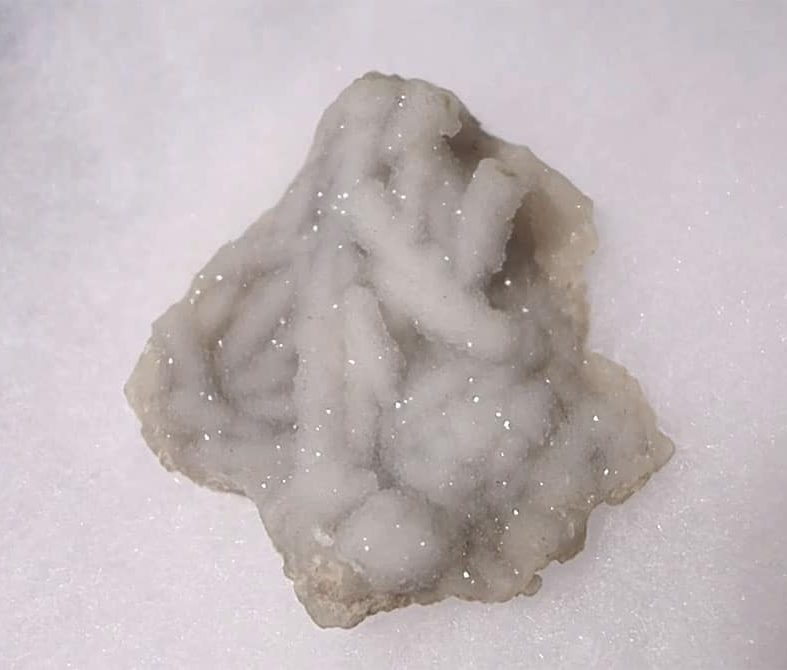
A lot of people don’t see natural coral as gemstones. But they do have their place. There are many people who collected fossilized coral. Coral has also been used in jewelry since ancient times.
21. White Scolecite

credited: Robert M. Lavinsky
This white gemstone is known for its psychic abilities and connection to the spirit world. It is also said to work well with the heart chakra, throat chakra, third eye chakra, and crown chakra. It’s said to have high vibrations and frequency.
Aside from its metaphysical properties, this white scolecite doesn’t have a place among gemstone jewelry in the industry. It can also be known as natrolite and mesolite. It rates a 5 on the mohs scale and is very brittle.
Where to Buy a White Gemstone?
If you’re looking to buy an opaque white gemstones, majority of those stones won’t be found at fine jewelry retailers. You’re more likely to find them from crystal shops and the like.
Clear gemstones are a lot easier to find. For natural white sapphires, white topaz, and moissanite, we recommend Brilliant Earth.
For the rare fancy white diamonds, we recommend checking out Leibish and Co.