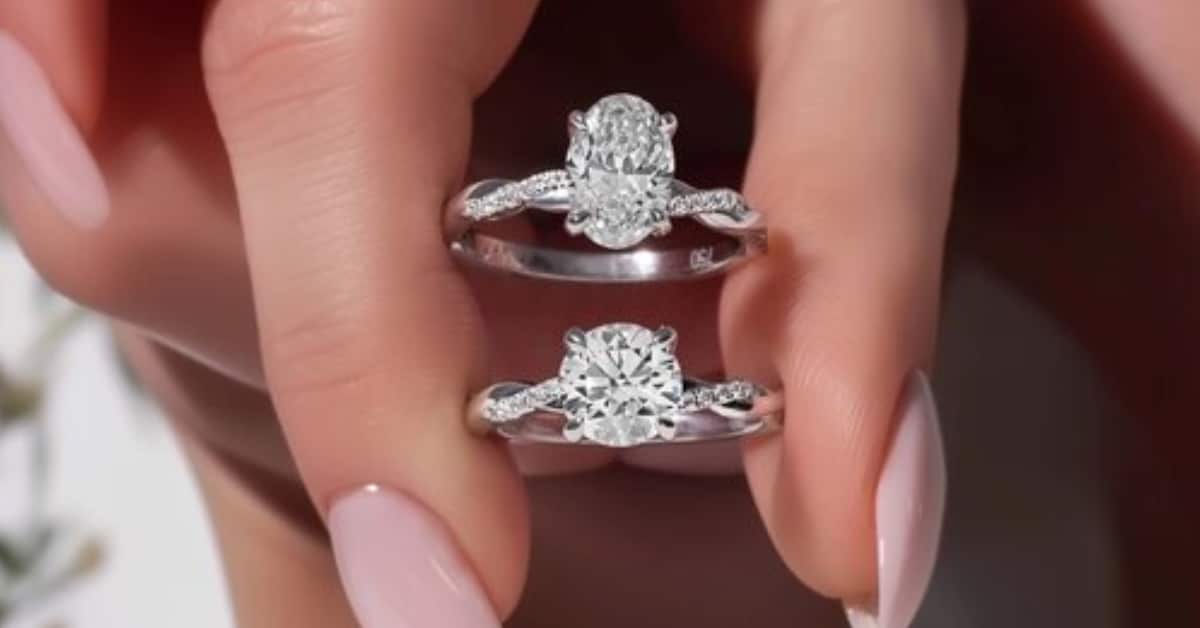
“One shape. Three stunning styles.”
Oval diamonds have surged in popularity over the past five years, and lab grown options have accelerated this trend dramatically. The elongated silhouette creates a flattering, finger-lengthening effect that round diamonds cannot replicate. Combined with excellent brilliance and lower price points, oval lab grown diamond engagement rings represent one of the smartest choices buyers can make.
According to jewelry industry reports, oval diamonds now rank as the second most popular shape for engagement rings, trailing only round brilliants. Among lab grown diamond purchases specifically, ovals frequently claim the top spot.

“Five carats of endless brilliance.”
Juli “Jewels” Church, Certified Diamontologist at LearningJewelry, explains the appeal: “Oval diamonds give you more visual size per carat than rounds. A well-cut 1.5 carat oval faces up like a 1.75 carat round. For buyers wanting maximum impact within their budget, ovals deliver.”
Why Oval Lab Grown Diamond Engagement Rings Stand Out
Oval diamonds combine the brilliance of round cuts with a distinctive elongated profile. Their 58 facets create the same fire and sparkle as round brilliants while offering unique aesthetic advantages.
The shape flatters virtually every hand type. On shorter fingers, the elongated profile creates visual length. On longer fingers, ovals maintain elegant proportions without appearing undersized.

“Timeless sparkle, perfectly balanced.”
Lab grown oval diamonds amplify these benefits through accessibility. Where a high-quality 2 carat natural oval might cost $12,000-$18,000, comparable lab grown diamond prices fall between $2,500-$5,000.
Oval Lab Grown vs Round Lab Grown Diamonds
Factor | Oval Lab Grown | Round Lab Grown |
Price Per Carat | 15-25% Less | Higher |
Face-Up Size | Appears Larger | Standard |
Brilliance | Excellent | Maximum |
Finger Coverage | Elongating | Balanced |
Bow-Tie Effect | Possible | None |
Setting Versatility | High | Highest |
Inclusion Hiding | Very Good | Excellent |
Color Masking | Good | Better |
Resale Demand | Growing | Highest |
Unique Factor | Distinctive | Classic |
Round brilliants technically return more light due to mathematically optimized proportions. However, well-cut ovals come remarkably close while offering larger appearance and lower costs.

“A graceful twist on forever.”
Understanding the Bow-Tie Effect
Every oval diamond displays some degree of bow-tie, a dark shadow resembling a bow-tie across the center. This optical phenomenon results from light leaking through the pavilion rather than reflecting back to the viewer.
Minimal bow-ties appear as subtle shadowing that adds depth and character. Severe bow-ties create distracting dark bands that diminish beauty significantly.

“Twisted elegance, timeless love.”
No grading report quantifies bow-tie severity. Visual inspection remains the only reliable evaluation method. Retailers like James Allen provide 360° HD videos allowing buyers to assess bow-tie presence before purchase.
Juli Church advises: “I tell buyers to view oval diamonds in motion, not static images. Bow-ties appear and disappear as diamonds move. A diamond that looks perfect in one angle might reveal problems when rotated. Video tools catch what photos miss.”
Ideal Proportions for Oval Lab Grown Diamonds
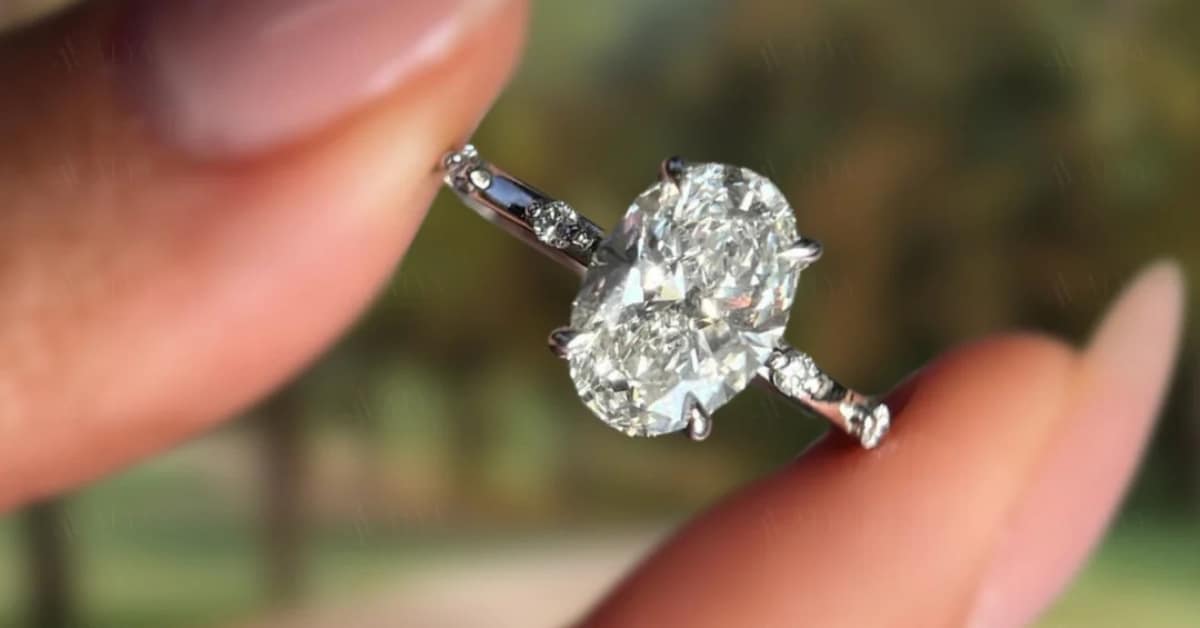
Unlike round diamonds, ovals lack standardized cut grades from most certification laboratories. Buyers must evaluate proportions independently.
Length-to-Width Ratio: Personal preference determines ideal ratio. Classic ovals measure 1.35-1.50 length-to-width. Elongated ovals stretch to 1.50-1.60. Rounder ovals fall between 1.25-1.35.
Table Percentage: Aim for 53-63% for optimal light return.
Depth Percentage: Target 58-65% to balance brilliance and face-up size.
Symmetry: Excellent or Very Good symmetry ensures balanced, even appearance from point to point.
Ovals with depths exceeding 68% carry weight in the pavilion rather than the face, meaning you pay for carat weight that remains hidden from view.

“Smooth lines, timeless oval.”
Best Color and Clarity for Oval Lab Grown Diamonds
Oval diamonds show color slightly more than rounds due to their elongated faceting pattern. Color tends to concentrate at the pointed ends.
Color Recommendations:
- Platinum/White Gold Settings: G-H color maintains white appearance
- Yellow/Rose Gold Settings: I-J color works beautifully, saving significant money
- Premium Seekers: D-F color for absolute colorlessness
Clarity Recommendations: Oval faceting hides inclusions effectively, making VS2 and SI1 viable choices for eye-clean diamonds. Diamond clarity grades impact price substantially, choosing VS2 over VVS1 at 1.5 carats saves $800-$1,500.
Examine inclusions near the points carefully. Inclusions at narrow ends face greater stress and potential durability concerns.

“Subtle sparkle, timeless elegance.”
Best Settings for Oval Lab Grown Engagement Rings
Setting selection dramatically affects how oval diamonds present on the hand.
Solitaire Setting
The solitaire setting highlights oval diamonds beautifully. Four-prong configurations expose maximum diamond surface while six prongs add security. Prong placement at the points protects the most vulnerable areas from chipping.
Thin bands (1.8-2mm) create contrast that emphasizes the oval’s elongated shape.
Halo Setting
Halo settings surround the center oval with smaller diamonds, adding perceived size and extra sparkle. An oval halo can make a 1 carat diamond appear closer to 1.5 carats.
Match halo shape to the center stone, oval halos complement oval centers better than round halos.
Three-Stone Setting
Flanking an oval center with two side stones creates balanced, substantial appearance. Pear-shaped or trillion side stones complement oval centers particularly well, their angles echoing the center stone’s curves.
Cathedral Setting
Cathedral settings raise oval diamonds above the band through arched metalwork. This adds height and drama while showcasing the elongated profile from every angle.
East-West Setting
Mounting an oval horizontally (east-west orientation) creates a modern, unexpected look. This setting suits buyers wanting distinctive style that stands apart from traditional vertical orientations.
Oval Lab Grown Diamond Price Ranges
Oval lab grown diamonds offer excellent value across carat weights.
Carat Weight | Color G-H | Clarity VS2-SI1 | Approximate Price |
0.75 Carat | G-H | VS2 | $500-$900 |
1.00 Carat | G-H | VS2 | $900-$1,500 |
1.50 Carat | G-H | VS2 | $1,500-$2,800 |
2.00 Carat | G-H | VS2 | $2,500-$4,500 |
2.50 Carat | G-H | SI1 | $3,500-$6,000 |
3.00 Carat | G-H | SI1 | $5,000-$9,000 |
Complete ring prices add $600-$2,500 depending on setting complexity and metal choice.
Case Study: Amanda’s Oval Lab Grown Engagement Ring
Amanda, a 31-year-old nurse from Denver, shared her experience with LearningJewelry:
“I have short fingers and always felt self-conscious about how rings looked on my hand. Round diamonds seemed to emphasize the width rather than create length.
After researching diamond shapes, I focused exclusively on ovals. My fiancé purchased a 1.75 carat oval lab grown diamond, G color, VS2 clarity, from Clean Origin for $2,900. We chose a delicate pavé band in 14k white gold.
The elongated shape transformed how my hand looks. Friends constantly comment on how elegant and flattering the ring appears. We spent under $4,000 total and received compliments suggesting we spent three times that amount.
The 360° video helped us avoid stones with severe bow-ties. We rejected four diamonds before finding one with minimal shadowing.”
Where to Buy Oval Lab Grown Engagement Rings
These retailers offer strong oval lab grown diamond selections:
James Allen
James Allen: 360° HD videos prove invaluable for evaluating bow-ties. Their extensive oval inventory includes thousands of lab grown options across carat weights.
Blue Nile
Blue Nile: Competitive pricing on oval lab grown diamonds with solid educational resources for first-time buyers.
Brilliant Earth

Brilliant Earth: Strong oval selection with commitment to ethical sourcing. Their imaging tools help evaluate bow-tie presence effectively.
Ritani
Ritani: Virtual gemologist consultations guide oval selection. Competitive pricing with detailed diamond imaging.
Helzberg Diamonds

Helzberg Diamonds: Physical store presence allows hands-on oval diamond evaluation alongside online selection.
Compare length-to-width ratios, bow-tie visibility, and pricing across retailers. The same specifications can vary 15-20% in price between vendors.
Caring for Oval Lab Grown Diamonds
Oval diamonds require attention to their pointed ends, which face higher chipping risk than curved edges.
Protective settings with prongs covering the points minimize damage potential. Regular cleaning maintains brilliance, warm water with mild soap weekly, professional cleaning every six months.
Remove oval rings during activities involving impact risk: gardening, weight lifting, or heavy housework. The points, while durable, remain more vulnerable than rounded edges.
Video Resource
For visual guidance on selecting oval lab grown diamonds, watch this helpful overview: