

I color diamonds occupy the third position within the near colorless range on the diamond color scale, offering a compelling balance between white appearance and budget-friendly pricing. These diamonds display soft warmth that remains difficult to detect in most mounted settings, while costing meaningfully less than G or H color options.
The near colorless category spans G, H, I, and J grades. I color sits closer to the warmer end of this range, white enough to satisfy most buyers, yet affordable enough to allow significant upgrades in carat weight or cut quality. For budget-conscious shoppers who prioritize size and sparkle over absolute colorlessness, I color frequently represents the optimal choice.
At LearningJewelry.com, our Certified Diamondologist Juli “Jewels” Church encountered I color diamonds daily during her six years at Kay and Zales: “I color diamonds are workhorses of the engagement ring market. They look white when mounted, especially in round brilliant cuts with excellent grades. The warmth that technically places them lower on the scale only appears under direct comparison to higher grades. Most customers who see their I color diamond in person are surprised how white it looks.”
Understanding when I color delivers excellent results, and when stepping up to H color makes sense, helps you maximize value without compromising appearance.
What Makes a Diamond I Color?
I color indicates a diamond graded as near colorless by gemological laboratories, positioned two grades below G on the GIA scale. The near colorless category includes G, H, I, and J, with I color sitting in the lower half of this range.
Diamond color results from nitrogen atoms trapped within the crystal structure during formation. These nitrogen molecules absorb blue light, producing yellow or brown tints. I color diamonds contain moderate amounts of nitrogen, enough to create soft warmth visible under laboratory comparison, but typically not enough to produce an obvious tint in mounted jewelry.
During grading, gemologists examine diamonds face-down against master comparison stones under standardized lighting. I color diamonds show noticeable warmth compared to colorless masters in this controlled environment, a difference that diminishes substantially once diamonds are set in rings and viewed under normal conditions.
| Category | Grades | Practical Appearance |
| Colorless | D, E, F | Icy white, no visible tint |
| Near Colorless | G, H, I, J | White to slightly warm |
| Faint | K, L, M | Noticeable warm tint |
The warmth in I color diamonds becomes most apparent when comparing directly against higher grades. Viewed independently in a ring setting, most observers perceive I color diamonds as simply white, particularly in brilliant-cut shapes with excellent cut grades.
I color Compared to Adjacent Grades
Understanding how I color relates to neighboring grades clarifies its value position.
I color vs H Color
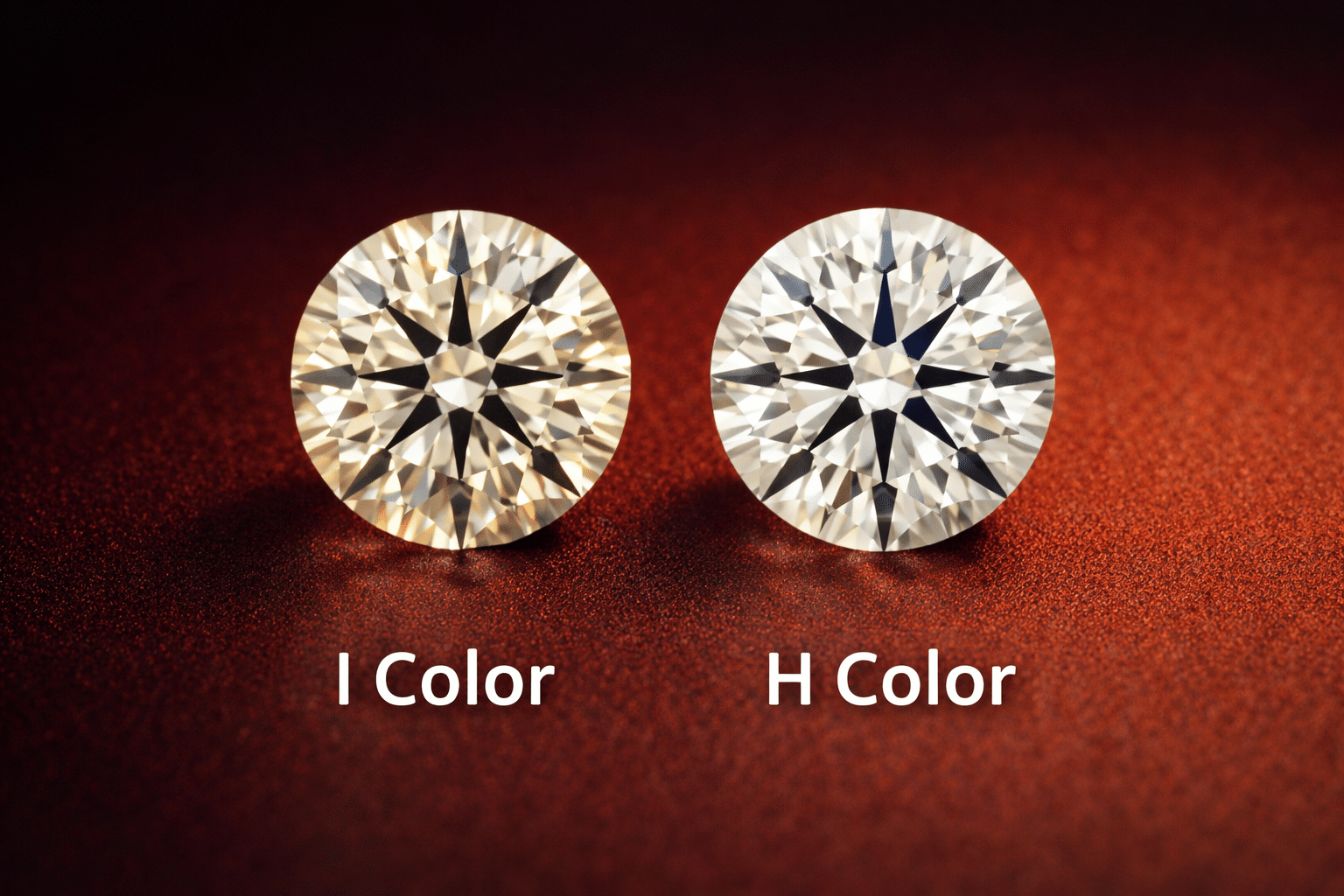
H color diamonds sit one grade above I within the near colorless range. H color shows slightly less warmth than I color, though the difference proves subtle in most viewing situations.
The distinction between H and I becomes more apparent in larger diamonds (above 1.5 carats) or step-cut shapes like emerald and Asscher. For round brilliants under 1.5 carats, many observers cannot reliably distinguish H from I color once mounted.
I color offers meaningful savings while delivering an appearance that satisfies most buyers.
Price difference: I color costs 5-10% less than H color.
I color vs J Color
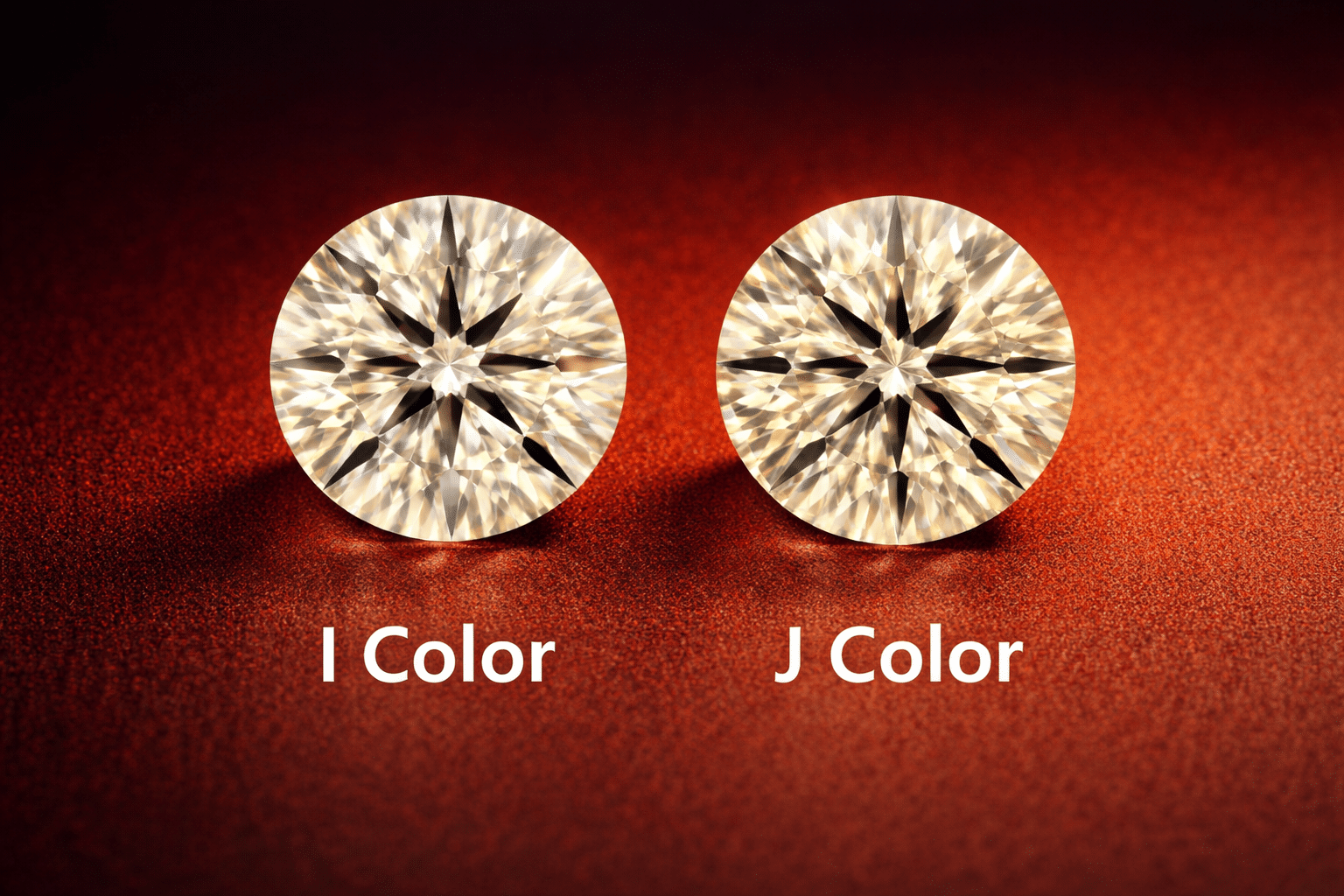
J color diamonds fall one grade below I, marking the boundary of the near colorless range. J color introduces additional warmth that becomes more readily detectable, particularly in white metal settings.
The step from I to J represents a more noticeable visual change than H to I. Buyers with moderate color sensitivity often perceive the difference, especially in larger stones or certain shapes.
Price difference: J color costs 5-10% less than I color.
I color vs D Color

D color represents the absolute pinnacle, completely colorless with zero detectable tint. The gap between I and D spans five grades, crossing from near colorless into colorless territory.
Under controlled comparison, the difference is apparent. I color shows soft warmth, while the D color appears ice-white. However, in mounted rings viewed under normal conditions, the distinction diminishes substantially, particularly in brilliant cuts with excellent light return.
The dramatic price difference makes I color attractive for buyers prioritizing size or cut quality.
Price difference:
I color costs 35-45% less than D color.
| Comparison | Visual Difference | Price Savings | Value Assessment |
| I vs H | Subtle in smaller stones | 5-10% | I offer strong value |
| I vs J | More noticeable | 5-10% | I safer for white metals |
| I vs D | Apparent under comparison | 35-45% | I delivers excellent value |
I color Diamond Pricing
I color diamonds occupy an accessible price point that enables meaningful budget flexibility, often the difference between a 1-carat and 1.3-carat diamond, or between good and excellent cut quality.
Typical Price Ranges (VS2 Clarity, Excellent Cut)
| Carat Weight | I color Price Range |
|---|---|
| 0.50ct | $1,000 – $2,200 |
| 1.00ct | $3,000 – $5,500 |
| 1.50ct | $5,500 – $12,000 |
| 2.00ct | $10,000 – $22,000 |
Multiple factors beyond color affect final pricing: diamond shape, certification laboratory, fluorescence, and retailer type all influence cost. Round brilliant cuts command premiums over fancy shapes.
Lab-Grown I color Diamonds
Lab-created I color diamonds deliver 60-80% savings compared to natural equivalents. A 1-carat lab-grown I color might cost $600-$1,300 versus $3,000-$5,500 for natural.
The I color grade carries identical meaning regardless of origin. Laboratory environments often produce higher color grades due to controlled conditions, but I color lab diamonds remain available from major retailers at exceptional value.
When I color Makes Sense
I color delivers genuine value for specific situations and buyer profiles.
Budget-Conscious Buyers: I color costs substantially less than colorless or even G/H grades while delivering a white appearance in most mounted settings. The savings can fund larger carat weight, better cut quality, or more elaborate settings, improvements that often create more visible impact than subtle color differences.
Round Brilliant Diamonds: Superior light return in well-cut round brilliants masks color effectively. I color round diamonds with excellent cut grades appear bright and white, making this pairing exceptionally cost-effective. The sparkle overwhelms subtle warmth.
Yellow and Rose Gold Settings: Warm metals complement I color beautifully. Any warmth in the diamond harmonizes with yellow or rose gold tones rather than contrasting. This pairing can make I color appear whiter than it would against cool metals, an excellent strategy for maximizing value.
Moderate Carat Weights: Diamonds under 1.5 carats display less visible body color than larger stones. I color performs excellently in this size range, appearing white without requiring G or H grades.
Size Priority: Buyers who want the largest possible diamond for their budget often find I color optimal. The visual impact of a 1.4-carat I color diamond exceeds that of a 1.1-carat G color in most real-world viewing situations.
When Higher Grades Serve Better
Certain situations benefit from H color or above rather than I color.
Large Diamonds Above 1.5 Carats: Body color becomes more visible as carat weight increases. In diamonds above 1.5 carats, I color’s warmth becomes more apparent. Consider H color for larger stones, particularly in white metal settings.
Step-Cut Shapes: Emerald and Asscher cuts display body color more readily due to their large, open facets. I color in step cuts shows warmth more noticeably than in brilliant cuts. For step cuts in white metals, G or H color provides a safer ground.
Platinum or White Gold with Sensitivity Concerns: While I color works in white metals for many buyers, those with keen color sensitivity may notice warmth against platinum or white gold. H color provides additional assurance for perfectionist tendencies.
Side Stone Comparison Issues: If your setting includes higher-color accent diamonds, an I color centre stone may appear warm by comparison. Either match the side stones to your centre diamond’s color or consider moving up to H color.
For buyers exploring additional savings, lower color diamonds offer further value with appropriate metal and shape choices.
Case Study: Marcus’s Size-Over-Color Strategy
Marcus, a 30-year-old firefighter from Atlanta, had a firm $5,000 budget and wanted maximum visual impact for his girlfriend, who loved larger stones.
“She’d shown me pictures of rings she liked; they were all 1.3 carats or bigger. Within my budget, getting that size meant dropping below G color. I needed to figure out if I color would actually look okay.”
Marcus used James Allen’s comparison tool to view I color diamonds against G color in their 360-degree videos. In round brilliant cuts, the difference was minimal. He also noticed I color costs roughly 20% less than G color at similar specifications.
“That 20% savings meant the difference between 1.1 carats and 1.4 carats. I chose size. My girlfriend notices carat weight, she doesn’t analyse color grades under magnification.”
He purchased a 1.41-carat I color, SI1 clarity, excellent cut round brilliant in yellow gold for $4,900. The warm metal complements any subtle warmth in the diamond. His girlfriend said yes immediately and specifically mentioned loving how “substantial” her ring looks compared to friends’ smaller diamonds.
Diamond Shape and I Color
Different cuts interact with color differently, affecting how much I color’s warmth displays.
Shapes Where I color Excels:
- Round brilliant, exceptional light return masks color effectively
- Princess cut, brilliant-style faceting minimizes warmth perception
- Cushion brilliant, strong sparkle reduces color visibility
Shapes Requiring More Consideration:
- Oval, can concentrate color at tips; I color works but watch larger sizes
- Pear and Marquise, pointed ends may show warmth; moderate sizes work well
- Emerald and Asscher, step-cut facets reveal body color; consider H color instead
- Radiant, can concentrate color in corners, especially larger stones
For round brilliant diamonds with excellent cut grades, I color performs nearly identically to H color in mounted settings. The light return overwhelms subtle warmth differences.
Setting Metal and I Color
Metal choice significantly influences how I color diamonds appear once mounted.
Yellow Gold: Optimal pairing for I color. Yellow gold’s warm tones complement the diamond’s subtle warmth, often making I color appear whiter than it would against cool metals. Buyers can confidently choose I color for yellow gold settings, the combination delivers excellent value and appearance.
Rose Gold: Similar benefits to yellow gold. Rose gold’s pink-warm tones blend with I color’s minimal warmth, creating a harmonious appearance.
White Gold and Platinum: I color can work in white metals, though warmth becomes slightly more visible against cool-toned settings. For white metal, I color diamonds, prioritize excellent cut quality to maximize sparkle that masks color. Buyers with exceptional color sensitivity may prefer H color for white metals.
Practical Strategy: Pair I color with yellow or rose gold for optimal value. For white metal settings, ensure excellent cut quality and consider round brilliant shapes that hide color effectively.
Where to Buy I color Diamonds
I color diamonds are widely available across reputable retailers, providing an excellent selection at accessible prices.
James Allen carries an extensive inventory of color diamonds with 360-degree HD video of every diamond. Their imaging allows direct comparison between H, I, and J color grades, helping verify that the I color delivers your desired appearance. Non-commissioned gemologists provide honest assessments about whether the color suits your specific setting and shape choices.
Blue Nile offers one of the largest online inventories with competitive I color pricing. Their search filters help narrow options efficiently, and detailed specifications support informed comparison.
Brilliant Earth provides I color options in both natural and lab-grown diamonds with emphasis on ethical sourcing. Buyers prioritizing supply chain transparency alongside value appreciate their approach.
Ritani enables diamonds to be sent to local jewellers for in-person inspection. Seeing I color compared to H color in person confirms whether the savings justify any minimal appearance trade-off for your eyes.
Helzberg Diamonds offers brick-and-mortar locations for side-by-side evaluation. Viewing the color next to higher grades under store lighting helps determine if the warmth level suits your preferences.
Is I Color Right for You?
I color diamonds deliver a white appearance at prices that enable meaningful upgrades in size or cut quality. For round brilliant diamonds in yellow gold settings, I color represents one of the best value propositions on the entire color scale.
The diamond colors explained across the near colorless range show that I color occupies a practical sweet spot, white enough to satisfy most buyers, affordable enough to maximize other quality factors. The warmth that technically places I color lower on the scale rarely bothers anyone once the diamond is mounted and worn.
Consider H color for large step-cut diamonds in white metal settings. Consider J color if additional savings matter, and you accept more noticeable warmth. For round brilliants paired with yellow gold, I color delivers exceptional results that rival higher grades at meaningfully lower prices.
Video Resource
For visual comparison of I color against H and J grades:
Frequently Asked Questions
What is an I color diamond?
I color indicates a diamond graded as near colorless, the third position within that category on the GIA scale. I color diamonds display soft warmth that remains largely undetectable in most mounted settings, particularly in brilliant-cut shapes with excellent cut grades.
Is I color good for an engagement ring?
I color is excellent for engagement rings, especially when paired with round brilliant cuts and yellow or rose gold settings. These diamonds appear white to most observers while costing substantially less than colorless or G/H grades, enabling larger carat weights or better cut quality.
Can you see the difference between H and I color diamonds?
Most people cannot reliably distinguish H from I color in round brilliant diamonds under 1.5 carats once mounted. The difference becomes more apparent in larger stones, step-cut shapes, or when comparing directly under controlled conditions. In everyday wear, the distinction is minimal.
What setting works best for I color diamonds?
Yellow gold and rose gold settings work optimally with I color, as warm metals complement the diamond’s subtle warmth and often make it appear whiter. White gold and platinum also work, though I color’s warmth becomes slightly more visible against cool metals. Excellent cut quality helps in any setting.
Is I color too yellow?
For most buyers, no. I color falls within the near colorless range and appears white in typical viewing conditions. The warmth becomes noticeable primarily under direct comparison to higher grades or in larger step-cut diamonds. In round brilliants with excellent cut, I color rarely appears yellow.
How much does an I color diamond cost?
A 1-carat I color diamond with VS2 clarity and excellent cut typically ranges from $3,000-$5,500 for natural stones. Lab-grown I color diamonds of equivalent quality cost $600-$1,300, representing 60-80% savings with identical visual appearance.