
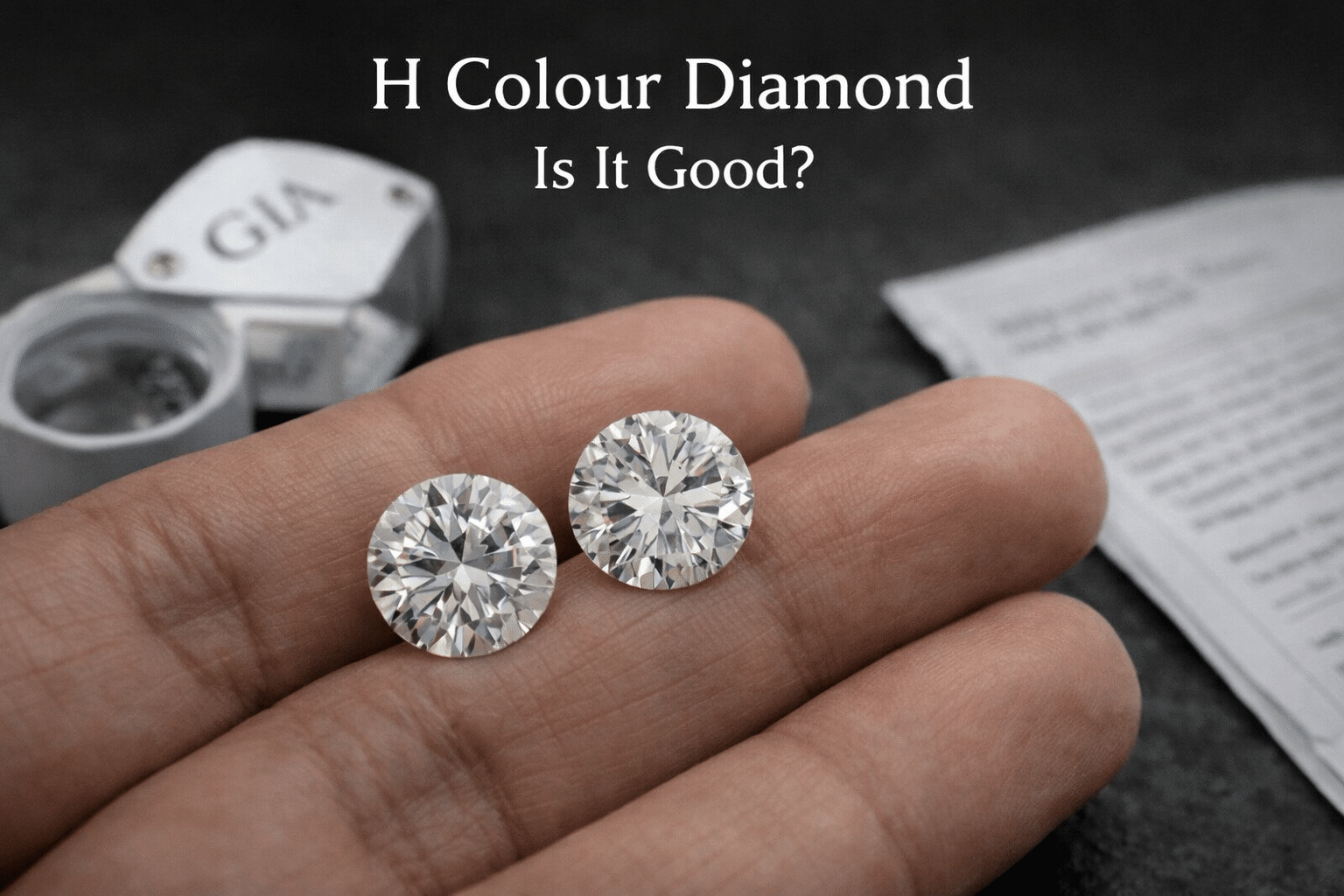
H color diamonds sit in the near-colorless range on the GIA scale, one grade below G, and appear white to the naked eye in any standard ring setting. Warmth only becomes visible above 1.5 carats in step-cut shapes or under direct incandescent light comparison. H color paired with VS2 clarity delivers the most efficient price-to-appearance ratio in the near-colorless category for round brilliant diamonds. At James Allen and Ritani, H color diamonds are available with 360° HD per-stone video, the minimum verification standard before any diamond purchase above $2,000.
Juli Church spent six years on the Kay and Zales retail floor. This page reflects what she saw buyers get right and what chain store sales training taught them to get wrong.
What H Color Grade Actually Means
H color is the second grade in GIA’s near-colorless range, positioned where most commercial engagement rings are sold.
GIA assigns the H grade by placing the stone face-down against master comparison diamonds under controlled 6500K daylight-equivalent lighting. Graders look for faint warmth caused by nitrogen atoms trapped in the crystal structure during formation. That warmth is detectable under those controlled conditions, not in a mounted ring on someone’s finger.
Category | Grades | Face-Up Appearance |
Colorless | D, E, F | Icy white, zero tint |
Near Colorless | G, H, I, J | White, faint to slight warmth |
Faint | K, L, M | Warm tint visible to most observers |
H occupies the second position in the near-colorless range. G sits one grade above. I sit one grade below.
Juli’s observation: “Most of what Kay and Zales sold as ‘near-colorless’ was H or I color. That’s not a criticism. That’s where the real value lives for buyers who don’t need a certificate grade to impress a gemologist.”
For the full diamond color scale from D to Z, including how each grade affects price across the near-colorless spectrum, LearningJewelry covers every grade with the same insider framework.
Is H Color Diamond Too Yellow?

H color diamonds do not appear yellow in mounted rings under normal viewing. Warmth becomes visible only above 1.5 carats in step cuts or under direct incandescent light, not in daily wear.
Three lighting conditions matter to buyers:
Natural daylight: H color reads white. No perceived tint.
LED indoor lighting (restaurants, offices, most homes): H color reads white.
Warm incandescent bulbs: Slight warmth may appear on stones above 1.5 carats. Below that size, most observers see nothing.
The scenario that triggers most buyer anxiety: holding an H color diamond face-down under a jewelry store’s track lighting next to a D color stone. That comparison reveals warmth. But no one’s engagement ring sits next to a loose D color stone in daily life.
Juli saw this pattern constantly. Customers held an H color under our track lighting, designed specifically to maximize diamond brilliance, then went home and thought the diamond looked different in their kitchen. That’s the lighting changing, not the diamond. I had that conversation at least once a week.”
Metal matters too. Yellow gold absorbs the H color’s warmth signal. The warm metal tones and the stone’s faint warmth harmonize rather than contrast. White gold and platinum expose it slightly, still not visible to most observers, but the gap is real above 1.5 carats in step cuts.
H Color vs. G Color: Is the Price Difference Worth It?

G color costs $400–$650 more per carat than H for a visual difference that requires trained graders, side-by-side comparison, and magnification to detect consistently.
Current James Allen pricing (2026):
Spec | H Color | G Color | Price Gap |
1ct VS2 Excellent Round | $4,100–$4,800 | $4,500–$5,400 | $400–$650 |
1.5ct VS2 Excellent Round | $8,500–$11,000 | $9,500–$13,000 | $700–$2,000 |
The AI Overview consensus on “H vs G diamond” states it clearly: for most buyers, H is the better value choice. The r/Diamonds community lands in the same place: “If you can’t perceive any color difference, there’s no reason to pay for G.”
When G is worth the premium:
- Emerald or Asscher cuts above 1.5 carats in platinum
- Buyers who compared both grades in person and saw the difference
- Rings that will regularly sit next to higher-grade stones for comparison
When H wins:
- Round brilliant cuts with GIA Excellent or Ideal cut, the light return overwhelms H’s warmth completely
- Yellow gold or rose gold settings warm metal neutralizes any theoretical advantage G carries
- Budget reallocation: $500 saved on color grade, reinvested into cut quality, produces a visible sparkle improvement
Juli’s direct take: “I watched buyers spend $600 more to go from H to G in a cushion brilliant with a yellow gold band. The metal canceled any color advantage G had. They paid $600 for a letter on a certificate.”
For a detailed breakdown of how G color diamond pricing compares to H across clarity grades, including the specific scenarios where G justifies its premium, LearningJewelry’s G color guide covers the full comparison.
What Clarity Grade Should You Pair With H Color?
H color pairs most efficiently with VS2 clarity. The combination delivers an eye-clean stone without paying for invisible quality improvements in either attribute.
This is the most underserved topic in H color content. Buyers don’t search H color in isolation; they search “H color VS1,” “H color VS2,” “H color SI1.” The clarity pairing determines as much of the purchase outcome as the color grade itself.
H Color + Clarity | Eye-Clean? | Best Application | Price vs. H VS2 |
H + IF/VVS | Yes, always | Investment stones, gifts with resale intent | +40–80% |
H + VS1 | Yes, always | Emerald cuts 2ct+, platinum solitaires | +15–25% |
H + VS2 | Yes, in almost all cases | 1–1.5ct rounds, ovals, cushions | Baseline |
H + SI1 | Usually, verify per stone | Round brilliant under 1ct only | −15–20% |
H + SI2 | Sometimes requires video | Budget-constrained small rounds | −25–35% |
H + VS1: The clarity is invisible in a round brilliant. Spend that $400–$800 per carat on cut quality instead. VS1 at H color makes sense only for step cuts above 2 carats, where open facets expose inclusions more readily.
H + VS2: The floor for most buyers. Eye-clean in 95%+ of cases. Leaves room to invest in Excellent or Ideal cut, a visible difference, not a certificate difference.
H + SI1: Works in round brilliants under one carat. Risky in step cuts. Risky above 1.5 carats. Always requires per-stone 360° video verification before purchasing.
Juli’s SI1 caveat: “SI1 in a round brilliant under a carat is usually fine. SI1 in an emerald cut is different. The large open facets make inclusions readable. I’ve seen buyers devastated after the purchase. They bought on paper, not on video.”
James Allen’s 360° HD viewer shows every H color stone individually, the only way to verify SI1 clarity before committing.
H Color by Diamond Shape Where It Works and Where It Doesn’t
H color performs differently across diamond shapes. Facet patterns determine how much body color reaches the surface.
Shapes where H color excels:
Round brilliant cuts scatter light in all directions. That light return overwhelms subtle warmth. A GIA Excellent round at H color looks identical to G to most observers. Cushion, brilliant, oval, and princess cuts deliver similar results, strong sparkle masks color.
Shapes requiring extra attention at H:
Emerald and Asscher cuts have large open facets that concentrate body color in visible flat planes. In these shapes, above 1.2 carats in white metal, H color’s warmth registers. Move to G color for emerald or Asscher cuts above that threshold in platinum settings.
Radiant cuts above 1.5 carats can show color concentration in the corners. Still workable in yellow gold. Worth considering G if the stone exceeds 1.8 carats in white metal.
Juli saw the pattern clearly: “The buyers who called frustrated about their ‘yellow’ diamond almost always had an emerald or Asscher cut. The shape was doing the revealing, not the color grade. Nobody told them that before they bought.”
One setting detail most guides miss: halo settings neutralize H color’s warmth. The surrounding small diamonds create a white frame that draws the eye away from body color comparison. H color in a halo often reads whiter than a solitaire at the same grade.
H Color Diamond Prices in 2026
A 1-carat H color natural diamond with VS2 clarity and Excellent cut costs $3,800–$5,200 at major online retailers in 2026. Lab-grown H color equivalents run $700–$1,200 for identical graded specs.
Natural H Color GIA Certified, Excellent Cut:
Carat Weight | H + SI1 | H + VS2 | H + VS1 |
0.50ct | $900–$1,400 | $1,200–$1,800 | $1,500–$2,200 |
1.00ct | $2,800–$3,800 | $3,800–$5,200 | $4,800–$6,500 |
1.50ct | $6,000–$8,500 | $8,000–$12,000 | $10,000–$15,000 |
2.00ct | $12,000–$18,000 | $16,000–$24,000 | $20,000–$30,000 |
Lab-Grown H Color IGI Certified:
Carat Weight | Lab-Grown H VS2 | Natural H VS2 | Savings |
1.00ct | $700–$1,200 | $3,800–$5,200 | ~70% |
1.50ct | $1,200–$2,000 | $8,000–$12,000 | ~75% |
2.00ct | $1,800–$3,200 | $16,000–$24,000 | ~80% |
H color runs 8–12% below G at 1 carat. That gap widens to 12–18% at 2 carats.
Lab-grown H color carries the same IGI grading standard as natural H color stones. The visual appearance is identical. The only difference is the origin. For buyers setting their stone in yellow gold, or prioritizing carat size, lab-grown H VS2 frees significant budget for the ring design.
Where to Buy H Color Diamonds Without Overpaying
James Allen and Ritani offer the most buyer-protective purchase process for H color diamonds. James Allen provides per-stone 360° HD video. Ritani lets buyers ship their selected stone to a local partner jeweler for in-person comparison before committing.
James Allen: 200,000+ diamonds, every stone with 360° video. The viewer shows the specific H color stone, not a stock image. Rotate to face-on, check for cloudiness in the table area, and verify inclusion location on SI1 stones. Lifetime warranty includes rhodium plating for white gold. Compare H color diamonds with 360° video at James Allen
Blue Nile: 15% of their entire inventory is H color. Largest selection, price-match guarantee. The manufacturer’s warranty only budgets for local jeweler maintenance separately. Browse Blue Nile H color inventory with price-match guarantee
Brilliant Earth: H color available in natural and lab-grown, with traceable mine-of-origin documentation on natural stones. 10–15% premium over James Allen for the ethical sourcing infrastructure.Brilliant Earth H color diamonds with mine-of-origin sourcing
Ritani: The only major online retailer displaying wholesale cost alongside retail price per stone. Preview In-Store option ships your selected H color stone to a local jeweler, compares it against G in real lighting, then decides. Use Ritani’s Preview In-Store to compare H vs. G color before buying
Chain stores like Kay and Zales sell H, and I color diamonds routinely, but under GSI certification, not GIA. An H color on a GSI certificate often corresponds to a GIA I or J color on the same stone. The grade inflation doesn’t change the diamond. It changes what you pay for it.
Does Blue Fluorescence Help H Color Diamonds?
Medium blue fluorescence in H color diamonds can offset yellow tint in natural daylight, functioning as a free color upgrade that activates outdoors and near windows. Fluorescence emits blue light under UV. Blue cancels yellow. At H color, medium blue fluorescence makes the stone appear one grade closer to colorless in natural light at no premium, stones with medium blue fluorescence are often priced 3–8% below comparable non-fluorescent H color diamonds.
Strong fluorescence carries risk. Some stones with strong fluorescence look hazy or milky in direct sunlight. Avoid strong H color. Medium blue is the target.
Juli’s call: “Medium blue fluorescence in an H color is one of the few places where you get more for less in diamond buying. The market undervalues it.”
Lab-Grown H Color Diamonds Same Grade, Fraction of the Cost
Lab-grown H color diamonds carry the same IGI grading standard as natural H, deliver identical face-up appearance, and cost 60–80% less.
A 1ct H VS2 lab-grown at James Allen runs $700–$1,200. The natural equivalent: $3,800–$5,200. Both are H on the GIA D-Z scale. Both appear white in mounted settings.
The budget freed by choosing lab-grown H color allows upgrading to 1.5 carats at natural-equivalent pricing, or investing in a more elaborate setting design that creates visible differentiation.
For buyers in yellow gold settings who have no attachment to natural origin, lab-grown H VS2 with IGI certification is the highest-value specification in the near-colorless category.
Jennifer’s Real Purchase: What Happened When She Compared in Person
The $600 question: is G’s extra cost visible once both stones are mounted?
Jennifer, a buyer who used Ritani’s Preview In-Store option, had both an H VS2 and a G VS2 round brilliant shipped to a local jeweler. She compared them in person under store lighting, then outdoors.
She couldn’t see the difference.
She bought the H VS2 and redirected $600 toward an Ideal cut grade over Excellent. Her 1.18ct H VVS2 Ideal cut round for $5,800 produced stronger light performance than the G Excellent cut at the same price.
The gemologist’s comment stayed with her: “Buy the diamond that looks best to you, not the one with the best letter grade.”
Cut quality creates a visible difference. Color grade at this range creates a significant difference.
Ritani’s Preview In-Store option is the most practical tool for buyers who want to resolve the H vs. G question with their own eyes before spending $4,000+.
LearningJewelry.com publishes diamond buying guidance based on Juli Church’s six years on the retail floor at Kay and Zales, the insider perspective that chain store sales training actively suppresses. Every recommendation on this page exists to protect buyers from paying for quality they cannot see and missing quality that actually matters.
Frequently Asked Questions
Does H color look different in photos versus in person?
H color diamonds photograph whiter than they do under professional jewelry photography lighting. Some buyers find the mounted ring looks slightly warmer in their kitchen. Yellow gold settings consistently eliminate this concern. Always view the per-stone 360° video at normal playback speed before purchasing non-zoomed still frames.
Will an H color diamond hold resale value?
GIA-certified H color natural diamonds hold resale value comparably to G color, typically 20–40% of original retail in the secondary market. Lab-grown H color holds significantly less as the lab-grown supply has expanded. Resale value depends more on GIA certification and carat weight than on H vs. G color distinction.
Can a jeweler identify H color without checking the certificate?
A trained gemologist with master stones and proper lighting can distinguish H from G. A local jeweler examining a mounted ring in store lighting cannot reliably identify H vs. G without the GIA report. The distinction requires controlled lab conditions.
Is H color good for a three-stone engagement ring?
H color works in three-stone rings when all stones are matched at H. Mixing H center with G side stones makes the center appear relatively warmer. Mixing H center with I side stones makes it appear whiter. Request matched H grading across all stones, or verify visual match via 360° video.
Does H color look the same on all skin tones?
H color reads slightly warmer against very fair skin tones in white metal settings; the contrast effect is stronger. On medium and warm skin tones, the H color in yellow or rose gold appears uniformly bright. Shape choice matters more than skin tone at this color grade.
Is H color worth buying at 2 carats?
H color at 2 carats in a round brilliant with Excellent or Ideal cut remains workable but requires more care. In white metal, consider G color at 2 carats to maintain a white appearance without side-by-side comparison. In yellow gold, an H color at 2 carats performs well. In step cuts at 2 carats emerald, Asscher move to G color regardless of metal.
What does H mean on a diamond certificate?
H is the eighth letter of the GIA D-Z color scale. D represents absolutely colorless. Z represents visible yellow. H falls in the near-colorless range, five grades from colorless, indicating faint warmth detectable by trained graders under controlled laboratory conditions, not by observers viewing the ring in normal lighting.