
F color diamonds mark the bottom of the colorless category on the diamond color scale, sitting alongside D and E grades as the whitest diamonds available. These stones display no detectable yellow or brown tint to the naked eye, appearing icy white under normal viewing conditions.
What makes F color particularly appealing is its position as the most accessible colorless grade. While D and E command peak premiums for nearly identical visual results, F color delivers the same colorless appearance at 10-15% lower cost. For buyers who want documented colorless status without paying maximum prices, F color hits a sweet spot.
At LearningJewelry.com, our Certified Diamondologist Juli “Jewels” Church frequently recommended F color during her six years at Kay and Zales: “F color diamonds give you colorless certification at a more reasonable price point. The visual difference between D, E, and F is essentially invisible once mounted. F color buyers get the prestige of colorless grading while keeping more money for cut quality or carat weight.”
Understanding how F color compares to adjacent grades, and when it makes sense over near colorless options, helps you determine whether this grade fits your priorities.
What Makes a Diamond F Color?
F color indicates a diamond graded as colorless by gemological laboratories. The colorless category contains three grades: D, E, and F. F sits at the boundary between colorless and near colorless, making it the entry point into the colorless tier.
Diamond color originates from nitrogen atoms trapped within the crystal structure during formation. These nitrogen molecules absorb blue light wavelengths, producing yellow or brown tints. F color diamonds contain such minimal nitrogen that the resulting color remains undetectable without laboratory comparison against master stones.
During grading, gemologists examine diamonds face-down under standardized lighting, comparing them to master stones of known grades. F color diamonds show the slightest warmth compared to D and E masters, a difference imperceptible to anyone except trained graders using specialized conditions.
| Grade | Classification | Practical Appearance |
| D | Colorless | Completely white |
| E | Colorless | Completely white |
| F | Colorless | Completely white |
| G | Near Colorless | White, extremely faint warmth |
| H | Near Colorless | White, very faint warmth |
The distinction between D, E, and F grades matters primarily for documentation and certification. In real-world viewing, mounted in jewelry, worn on a hand, and observed under normal lighting, all three colorless grades appear identically white.
F color Compared to Adjacent Grades
Understanding how F color relates to neighboring grades reveals its value proposition.
F color vs E Color

Both grades fall within the colorless range. The difference between E color diamonds and F color requires laboratory conditions and master comparison stones to detect. The average buyer examining them side by side would struggle to identify which is which.
F color offers slight savings while delivering identical visual results to E color in any practical setting.
Price difference: F color costs 5-10% less than E color.
F color vs D Color
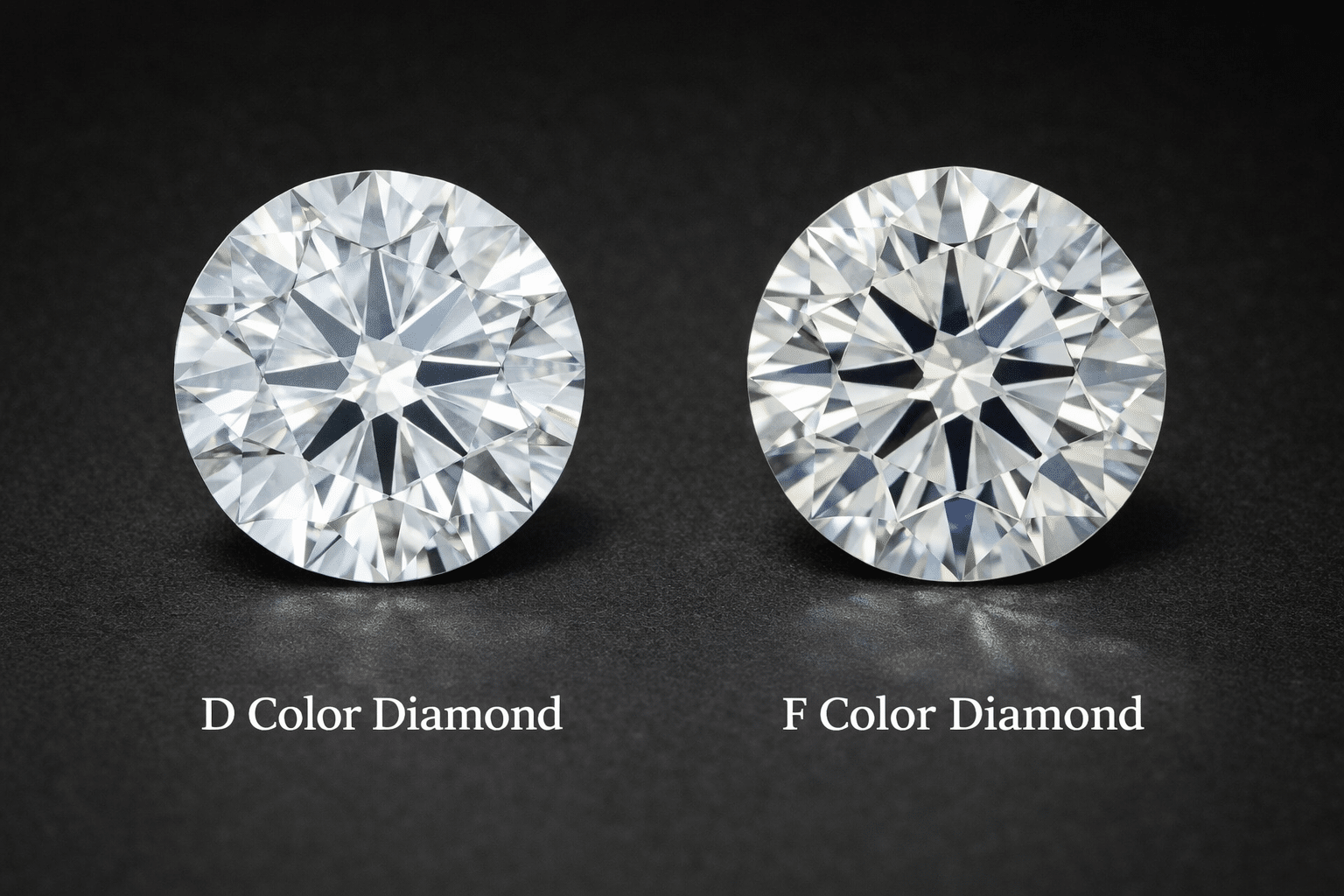
D color represents the absolute pinnacle of the color scale. The gap between F and D spans two grades, yet remains visually imperceptible once diamonds are mounted. Both grades appear icy white without detectable warmth.
The primary difference lies in documentation and pricing. D color certifies as the highest possible grade, while F certifies as colorless without that peak designation.
Price difference: F color costs 10-15% less than D color.
F color vs G Color
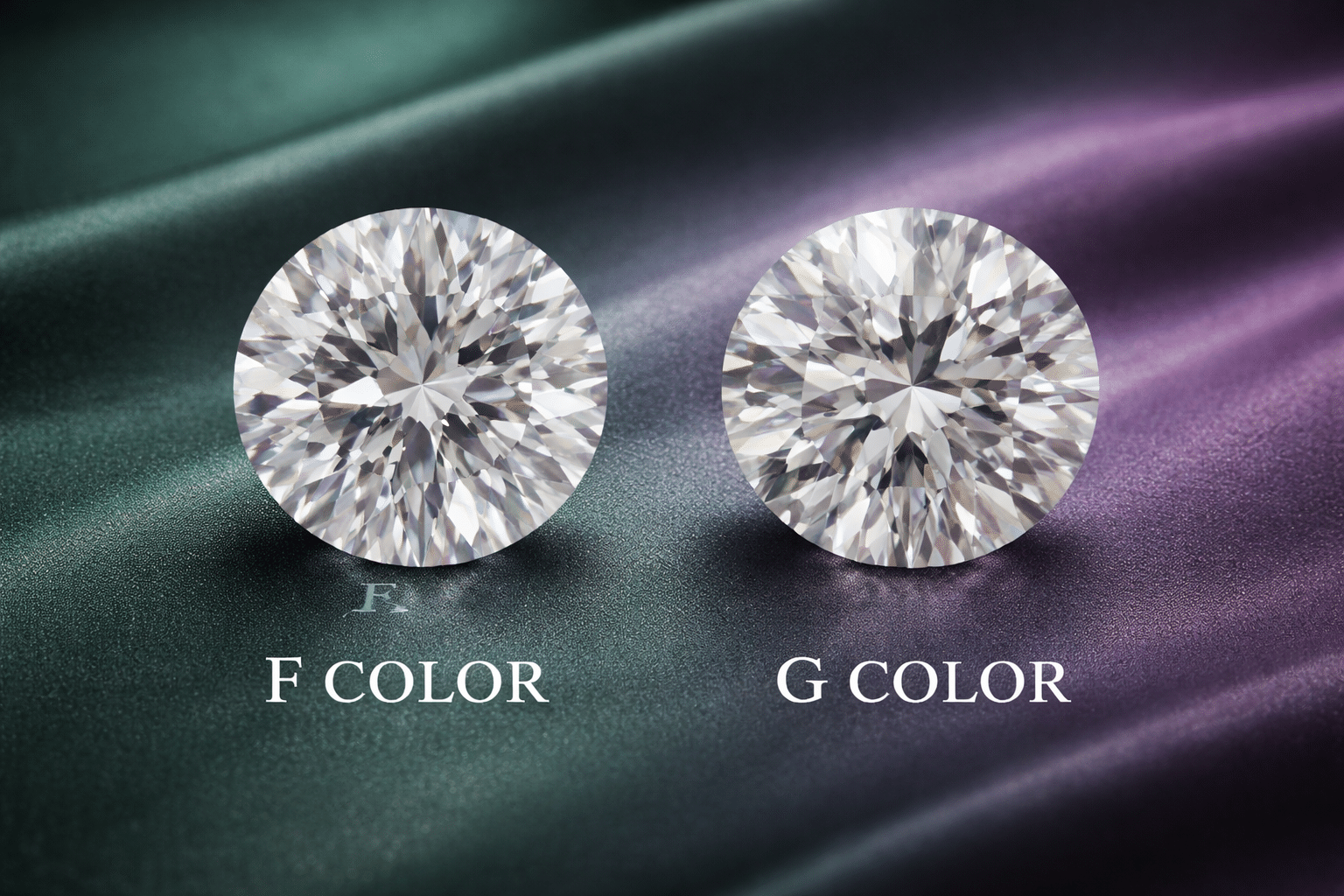
G color marks the beginning of the near colorless range and represents the best value diamond color for most engagement ring buyers. This comparison crosses the boundary between colorless and near colorless categories.
Some observers might detect subtle warmth in G color when comparing directly against F color under controlled conditions. However, viewed independently or mounted in settings, most people perceive both grades as white.
The price difference between F and G proves more significant than adjacent colorless grades, reflecting the category boundary.
Price difference:
G color costs 10-15% less than F color.
| Comparison | Visual Difference | Price Savings | Practical Assessment |
| F vs D | Imperceptible | 10-15% | F saves money, same appearance |
| F vs E | Imperceptible | 5-10% | Both excellent choices |
| F vs G | Minimal, requires comparison | 10-15% | G offers strong value |
F color Diamond Pricing
F color diamonds occupy the most accessible position within the colorless tier, commanding premiums above near colorless grades while costing less than D and E.
Typical Price Ranges (VS2 Clarity, Excellent Cut)
| Carat Weight | F color Price Range |
|---|---|
| 0.50ct | $1,600 – $3,500 |
| 1.00ct | $4,500 – $9,000 |
| 1.50ct | $9,000 – $20,000 |
| 2.00ct | $16,000 – $35,000 |
Multiple factors beyond color influence pricing: diamond shape, certification laboratory, fluorescence, and retailer type all affect the final cost. Round brilliant cuts command higher prices than fancy shapes. GIA certification adds a premium over other laboratories.
Lab-Grown F color Diamonds
Lab-created F color diamonds deliver 60-80% savings compared to natural equivalents. A 1-carat lab-grown F color might cost $1,000-$2,200 versus $4,500-$9,000 for natural.
The F color grade carries identical meaning for lab-grown and natural diamonds; both undergo the same grading processes. Laboratory environments actually produce higher percentages of colorless diamonds since controlled conditions introduce fewer nitrogen impurities during the growth process.
Lab-grown F color represents exceptional value for buyers prioritizing colorless appearance without natural diamond pricing.
When F color Makes Sense
F color delivers genuine benefit for specific situations and buyer profiles.
Colorless Certification at Accessible Pricing: F color provides documented colorless status at the lowest price point within that category. Buyers wanting colorless certification without D or E premiums find F color compelling.
Step-Cut Diamond Shapes: Emerald and Asscher cuts display body color more readily than brilliant cuts. Their large, open facets reveal warmth that brilliant-style faceting would mask. F color ensures step cuts maintain a bright, white appearance without visible tint.
White Metal Settings: Platinum and white gold reflect light back into diamonds, making any warmth more apparent. F color eliminates concerns about color contrast against cool-toned metals.
Comparison Shopping Confidence: If you plan to compare your diamond against others frequently, showing friends, family, or comparing to jewelry store displays, an F color ensures your stone holds its own against most diamonds you encounter.
Personal Value on Colorless Grade: Some buyers simply want a diamond certified as colorless. F color achieves that designation at the most accessible price point.
When Near Colorless Grades Deliver Equal Results
For many engagement ring buyers, G or H color provides equivalent visual results at meaningful savings.
Yellow or Rose Gold Settings: Warm metals reflect golden tones into any diamond. F color diamonds in yellow gold absorb those warm reflections, reducing the visual advantage of colorless grading. Near colorless grades (G–J) complement warm metals beautifully while costing 15-25% less.
Round Brilliant Cuts: Superior light return in well-cut round brilliants overwhelms subtle color differences. A round brilliant with excellent cut in G or H color appears white and bright, making the F color premium harder to justify visually.
Budget Optimization: Fixed budgets require trade-offs between quality factors. F color with average cut quality will look worse than G color with excellent cut. The sparkle from superior cut quality creates more visual impact than the color difference between F and G.
Size Priority: The difference between 1.25ct and 1.55ct is immediately visible. The difference between F and G colors often is not. Buyers prioritizing visual presence typically create more impact by maximizing carat weight rather than color grade.
Juli Church notes: “For round diamonds in any metal, G color delivers results visually indistinguishable from F color in mounted jewelry. The savings can fund a meaningful jump in carat weight or ensure excellent cut quality, both of which create more noticeable visual impact.”
Case Study: Michelle’s Colorless-at-a-Discount Strategy
Michelle, a 31-year-old pediatric nurse from Denver, wanted colorless certification but refused to pay D or E premiums she considered unnecessary.
“I researched for months. Every expert said the same thing, D, E, and F look identical once mounted. So why pay extra for D when F gets the same ‘colorless’ classification? It felt like paying for bragging rights nobody would ever verify.”
Michelle found a 1.22-carat F color, VS2 clarity, excellent cut oval diamond for $7,400 through Brilliant Earth. She paired it with a platinum pavé setting, spending $9,100 total.
“The certificate says colorless. The diamond faces up white. I saved probably $1,500 compared to D color at the same size. That money went toward our honeymoon fund instead of invisible color improvement.”
Her approach reflects a practical mindset many buyers share. Michelle’s oval sparkles brilliantly in its platinum setting, and she reports that three jewelers who’ve cleaned her ring have complimented its quality without ever suggesting the color grade was anything less than top-tier.
Diamond Shape and F Color
Different cuts interact with color differently, affecting how much value F color provides.
Shapes That Benefit Most from F Color:
- Emerald cut, large open facets display body color readily
- Asscher cut, similar to an emerald with prominent color display
- Baguette, elongated step-cut facets reveal tint
- Radiant cut, can concentrate color in corners
Shapes Where Near Colorless Works Equally Well:
- Round brilliant, exceptional light return masks subtle warmth
- Cushion brilliant, strong sparkle minimizes color perception
- Princess cut, brilliant-style faceting hides minor warmth
- Oval, good light return, though tips can show color
For round brilliant diamonds with excellent cut grades, dropping to G or H color rarely produces a visible difference compared to F color. The savings fund a larger carat weight or ensures optimal cut quality, both delivering more noticeable visual improvement.
Setting Metal and F Color
Metal choice significantly affects how diamond color appears once mounted.
White Gold and Platinum: Cool metals complement the F color’s icy appearance effectively. The colorless diamond against white metal creates a classic, bright presentation. F color eliminates any possibility of warmth contrast in white settings.
Yellow Gold: Reflects warm tones into any diamond. F color in yellow gold picks up golden hues from the metal, diminishing some visual benefit of colorless grading. Near colorless grades (G–J) work beautifully with yellow gold; the metal masks subtle warmth while providing substantial savings.
Rose Gold: Similar effect to yellow gold. Rose settings impart pink-warm reflections that blend with slight warmth in lower color grades. F color loses some visual advantage compared to a white metal presentation.
Practical Strategy: Reserve F color for white metal settings where its colorless appearance shows fully. For yellow or rose gold, near colorless grades deliver equivalent mounted appearance at lower cost.
Where to Buy F color Diamonds
Evaluating F color diamonds requires imagery that accurately displays the subtle differences between colorless and near colorless grades.
James Allen provides 360-degree HD video of every diamond, enabling direct comparison between F, G, and H color grades before purchasing. Their non-commissioned gemologists offer honest guidance about whether F color delivers visible benefit for your specific setting and shape choices. The 30-day return policy allows real-world evaluation.
Blue Nile carries extensive F color inventory with competitive pricing. Their search filters help narrow options efficiently, and detailed specifications support informed comparison shopping.
Brilliant Earth offers F color options in both natural and lab-grown diamonds with emphasis on ethical sourcing. Supply chain transparency accompanies color quality for buyers prioritizing both factors.
Ritani allows diamonds to be sent to local jewelers for in-person inspection. Viewing F color alongside G color in person helps determine whether the colorless premium delivers visible value for your specific situation.
Helzberg Diamonds provides brick-and-mortar locations for side-by-side comparison under store lighting. Seeing F color next to near colorless options in person informs the decision more effectively than online imagery alone.
Making the F color Decision
F color diamonds deliver colorless certification at the most accessible price point within that elite category. Whether that certification provides visible value depends on your metal choice, diamond shape, and personal priorities.
For step-cut diamonds in white metal settings, an F color provides meaningful benefit, the open facets display color more readily, and cool metals reveal any warmth present. For round brilliants in yellow gold, the diamond color scale offers better value in the G–H range, where savings fund superior cut quality or larger size.
F color represents an excellent choice for buyers wanting documented colorless status without maximum D or E pricing. For buyers focused purely on visual results rather than certification, near colorless grades often deliver equivalent appearance at significant savings.
Video Resource
For visual comparison of F color against E and G grades:
Frequently Asked Questions
What is an F color diamond?
F color indicates a diamond graded as colorless, the third-highest rating on the GIA color scale. F color diamonds show no visible yellow or brown tint and sit at the boundary between the colorless category (D, E, F) and the near colorless category (G, H, I, J).
Is F color considered a good diamond?
F color is excellent; it falls within the colorless range, meaning no detectable tint is visible to the naked eye. F color diamonds appear icy white and represent the most accessible price point within the colorless tier.
Can you see the difference between F and G color diamonds?
Most people cannot distinguish F from G color once diamonds are mounted in settings. Direct side-by-side comparison under controlled lighting may reveal subtle warmth in G color, but normal viewing conditions make them appear equally white.
How much does an F color diamond cost?
A 1-carat F color diamond with VS2 clarity and excellent cut typically ranges from $4,500-$9,000 for natural stones. Lab-grown F color diamonds of equivalent quality cost $1,000-$2,200, representing 60-80% savings.
Is F color better than G color?
F color is technically higher on the grading scale, falling within colorless rather than near colorless. However, the visual difference proves minimal once diamonds are mounted. G color costs 10-15% less while delivering an appearance most observers cannot distinguish from F color.
What metal setting works best for F color diamonds?
Platinum and white gold complement the F color most effectively, allowing the icy white appearance to show fully. Yellow and rose gold settings reflect warm tones into any diamond, reducing the visual benefit of colorless grading. For warm metals, near colorless grades often make more financial sense.