Buying a diamond feels overwhelming. Color grades, clarity ratings, certification acronyms, and carat weights, the terminology alone creates confusion before you even start comparing actual stones. Yet understanding these fundamentals transforms diamond shopping from stressful guesswork into confident decision-making.

See how each carat size changes the look
The difference between a smart diamond purchase and an expensive mistake often comes down to knowing which factors matter most for your specific situation. A flawless D color diamond sounds impressive, but spending premium prices on characteristics invisible to the naked eye wastes money that could buy a larger, more impressive stone.
This guide breaks down the three pillars of diamond quality, color, clarity, and certification, giving you practical knowledge to select the best diamond for your budget and preferences. No sales pressure, no industry jargon without explanation, just straightforward guidance from years of jewelry expertise.
Juli “Jewels” Church, Certified Diamondologist at LearningJewelry.com, helps buyers navigate these decisions daily: “Most people overspend on diamond grades they cannot actually see. Understanding where to invest and where to save creates dramatically better results. A knowledgeable buyer gets a more beautiful diamond for less money than someone purchasing blind.”

See today’s prices & discover the newest designs
For detailed information on specific topics, explore our in-depth guides:
- VVS Diamond Guide: Defining Very Very Slightly Included
- Diamond Color vs Clarity: Which Matters More?
- IGI vs GIA Certification: What’s the Difference?
- VVS1 Diamond Clarity: Everything You Need to Know
- The Rarest Diamond Color: What Tops the Scarcity Chart?
- D Color Diamonds: The Supreme Standard of Icy Cool Elegance
- SI2 Diamonds: Can Beauty Be Found in Their Imperfection?
- VVS1 vs VVS2 Diamonds: A Side-by-Side Comparison
- SI1 Diamond Clarity: Does It Still Look Good?
- Diamond Clarity Chart Explained: From FL to I3
Understanding the 4Cs: Foundation of Diamond Quality
The Gemological Institute of America (GIA) established the 4Cs framework, Cut, Color, Clarity, and Carat, as the universal standard for evaluating diamond quality. While all four factors matter, this guide focuses on Color, Clarity, and Certification, as Cut and Carat decisions typically come more intuitively to buyers.
Each C affects both appearance and price. Understanding their relative importance helps allocate your budget where it creates the most visible impact.
Diamond Color: What the Grades Mean

Diamond color grading measures the absence of color in white diamonds. The scale runs from D (completely colorless) through Z (light yellow or brown tint). Counterintuitively, less color means higher grades and higher prices.
The Diamond Color Scale
| Grade Range | Classification | Appearance | Price Impact |
| D-E-F | Colorless | No visible color | Premium pricing |
| G-H-I-J | Near Colorless | Slight warmth, often invisible | Best value range |
| K-L-M | Faint | Noticeable warm tint | Budget-friendly |
| N-R | Very Light | Obvious yellow/brown | Significantly discounted |
| S-Z | Light | Strong color presence | Lowest prices |
Colorless Diamonds (D-E-F)
D color diamonds represent the pinnacle of the color scale, completely devoid of any yellow or brown tint. These stones appear icy white and command premium prices.
The practical reality: most people cannot distinguish D from E or F color without laboratory equipment and side-by-side comparison against known reference stones. The visual difference between these top three grades proves minimal to naked eye observation.
D-E-F diamonds make sense for buyers prioritizing absolute top quality, platinum or white gold settings where any warmth would contrast noticeably, or investment-grade purchases where documentation matters.
Compare today’s prices & explore the latest designs
Near Colorless Diamonds (G-H-I-J)
This range offers the best value for most buyers. G and H color diamonds face up white in virtually all settings, while I and J grades show only slight warmth, often undetectable once mounted.
The price difference between G color and D color can reach 20-30% for otherwise identical stones. Those savings buy a significant size increase or clarity upgrade without visible color compromise.
Most jewelry professionals recommend G-H color as the sweet spot, balancing quality and value.
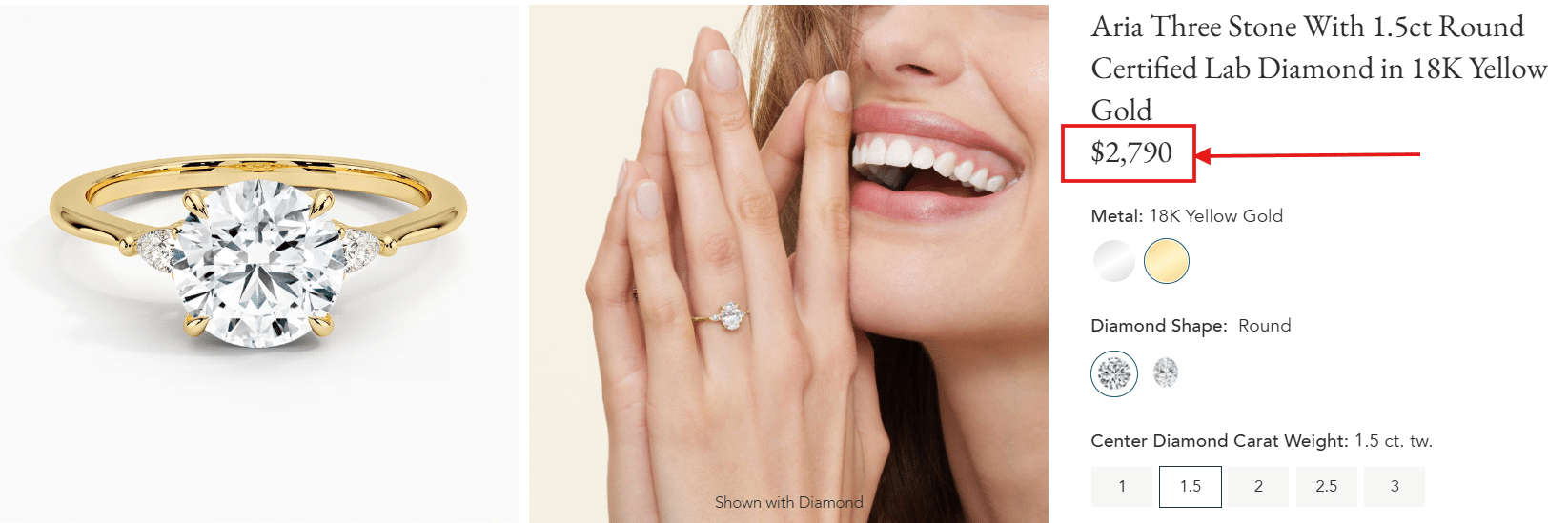
Understanding Color in Context
Several factors affect how diamond color appears:
Setting Metal: Yellow and rose gold settings mask warm diamond tones. White metals make any warmth more apparent. An I color diamond looks whiter in yellow gold than a G color stone in platinum.
Diamond Size: Larger diamonds show color more readily than smaller stones. A 2-carat J color diamond displays more visible warmth than a 0.50-carat J color.
Diamond Shape: Certain cuts hide color better than others. Round brilliants mask warmth effectively. Step cuts like emerald and Asscher reveal color more obviously.
Lighting Conditions: Diamonds appear differently under various light sources. What looks perfectly white under jewelry store lighting may show warmth in natural daylight.
Learn more about how color and clarity interact in our Diamond Color vs Clarity comparison guide.
Diamond Clarity: Understanding Inclusions

Clarity grades measure the presence of internal inclusions and external blemishes in diamonds. These natural characteristics formed during the diamond’s creation deep within the earth.
The Diamond Clarity Scale
| Grade | Name | Description | Visibility |
| FL | Flawless | No inclusions or blemishes at 10x | Invisible at any magnification |
| IF | Internally Flawless | No inclusions, minor surface blemishes at 10x | Invisible to the naked eye |
| VVS1-VVS2 | Very Very Slightly Included | Minute inclusions are difficult to see at 10x | Invisible to the naked eye |
| VS1-VS2 | Very Slightly Included | Minor inclusions visible at 10x | Typically invisible to the naked eye |
| SI1-SI2 | Slightly Included | Noticeable inclusions at 10x | May be visible to the naked eye |
| I1-I2-I3 | Included | Obvious inclusions affecting appearance | Visible to the naked eye |
For detailed visual examples of each grade, see our Diamond Clarity Chart Explained guide.
VVS Clarity: Very Very Slightly Included

VVS diamonds contain minute inclusions that challenge even trained gemologists to locate under 10x magnification. These stones appear flawless to casual observation.
The VVS1 grade indicates inclusions visible only from the pavilion (bottom) side. VVS2 inclusions may be visible from the crown (top) but remain extremely difficult to find.
VVS clarity commands premium pricing for characteristics invisible without magnification. Most buyers find better value in lower clarity grades that appear identical to the naked eye.
VS Clarity: The Sweet Spot

VS1 and VS2 diamonds contain minor inclusions visible under magnification but invisible to unaided observation. This grade range offers excellent value; you pay for actual visible quality rather than laboratory distinctions.
For most engagement rings and fine jewelry, VS clarity delivers the perfect balance of quality and value. The diamonds appear flawless during normal wear while costing significantly less than VVS or higher grades.
SI Clarity: Budget-Conscious Options

SI1 diamonds contain noticeable inclusions under magnification that may or may not be visible to the naked eye, depending on the inclusion type, size, and location.
SI2 diamonds more commonly show visible inclusions, though many SI2 stones remain “eye-clean”, meaning inclusions cannot be seen without magnification during normal viewing.
The key with SI clarity: examine each specific diamond rather than relying on grade alone. An SI1 with a black crystal inclusion near the table looks worse than an SI2 with white feathers near the edge.

Eye-Clean: The Practical Standard
“Eye-clean” describes diamonds where inclusions cannot be detected by the naked eye at normal viewing distance (approximately 6-12 inches). This practical standard matters more than technical clarity grades for most buyers.
A VS2 diamond is virtually guaranteed eye-clean. Many SI1 diamonds achieve eye-clean status. Some SI2 diamonds qualify. The grade provides guidelines, but individual stone inspection determines actual appearance.

Diamond Certification: Your Quality Guarantee
Diamond certification provides independent verification of a stone’s characteristics. Certificates (also called grading reports) document the 4Cs along with measurements, proportions, and identifying features.

See how a classic solitaire looks at today’s price
Why Certification Matters
Without certification, you rely entirely on the seller’s claims about diamond quality. Certificates from reputable laboratories provide:
- Independent third-party quality verification
- Standardized grading terminology
- Documentation for insurance purposes
- Comparison basis for shopping across vendors
- Protection against misrepresentation
Never purchase a significant diamond without certification from a recognized laboratory.

| Laboratory | Reputation | Grading Strictness | Best For |
| GIA | Gold standard | Most strict/consistent | Natural diamonds, maximum confidence |
| IGI | Highly respected | Slightly lenient on some grades | Lab-grown diamonds, good value |
| AGS | Excellent | Very strict, cut-focused | Cut quality verification |
| GCAL | Good | Consistent grading | Additional verification |
| EGL | Varies | Less consistent | Budget purchases (verify carefully) |
GIA vs IGI Certification
The IGI vs GIA comparison represents the most common certification question buyers face.
GIA (Gemological Institute of America): The industry gold standard. GIA grading proves most consistent and generally most strict. Natural diamond purchases benefit most from GIA certification.
IGI (International Gemological Institute): Highly respected, particularly dominant in lab-grown diamond certification. Some studies suggest IGI grades run slightly more lenient than GIA on color and clarity, meaning an IGI “G color” might grade “H color” at GIA.
For natural diamonds, GIA certification commands premium prices reflecting market confidence. For lab-grown diamonds, IGI certification provides reliable grading at the prevailing industry standard.

Reading a Diamond Certificate
Key certificate information includes:
Report Number: Unique identifier for verification
Shape and Cut: Diamond shape and cutting style
Measurements: Dimensions in millimeters
Carat Weight: Precise weight to hundredths of a carat
Color Grade: D-Z scale rating
Clarity Grade: FL-I3 scale rating
Cut Grade: Excellent to Poor (GIA) or Ideal to Poor (AGS)
Polish and Symmetry: Surface and alignment quality
Fluorescence: Presence and strength of UV reaction
Clarity Plot: Diagram showing inclusion locations
Always verify certificates through laboratory websites using the report number.

How to Choose: Practical Recommendations
Balancing color, clarity, and certification involves matching priorities to budget.
Best Value Recommendations
| Priority | Color | Clarity | Certification |
| Maximum Size | I-J | SI1-SI2 (eye-clean) | GIA or IGI |
| Balanced Quality | G-H | VS2-SI1 | GIA or IGI |
| Premium Quality | E-F | VVS2-VS1 | GIA |
| Investment Grade | D-E | IF-VVS1 | GIA |
Decision Framework
Step 1: Set Your Budget
Know your total spending limit before comparing diamonds. This prevents emotional overspending on unnecessary upgrades.
Step 2: Prioritize Cut Quality
Cut affects brilliance more than any other factor. Never compromise cut grade to afford higher color or clarity, a well-cut H/SI1 outperforms a poorly-cut D/VVS1 visually.
Step 3: Select Color Based on Setting
White metals: G-H color minimum recommended. Yellow/rose gold: I-J color works beautifully with Platinum with melee diamonds: Match the center stone to the side stones
Step 4: Choose Eye-Clean Clarity VS2 guarantees eye-clean status. SI1 usually delivers eye-clean results. SI2 requires individual verification. Higher grades waste money on invisible characteristics.
Step 5: Verify Certification
Insist on GIA or IGI certification. Verify report numbers through laboratory websites. Compare only diamonds with equivalent certification standards.
Step 6: Compare Specific Stones
Grade ranges provide guidelines, but individual diamonds vary. A particular SI1 may look better than a specific VS2. Always examine actual stones or high-quality imagery.
Where to Buy Certified Diamonds
Reputable retailers provide certified diamonds with transparent pricing and return policies.
James Allen
Extensive inventory with 360° HD imagery, allowing detailed inspection of every diamond. Non-commissioned gemologists provide guidance. Strong return policy and competitive pricing make James Allen excellent for online diamond shopping.
Blue Nile
Blue Nile is the industry pioneer in online diamond sales. Large selection, competitive pricing, and educational resources help buyers make informed decisions. Reliable certification and customer service.
Brilliant Earth

Brilliant Earth’s focus on ethically sourced diamonds appeals to conscious buyers. Good selection of both natural and lab-grown certified diamonds. Premium pricing reflects ethical sourcing emphasis.
Ritani
Virtual gemologist consultations help buyers evaluate diamonds remotely. Quality inventory with detailed imaging. Ritani provides a good option for buyers wanting personalized guidance .
Helzberg Diamonds:

Physical store presence combined with online shopping. Helpful for buyers wanting an in-person examination alongside online convenience.
Fancy Color Diamonds: Beyond the D-Z Scale
While most buyers seek colorless diamonds, fancy color diamonds occupy a separate category where strong color presence creates value rather than diminishing it.
Fancy yellow, pink, blue, green, and other colored diamonds follow different grading standards. The most saturated, vivid colors command the highest prices, opposite of the colorless scale.
Natural fancy color diamonds rank among the world’s rarest gemstones. The famous Hope Diamond (blue) and Pink Star (pink) sold for tens of millions of dollars.
For most buyers, fancy color diamonds represent special occasion purchases or collection pieces rather than typical engagement ring options.

Case Study: Michael’s Diamond Search
Michael, a 32-year-old engineer from Seattle, approached his engagement ring purchase systematically:
“I set a $12,000 budget for the diamond alone. My initial instinct was buying the highest grades possible, maybe a D/VVS1 around 0.80 carats.
Research changed my approach completely. I learned that D color and VVS1 clarity would be invisible improvements over G color and VS2 clarity. The premium pricing bought characteristics only a gemologist with magnification could detect.
I shifted strategy: prioritize cut quality, accept G color (indistinguishable from D in her platinum setting), and find an eye-clean VS2 or SI1.
My comparison process at James Allen:
Option A: 0.85ct D/VVS1 Excellent cut, $11,800
Option B: 1.15ct G/VS2 Excellent cut, $11,200
Option C: 1.31ct G/SI1 Excellent cut, $11,500
I examined each diamond using their 360° imaging. The SI1 was clearly eye-clean; I could not locate inclusions even knowing where to look.
I chose Option C: 1.31 carats of eye-clean, beautifully cut diamond for less than the 0.85ct “premium” option. The difference in face-up size between 0.85ct and 1.31ct is dramatic and immediately visible.
My fiancée receives constant compliments on her ring. Nobody has ever asked about clarity grade. Everyone notices the impressive size.

Compare bold carat sizes and see the price gap
Video Resource
For visual guidance on diamond selection:
Frequently Asked Questions about How to Choose the Best Diamond
What diamond clarity is best for the money?
VS2 and SI1 clarity grades offer the best value for most buyers. Both grades typically produce eye-clean diamonds at significantly lower prices than VVS or higher grades. The key is examining specific stones to verify no visible inclusions.
Does diamond color really matter?
Diamond color matters, but not as much as marketing suggests. Most people cannot distinguish G color from D color in mounted jewelry. The G-H range provides excellent value, appearing white while costing 15-25% less than colorless grades.
Should I buy GIA or IGI certified diamonds?
For natural diamonds, GIA certification provides the most consistent and widely trusted grading. For lab-grown diamonds, IGI certification represents the industry standard. Both laboratories provide reliable quality verification.
What is the best diamond color and clarity combination?
G-H color with VS2-SI1 clarity delivers optimal value for most buyers. This combination produces visibly beautiful diamonds without paying premiums for characteristics invisible to the naked eye.
Is VVS clarity worth the extra cost?
For most buyers, no. VVS diamonds contain inclusions invisible without magnification, the same practical result as VS clarity at a lower cost. VVS makes sense only for investment-grade purchases or buyers prioritizing absolute top specifications.
How do I know if a diamond is eye-clean?
Examine the diamond (or high-quality 360° imagery) at normal viewing distance without magnification. If you cannot detect inclusions, the diamond qualifies as eye-clean. VS2 grades guarantee eye-clean status; SI1 and SI2 require individual verification.
What diamond certification should I look for?
GIA and IGI certifications provide reliable quality verification. Always verify certificate numbers through laboratory websites. Avoid uncertified diamonds or certificates from lesser-known laboratories for significant purchases.