GSI (Gemological Science International) is a for-profit gemological laboratory founded in 2005 that grades diamonds primarily for large retail chains, Zales, Jared, and Kay Jewelers, not for independent buyers. A GSI grading report covers the 4Cs, polish, symmetry, fluorescence, and measurements, with the detail level varying by report format.
GSI grading runs consistently looser than GIA, AGS, and IGI, meaning the same physical diamond regularly receives higher color and clarity grades from GSI than it would from an independent lab, a gap that directly costs buyers money. Among major diamond certification bodies, GSI ranks below GIA, AGS, and IGI in grading consistency, a fact that resale markets and independent appraisers reflect in their valuations.
For natural diamonds, GIA remains the only certification Learning Jewelry recommends without reservation; for lab-grown diamonds, IGI from a reputable online vendor is the reliable alternative.

What Is GSI, Gemological Science International?
GSI is a for-profit diamond grading laboratory, the only major gem lab founded in the 21st century, with headquarters in New York City and offices across four continents.
Founded in 2005, Gemological Science International built its business by targeting a specific market: large jewelry retail chains that need fast, high-volume diamond grading at a lower cost than GIA. That strategy worked. GSI became the dominant grading lab for Kay Jewelers, Zales, and Jared, three of the biggest chain retailers in the United States.

That context matters for every buyer who encounters a GSI certificate.
GSI’s primary customers are retail chain buyers and inventory managers, not the consumers standing at the counter. The lab grades at speed, at volume, and at a price point that serves the retailer’s cost structure. That’s the foundational fact behind every discussion about GSI grading quality.
Beyond standard diamond grading, GSI also provides gemstone identification services, lab-grown diamond certification, colored stone reports, and a proprietary light performance analysis called the PSX report. These are legitimate services. The question isn’t whether GSI operates a real lab; it does. The question is whether their grading standards protect the buyer or the seller.
If you’re evaluating diamond certification options that buyers trust, GSI’s retail chain alignment is the first fact you need on the table.
What’s on a GSI Diamond Grading Report?
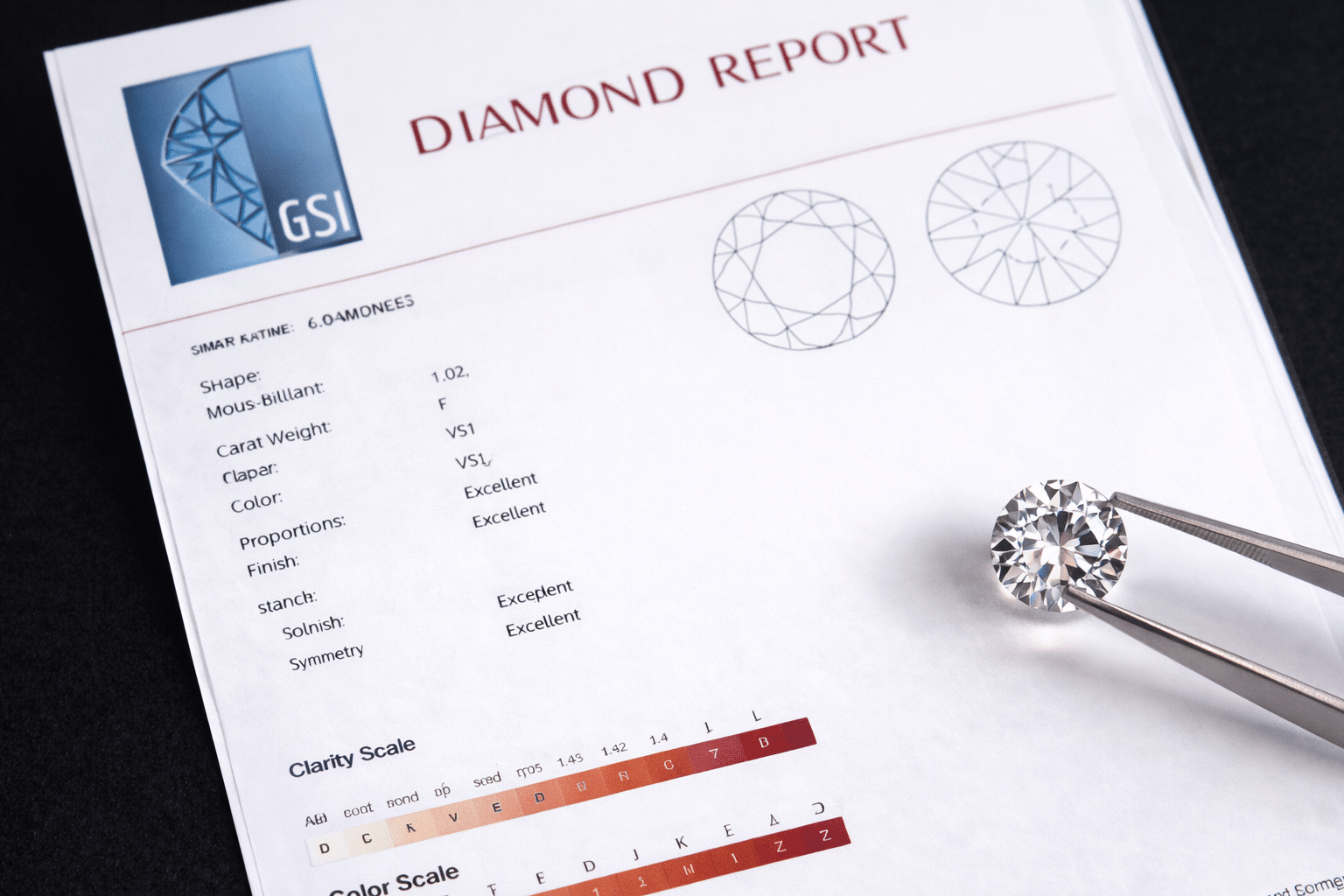
A GSI diamond grading report evaluates the 4Cs, cut, color, clarity, and carat weight, along with polish, symmetry, fluorescence, precise measurements, and a clarity plot, with the level of detail depending entirely on which report format accompanies the diamond.
Every GSI report covers the core characteristics: shape and cutting style, carat weight, color grade on the D-to-Z scale, clarity grade from FL to I3, and cut grade on a scale from Ideal to Poor. Supporting data includes polish, symmetry, proportions, fluorescence, and a report number tied to GSI’s online verification portal.

The clarity plot, a diagram showing the location and type of inclusions, appears on some formats and not others. This matters. An inclusion plot tells you exactly what flaws are present, where they sit, and whether they’d affect a diamond’s appearance. Buying a diamond without seeing its inclusion plot is buying blind.
GSI Report Formats: FDX, IDX, SDX, MDX
GSI offers four report formats with progressively less detail as the format gets smaller.
Format | Full Name | Size | Clarity Plot Included |
FDX | Full Diamond Examination Report | 8.5″ × 11″ | Yes |
IDX | Intermediate Diamond Examination Report | 6.75″ × 5″ bifold | Not always |
SDX | Special Diamond Examination Report | 3.75″ × 2.75″ | No |
MDX | Modified Diamond Examination Report | Credit card size | No |
The FDX is the format to request. The MDX, credit card-sized, contains the bare minimum information about a diamond. If a retailer presents a credit-card-sized certificate alongside a diamond priced at several thousand dollars, that’s a signal worth pausing on.
Juli Church, Learning Jewelry’s certified diamontologist and former Kay Jewelers sales trainer, puts it directly: “The MDX is essentially a stub. At Kay, I saw customers handed the smallest format, and they had no idea that a full report existed. They assumed whatever paper came with the diamond was standard.”

GSI Lab Grown Diamond Report
GSI lab-grown diamond reports follow the same FDX/IDX/SDX/MDX format structure as natural diamond reports, with one non-negotiable addition: a clear “laboratory-grown” disclosure on both the certificate and the girdle inscription.
This labeling distinction carries real financial weight. Lab-grown diamonds sell for 50–80% less than natural diamonds of equivalent carat weight. A mislabeled or inadequately disclosed stone creates serious overpayment risk. GSI’s disclosure is explicit and visible on their lab-grown reports, which are accurate and worth acknowledging.
For buyers interested in lab-grown vs. natural diamond value differences, the report type is the first thing to confirm before any other evaluation.

GSI Colored Stone Report
GSI’s colored stone report, the FGX, evaluates gemstone species identification, weight, color grade, shape, cutting style, and treatment disclosure. Treatment disclosure is the most buyer-critical element: a heated ruby and an unheated ruby of the same visual quality have dramatically different market values, and the FGX report addresses this.
Sub-formats follow the same size hierarchy: IGX (passport), SGX (letterhead), MGX (credit card).
How Accurate Is GSI Diamond Grading? The Consistency Problem
GSI grading is consistently looser than GIA, AGS, and IGI, meaning diamonds graded by GSI regularly receive higher color and clarity grades than independent labs would assign to the same stone.
This isn’t a rare occurrence or an opinion from a competing retailer. It’s a documented pattern: buyers who purchase GSI-certified diamonds and then send the same stones to GIA for re-grading regularly receive lower grades. The gap typically runs 1–2 color grades and 1 clarity grade.
Here’s what that gap looks like in real money. A diamond GSI graded as VS2 clarity and F color carries a listed price of approximately $5,120. The same diamond submitted to GIA may come back graded VS1 clarity and G color, and priced at around $6,460. That’s the same physical diamond, carrying two different price tags, because two different labs applied two different standards.
The buyer in this scenario isn’t being sold a fake diamond. They’re being sold a real diamond at an inflated price, backed by a certificate that overstates its quality.

Juli Church’s direct experience:
“I personally own a GSI-certified Tolkowsky engagement ring I bought from Kay before I left the company. At the time, I genuinely believed I had purchased the best ring in the store. I didn’t understand what a grading certificate meant, and no one at Kay explained it to me. That’s not an oversight. Kay’s retail model functions better when customers don’t know the difference between GSI and GIA. I found out the difference the hard way, after I left the company and started learning what independent grading actually looks like.”
No competing article on this topic has that experience. Juli owned a GSI-certified stone from Kay, worked the floor, trained new hires in product knowledge, and left because of what she witnessed. That’s the information gap LearningJewelry exists to close.
The grading consistency problem compounds when you try to compare two GSI-certified diamonds to each other. If GSI’s grading varies, and documented re-grading results confirm it does, then comparing a GSI H/VS2 to another GSI H/VS2 doesn’t guarantee you’re comparing equivalent diamonds. The inconsistency makes apples-to-apples evaluation nearly impossible.

How GSI Certification Affects What You Pay
GSI-certified diamonds are typically priced as though the inflated grades are accurate, meaning buyers pay premium prices for quality that the diamond doesn’t hold on any independent grading scale.
The pricing mechanism works like this: a retailer submits a diamond to GSI, receives grades that come back higher than GIA would issue, and prices the stone based on those grades. The buyer pays for the stated quality, not the actual quality.
GSI diamonds often appear cheaper than GIA diamonds of the “same” stated grade. That perceived discount is the danger zone. The GSI diamond isn’t a bargain. It’s a stone graded to a different standard, priced accordingly, and the difference between the two price points rarely reflects the true quality gap.
For buyers purchasing a diamond with insurance in mind, appraisers who know the grading labs will apply a discount to GSI-certified valuations. A stone your GSI certificate says is worth $6,000 may be appraised at $4,200 by an independent jewelry appraiser, creating a gap between purchase price and insured value from day one.
Juli’s assessment from the retail floor: “The markup at Kay on GSI-certified inventory was real. The grades made diamonds look better than they were on a GIA scale. Customers walked out having paid for quality they didn’t have. I watched it happen every shift.”
GSI vs. GIA, IGI, AGS, EGL, and GCAL
Among major gemological labs, GSI ranks below GIA, AGS, and IGI in grading consistency, a position reflected in resale markets, independent appraisals, and the types of retailers who rely on each certification body.
GSI vs. GIA
GIA (Gemological Institute of America) is a nonprofit institution founded in 1931, and the lab is credited with creating the 4C grading system. Its grades are stricter, more consistent across reports, and universally accepted by independent jewelers, estate buyers, and resale platforms.
The same diamond graded by both labs typically receives 1–2 color grades and 1 clarity grade lower from GIA than from GSI. For natural diamonds, GIA is the standard Learning Jewelry recommends without qualification.
For a full breakdown of what GIA diamond certification includes and why it matters, that’s where to start.
GSI vs. IGI
IGI (International Gemological Institute) grades looser than GIA but stricter than GSI, placing it in an acceptable, not ideal, category for lab-grown diamond purchases from reputable vendors like James Allen or Brilliant Earth.
For natural diamonds, IGI is not Learning Jewelry’s first recommendation. For lab-grown diamonds, IGI is the practical standard the market has moved toward. The IGI vs. GIA comparison covers this in full detail.
GSI vs. AGS
AGS (American Gem Society) matches GIA in reliability and is particularly respected for cut grading. AGS uses a 0–10 numerical scale where 0 = ideal, rather than GIA’s descriptive Excellent-to-Poor system. AGS-certified diamonds are less commonly available than GIA-certified stones, especially online, but carry the same level of buyer protection.
GSI vs. EGL and GCAL
EGL (European Gemological Laboratory) carries a reputation for looser grading than GSI; industry consensus places EGL grades 2+ grades above GIA in some cases. Avoid EGL-certified diamonds.
GCAL (Gem Certification & Assurance Lab), founded in 2001, offers reliable grading with a unique accuracy guarantee and an increasing presence in the lab-grown diamond market. GCAL is more trustworthy than GSI and worth considering when GIA isn’t available.
The reliability hierarchy among major labs, from most to least strict: GIA = AGS > IGI > GCAL > GSI > EGL.
Should You Buy a Diamond With a GSI Certificate?
Buying a GSI-certified diamond carries real financial risk, not because the certificate is fraudulent, but because grade inflation means you’re likely paying for a quality level the diamond doesn’t hold on any independent grading scale.
GSI-certified diamonds appear in three main contexts:
- Mall chain stores (Kay, Zales, Jared): The most common GSI environment. Avoid purchasing here unless you have the diamond independently regraded before finalizing.
- Online retailers with mixed inventory: Some platforms list GSI-certified diamonds alongside GIA-certified stones at lower prices. The discount rarely compensates for the grade uncertainty.
- Private resale and estate sales: Highest risk. A GSI certificate on a pre-owned diamond tells you the report existed, not that the grades were accurate when issued.
The only scenario where a GSI-certified diamond makes financial sense: the price is discounted deeply enough to account for grade uncertainty, and you’ve confirmed the diamond’s actual quality through independent evaluation before purchase.
Juli’s verdict: “I wouldn’t buy a diamond with a GSI certificate. Not because GSI runs a fraud operation, it doesn’t. GSI runs a legitimate lab that built its business serving retailers. You’re not the retailer. The certificate wasn’t written for you.”
How to Look Up and Verify a GSI Report
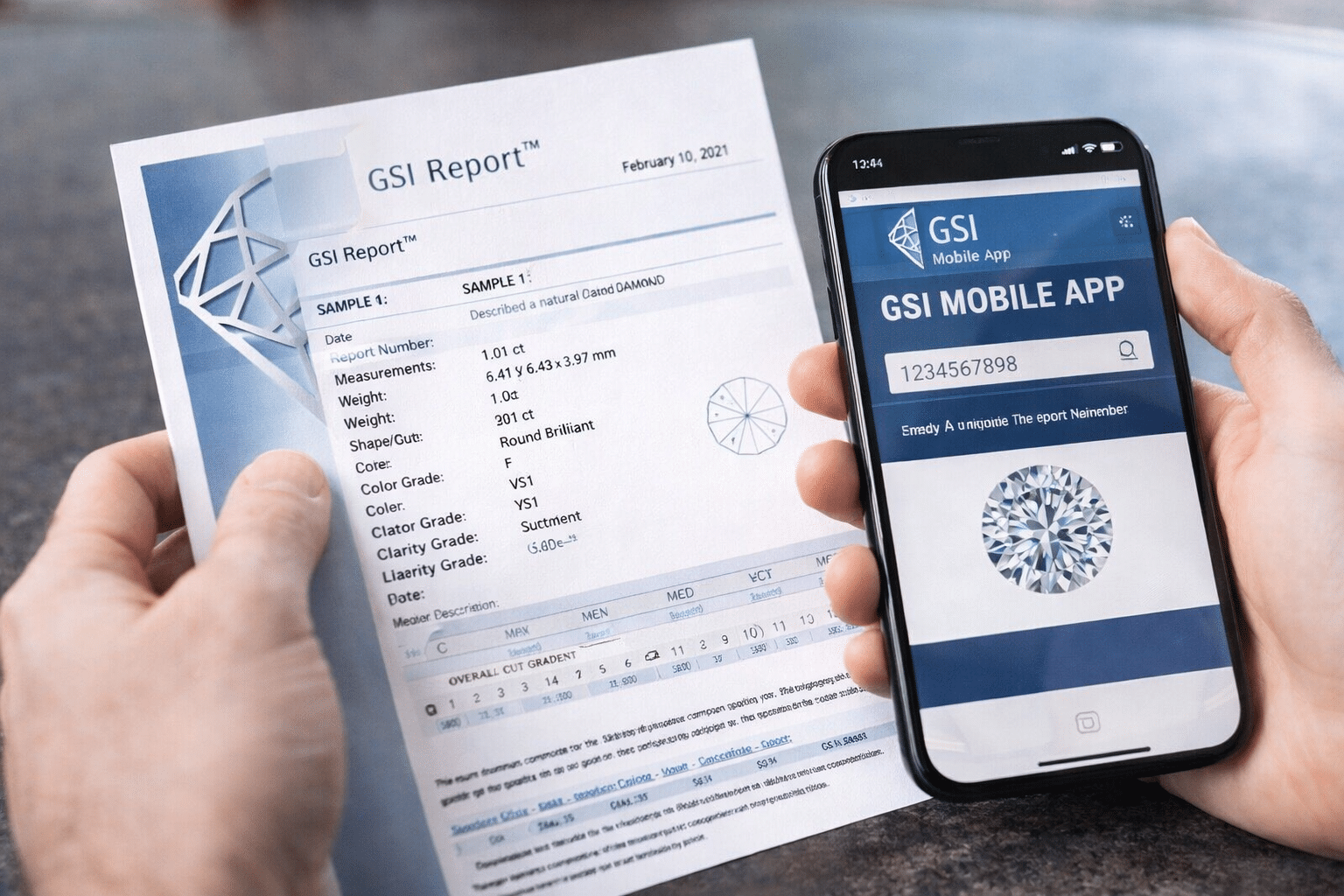
Every GSI grading report can be verified online through GSI’s official report portal at gemscience.net using the report number printed on the certificate.
The verification step confirms the report is genuine and that the grades on the physical certificate match what GSI’s database shows. What it does not confirm: that those grades are accurate compared to GIA standards.
Verifying a GSI report is a useful step when evaluating a pre-owned diamond. Finding a discrepancy between the physical certificate and the online record would indicate a counterfeit report, a separate problem from grade inflation, and is worth screening for in secondary market purchases.
Does GSI Certification Affect Diamond Resale Value?
GSI-certified diamonds receive lower resale offers than GIA-certified stones of equivalent stated grades. Pawn shops, estate buyers, and independent appraisers all factor lab credibility into their valuations.
Pawn shops will accept GSI certificates as documentation, but they apply a steeper discount to the valuation compared to GIA-certified stones. The “will a pawn shop accept GSI certification” answer is yes, but at a lower number than you’d receive for the same diamond with a GIA certificate.
For jewelry insurance purposes, an appraiser who re-evaluates based on their own assessment rather than the GSI certificate may value the stone lower than the purchase price, creating a coverage gap from day one of ownership.
What Diamond Certification Should You Buy Instead?
For natural diamonds, GIA certification from a reputable online retailer is the only recommendation that holds up to independent scrutiny. James Allen and Blue Nile both carry extensive GIA-certified diamond inventories with 360° video inspection tools, something no mall retailer can offer.
For lab-grown diamonds, IGI from Brilliant Earth or James Allen is the practical standard. GIA has begun issuing lab-grown reports, but IGI remains more widely available in this category.
Regardless of certificate, avoid purchasing from Kay, Zales, or Jared; even a GIA cert from a chain retailer carries a chain retailer markup.
For more context, the guide to 4 diamond labs buyers should avoid covers the full certification landscape, including why some labs with legitimate-sounding names don’t make the cut. And if you want to see how the top online retailers stack up on selection and pricing, the best places to buy jewelry online guide covers that directly.
Frequently Asked Questions: GSI Diamond Certification
Can I send a GSI-certified diamond to GIA for re-grading?
Any loose diamond can be submitted to GIA for independent grading regardless of which lab originally certified it. The process costs $50–$150, depending on carat weight. Expect the GIA result to come back 1–2 color grades and 1 clarity grade lower than the GSI certificate states; that gap is consistent with documented buyer re-grading experiences.
Do all Kay Jewelers diamonds carry GSI certificates?
No. A significant portion of Kay’s inventory is uncertified entirely, particularly in lower-priced engagement ring lines. Where certificates exist, GSI is the most common lab. Kay rarely sells GIA-certified diamonds in-store because GIA grading is slower and more expensive, both factors that conflict with Kay’s high-volume sales model.
Will a pawn shop accept a GSI certificate?
Pawn shops accept GSI certificates as documentation of the stone’s stated characteristics. However, they apply a steeper discount to GSI-certified stones compared to GIA-certified diamonds of the same stated grades. The certificate gets accepted, and the valuation reflects what pawn buyers know about GSI’s grading standards.
Is a GSI certificate valid for jewelry insurance?
Most jewelry insurance providers accept GSI certificates as supporting documentation. The risk is on the appraisal side: an independent appraiser evaluating the stone for insurance purposes may assign a lower value than the GSI certificate suggests, which would reduce your insured coverage relative to what you paid.
What makes the GSI light performance report different from standard grading?
The GSI PSX light performance report measures five optical characteristics: brilliance (white light return), fire (spectral color dispersion), scintillation (sparkle pattern), contrast effect (light and dark patterns), and efficiency (how well the cut maximizes light return). GIA does not offer a comparable light performance report. The PSX is a legitimate differentiator in GSI’s service lineup, but it doesn’t offset the consistency problems in the 4Cs grading.
Why do some online retailers sell GSI-certified diamonds alongside GIA-certified stones?
Some legitimate online platforms list GSI-certified diamonds at lower prices to serve buyers across different budget levels. This reflects market inventory, not retailer quality. Purchasing a GSI-certified diamond from an otherwise reputable platform doesn’t resolve the grading consistency problem; the discount you see rarely equals the actual quality gap versus a GIA stone at the same stated grade.
Is GSI the same organization as the GSI Institute?
No. Gemological Science International (the diamond grading lab) and GSI Institute (a gemological education organization) are separate entities with no affiliation. When evaluating a diamond certificate labeled “GSI,” confirm it was issued by Gemological Science International by verifying the report number at gemscience.net.
Does GSI grade lab-grown diamonds differently from natural diamonds?
GSI applies the same 4Cs evaluation structure to lab-grown diamonds as to natural diamonds. The critical difference is the disclosure: lab-grown stones are clearly labeled as such on the report and on the girdle inscription. The grading standards applied to lab-grown diamonds carry the same consistency concerns as GSI’s natural diamond grading.