To understand where SI2 stands on the clarity scale, it helps to first see how all grades compare in our expert diamond clarity guide.

SI2 clarity diamonds sit at the lower end of commonly recommended grades, a territory where visible inclusions become increasingly likely, but significant savings await buyers willing to search carefully. The question facing budget-conscious shoppers: can you find an SI2 diamond that looks beautiful, or does this grade guarantee disappointment?
The honest answer: SI2 clarity requires careful individual evaluation. Some SI2 diamonds appear eye-clean and offer exceptional value. Others display obvious inclusions that detract from their beauty. Unlike higher grades, where you can purchase confidently based on certification alone, SI2 demands hands-on (or eyes-on) assessment of each specific stone.
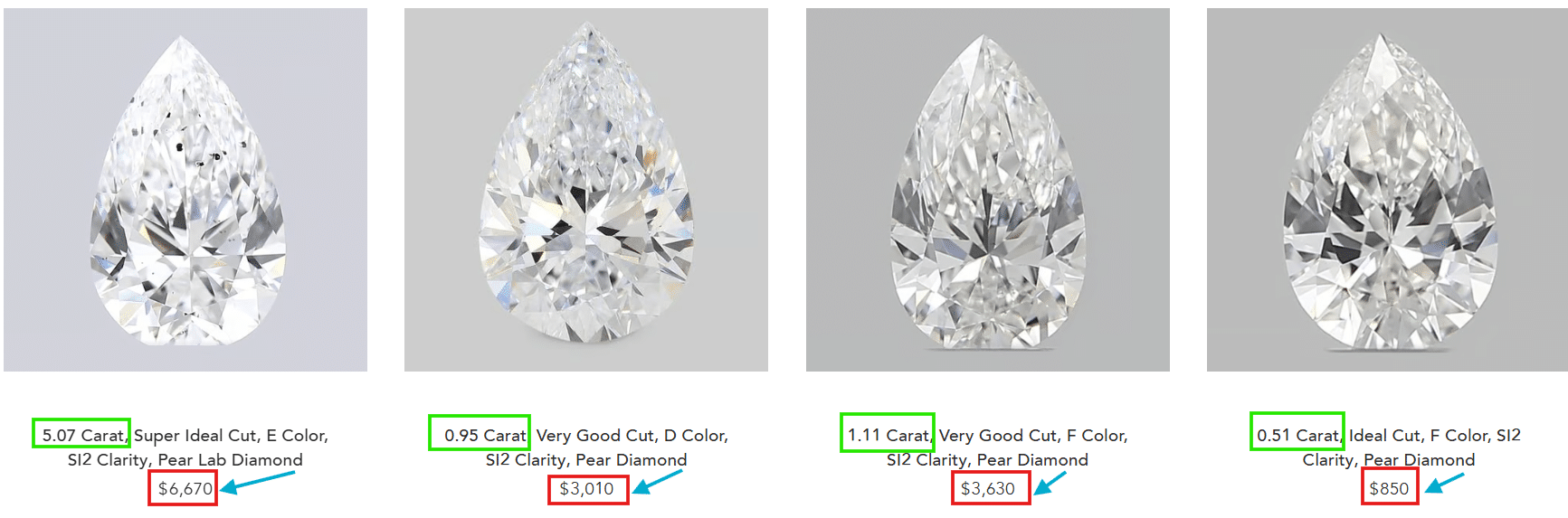
Understanding what SI2 clarity means, how it compares to other grades, and how to find the rare eye-clean specimens helps you decide whether this budget-friendly option suits your needs.
Juli “Jewels” Church, Certified Diamondologist at LearningJewelry.com, offers realistic expectations: “SI2 diamonds divide into two camps, those that work beautifully and those that do not. The grade itself does not guarantee either outcome. Success requires examining individual stones and knowing exactly what to look for. When you find a good SI2, the value proposition is excellent.”

What Is SI2 Diamond Clarity?
SI2 stands for “Slightly Included 2”, the lower of two grades within the Slightly Included tier. The GIA assigns this grade to diamonds containing noticeable inclusions easily visible under 10x magnification, which may also be visible to the naked eye.
Understanding the Clarity Scale
| Grade | Classification | Visibility to the Naked Eye |
| FL-IF | Flawless/Internally Flawless | Never visible |
| VVS1-VVS2 | Very Very Slightly Included | Never visible |
| VS1-VS2 | Very Slightly Included | Never visible |
| SI1 | Slightly Included 1 | Usually not visible |
| SI2 | Slightly Included 2 | Often visible |
| I1-I2-I3 | Included | Always visible |
For a complete breakdown of all grades, see our Diamond Clarity Chart.
SI2 represents the last clarity grade many reputable retailers carry for engagement ring center stones. Below SI2, the included grades (I1, I2, I3) contain obvious inclusions affecting both appearance and potentially durability.

What Causes SI2 Inclusions?
Inclusions form during diamond creation, either during natural geological processes or laboratory growth. Common SI2 inclusion types include:
- Crystals: Mineral deposits trapped within the diamond
- Feathers: Internal fractures appearing as wispy lines
- Clouds: Clusters of tiny pinpoints creating hazy areas
- Needles: Thin, elongated crystal inclusions
- Knots: Crystal inclusions reaching the surface
SI2 diamonds typically contain multiple inclusions or larger individual inclusions than higher grades. Their location, color, and type determine whether they prove visible during normal observation.

Select one diamond for your setting
SI2 vs Other Clarity Grades

Understanding how SI2 compares helps evaluate its value proposition.
SI2 vs SI1 Clarity
SI1 diamonds represent the higher Slightly Included grade with meaningful differences from SI2.
| Factor | SI1 | SI2 |
| Eye-Clean Likelihood | Usually | Sometimes |
| Inclusion Location | Often near edges | Often near center |
| Inclusion Size | Smaller | Larger |
| Price Difference | 10-20% more | Baseline |
| Recommendation | Good budget choice | Requires careful selection |
SI1 offers a higher probability of eye-clean status, making it safer for buyers who cannot examine individual stones carefully. SI2 requires more diligent evaluation but rewards successful searches with additional savings.
SI2 vs VS2 Clarity
VS2 diamonds represent the first grade, essentially guaranteeing eye-clean status.
| Factor | VS2 | SI2 |
| Eye-Clean Status | Guaranteed | Variable |
| Price Difference | 20-35% more | Baseline |
| Selection Difficulty | Easy | Requires effort |
| Risk Level | Very low | Moderate |
VS2 suits buyers wanting guaranteed results without individual stone evaluation. SI2 suits those willing to invest time in finding the right specific diamond.
SI2 vs I1 Clarity
I1 sits one grade below SI2 with significant quality differences.
| Factor | SI2 | I1 |
| Visible Inclusions | Often | Always |
| Impact on Beauty | Variable | Significant |
| Durability Concerns | Rare | Possible |
| Recommendation | Consider carefully | Avoid for center stones |
Most reputable jewelers do not recommend I1 clarity for engagement ring center stones. SI2 represents the practical floor for quality purchases.
SI2 vs VVS2 Clarity
Comparing SI2 to high-clarity VVS2 illustrates the value trade-off.
| Factor | VVS2 | SI2 |
| Eye-Clean | Always | Sometimes |
| Under Magnification | Nearly flawless | Obvious inclusions |
| Price Difference | 40-60% more | Baseline |
| Value Proposition | Premium quality | Budget optimization |
Both grades can produce diamonds that appear identical during normal wear, when SI2 achieves eye-clean status. The VVS2 premium purchases invisible perfection and guaranteed results.

Choose this radiant engagement ring
How Much Do SI2 Diamonds Cost?
SI2 clarity offers significant savings compared to higher grades.
SI2 Price Ranges by Carat Weight
| Carat Weight | SI2 Price Range | VS2 Comparison |
| 0.50ct | $800-$1,800 | $1,000-$2,200 |
| 1.00ct | $3,000-$6,000 | $4,000-$7,500 |
| 1.50ct | $5,500-$10,000 | $7,500-$14,000 |
| 2.00ct | $9,000-$18,000 | $13,000-$25,000 |
Ranges assume G-H color and excellent cut. Other factors shift pricing.

See how each carat size changes the look
Lab-Grown SI2 Diamonds
Lab-created SI2 diamonds cost 60-80% less than natural equivalents. A 1-carat lab-grown SI2 might cost $800-$1,500 compared to $3,000-$6,000 for natural.
Lab diamonds tend to have more limited inclusion types due to controlled growth environments. Finding eye-clean lab-grown SI2 diamonds may prove easier than with natural stones.
Can SI2 Diamonds Be Eye-Clean?
Yes, some SI2 diamonds achieve eye-clean status, meaning inclusions cannot be detected without magnification during normal observation. However, this outcome is not guaranteed and requires individual verification.
What Makes SI2 Eye-Clean?
Several factors determine whether specific SI2 diamonds appear eye-clean:
Inclusion Location: Inclusions near edges or under facets hide better than those centered under the table.
Inclusion Color: White or transparent inclusions blend more effectively than dark crystals.
Inclusion Type: Feathers and clouds often hide better than black crystal inclusions.
Diamond Shape: Brilliant cuts (round, princess, cushion) hide inclusions better than step cuts (emerald, Asscher).
Carat Weight: Smaller diamonds hide inclusions more effectively than larger stones.
How to Find Eye-Clean SI2 Diamonds
Successfully hunting for eye-clean SI2 requires specific strategies:
Shop Online: Online retailers display hundreds of SI2 diamonds with detailed imagery. Physical stores rarely stock enough inventory for effective comparison.
Use 360° Video: Retailers like James Allen provide rotating video at high magnification. Examine each diamond carefully, then use zoom-out features to approximate normal viewing.
Check Inclusion Location: Prioritize diamonds with inclusions near edges rather than centered under the table. Edge inclusions often disappear under prong settings.
Avoid Dark Inclusions: Black crystal inclusions prove most visible. White feathers and clouds hide more effectively.
Prioritize Excellent Cut: Well-cut diamonds return more light, helping mask inclusions through brilliance.
Verify Return Policies: Always confirm return options before purchasing SI2 diamonds. You may need to examine in person before committing.

Diamond Shapes and SI2 Clarity
Shape significantly affects inclusion visibility at the SI2 grade.
| Shape | SI2 Suitability | Notes |
| Round Brilliant | Good | Light return helps mask inclusions |
| Princess | Good | Brilliant faceting hides flaws |
| Cushion | Moderate | Larger facets may reveal inclusions |
| Oval | Moderate | An elongated shape can show inclusions |
| Emerald | Poor | Step cuts reveal inclusions readily |
| Asscher | Poor | Open facets expose clarity characteristics |
For step-cut shapes like emerald and Asscher, consider SI1 or VS2 clarity instead. Their large, open facets make inclusion visibility much more likely at the SI2 grade.

Are SI2 Diamonds Durable?
Most SI2 diamonds present no durability concerns. However, certain inclusion types warrant caution:
Surface-Reaching Feathers: Large feathers extending to the surface could potentially chip if struck along their plane.
Cavity Inclusions: Open cavities on the surface create vulnerable spots.
Large Cleavage Planes: Significant internal fractures along cleavage directions pose a theoretical risk.
Examine grading reports for inclusion plots showing characteristic locations. Avoid SI2 diamonds with significant surface-reaching inclusions in exposed positions.
For typical SI2 diamonds with internal inclusions, durability matches higher clarity grades. The inclusions affect appearance, not structural integrity.

Case Study: David’s SI2 Diamond Search
David, a 30-year-old teacher from Minneapolis, shares his SI2 experience:
“My budget was $5,000 for a round diamond around 1.25 carats. At VS2 clarity, I could afford approximately 1.10 carats. SI2 opened possibilities for larger stones if I could find an eye-clean example.
I spent several hours on James Allen examining SI2 diamonds in my size range. Many showed obvious dark inclusions, immediate rejects. Others had inclusions positioned under the table where they would be visible.
After reviewing approximately 40 stones, I found three candidates with inclusions near edges and no dark crystals in prominent positions. Each had small white feathers or clouds rather than black spots.
I ordered my top choice, a 1.32ct SI2 with a feather near the 5 o’clock position. Their 30-day return policy gave me confidence to evaluate in person.
When the diamond arrived, I examined it carefully under different lighting conditions. The feather was invisible without magnification. Completely eye-clean. My fiancée and I both studied it, knowing exactly where to look; neither could see the inclusion.
Final result: 1.32ct eye-clean diamond for $4,800 versus 1.08ct VS2 at a similar price. The search required effort, but the 22% size increase was worth it.
My advice: SI2 works beautifully if you invest time in selection. Do not buy SI2 blindly based on grade alone; examine every stone individually.”

Video Resource
For visual guidance on evaluating SI2 diamonds:
Frequently Asked Questions
Is SI2 a good diamond clarity grade?
SI2 can deliver excellent value when individual diamonds are carefully selected for eye-clean status. The grade itself does not guarantee good or bad results; specific stone evaluation determines the outcome. SI2 suits budget-conscious buyers willing to invest selection time.
Can you see inclusions in SI2 diamonds?
Often yes, but not always. SI2 diamonds frequently contain visible inclusions, but some achieve eye-clean status depending on inclusion type, color, size, and location. Individual evaluation is mandatory for SI2 purchases.
What is the difference between SI1 and SI2 diamonds?
SI1 diamonds usually achieve eye-clean status, while SI2 diamonds often show visible inclusions. SI1 inclusions tend to be smaller and positioned near edges. SI2 costs 10-20% less but requires more careful selection.
Should I buy SI2 clarity for my engagement ring?
SI2 can work beautifully for engagement rings when you find eye-clean examples. Shop online with 360° video, prioritize diamonds with edge-positioned inclusions, avoid dark crystals, and verify return policies. Step-cut shapes should avoid SI2 in favor of higher clarity.
Are SI2 diamonds of bad quality?
Not inherently. SI2 represents lower clarity but can produce beautiful diamonds. Quality depends on specific stone characteristics rather than grade alone. Eye-clean SI2 diamonds offer exceptional value; visibly included SI2 diamonds should be avoided.
Do SI2 diamonds need certification?
Absolutely. All diamond purchases should include certification from reputable laboratories (GIA or IGI). Certification confirms the stated clarity grade and documents inclusion characteristics. Never purchase uncertified diamonds regardless of clarity grade.
Finding the right SI2 diamond takes knowledge and patience. Our complete clarity guide will help you spot the winners.