Not sure whether to focus on Diamond Color vs Clarity first? Our diamond buying guide walks you through each step of the decision-making process.
You have a budget. You cannot maximize everything. So when trade-offs become necessary, should you prioritize color grade or clarity grade?
Compare today’s prices & explore the latest designs
This question confronts nearly every diamond buyer. Both factors affect appearance and price significantly. Both carry confusing grade scales with subtle distinctions. And both offer opportunities to save money without sacrificing visible beauty, if you know where the thresholds actually matter.

Darker. Deeper. Rarer , Explore More
The short answer: for most buyers, clarity matters slightly more than color because low clarity can create visible inclusions, while moderate color grades remain undetectable in mounted jewelry. But the complete answer depends on diamond shape, setting metal, and personal sensitivity to each characteristic.

See the true size and brilliance before you buy.
Juli “Jewels” Church, Certified Diamondologist at LearningJewelry.com, helps buyers navigate this decision daily: “I tell customers to prioritize eye-clean clarity first, then optimize color within their remaining budget. A diamond with visible inclusions bothers everyone. A diamond with slight warmth bothers almost nobody once it is mounted in a ring.”
Understanding Diamond Clarity Grades
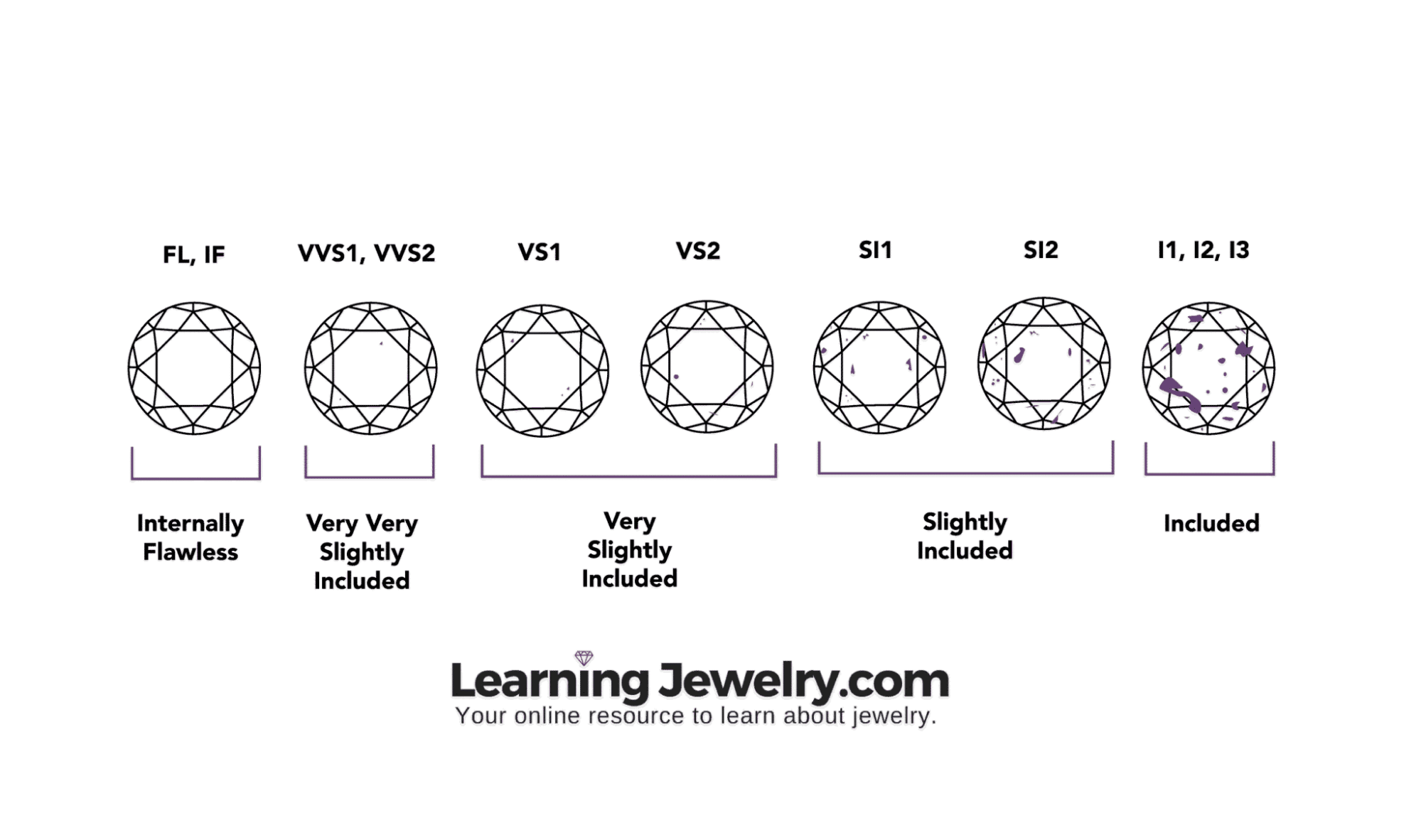
Diamond clarity measures internal inclusions and surface blemishes. The GIA clarity scale ranges from Flawless (no inclusions visible under 10x magnification) to Included (obvious inclusions visible to the naked eye).
| Grade | Classification | Visibility |
| FL-IF | Flawless/Internally Flawless | Invisible at any magnification |
| VVS1-VVS2 | Very Very Slightly Included | Invisible to the naked eye |
| VS1-VS2 | Very Slightly Included | Invisible to the naked eye |
| SI1-SI2 | Slightly Included | May be visible to the naked eye |
| I1-I2-I3 | Included | Visible to the naked eye |
For a detailed breakdown of each grade, see our Diamond Clarity Chart.
The critical concept for clarity: eye-clean diamonds. An eye-clean diamond contains no inclusions visible without magnification during normal observation. Eye-clean grades include:
- Flawless and Internally Flawless (always eye-clean)
- VVS diamonds (always eye-clean)
- VS diamonds (always eye-clean)
- SI1 diamonds (usually eye-clean, verify individually)
- SI2 diamonds (sometimes eye-clean, verify carefully)
Below SI2, diamonds typically show visible inclusions affecting appearance and potentially durability.

Understanding Diamond Color Grades
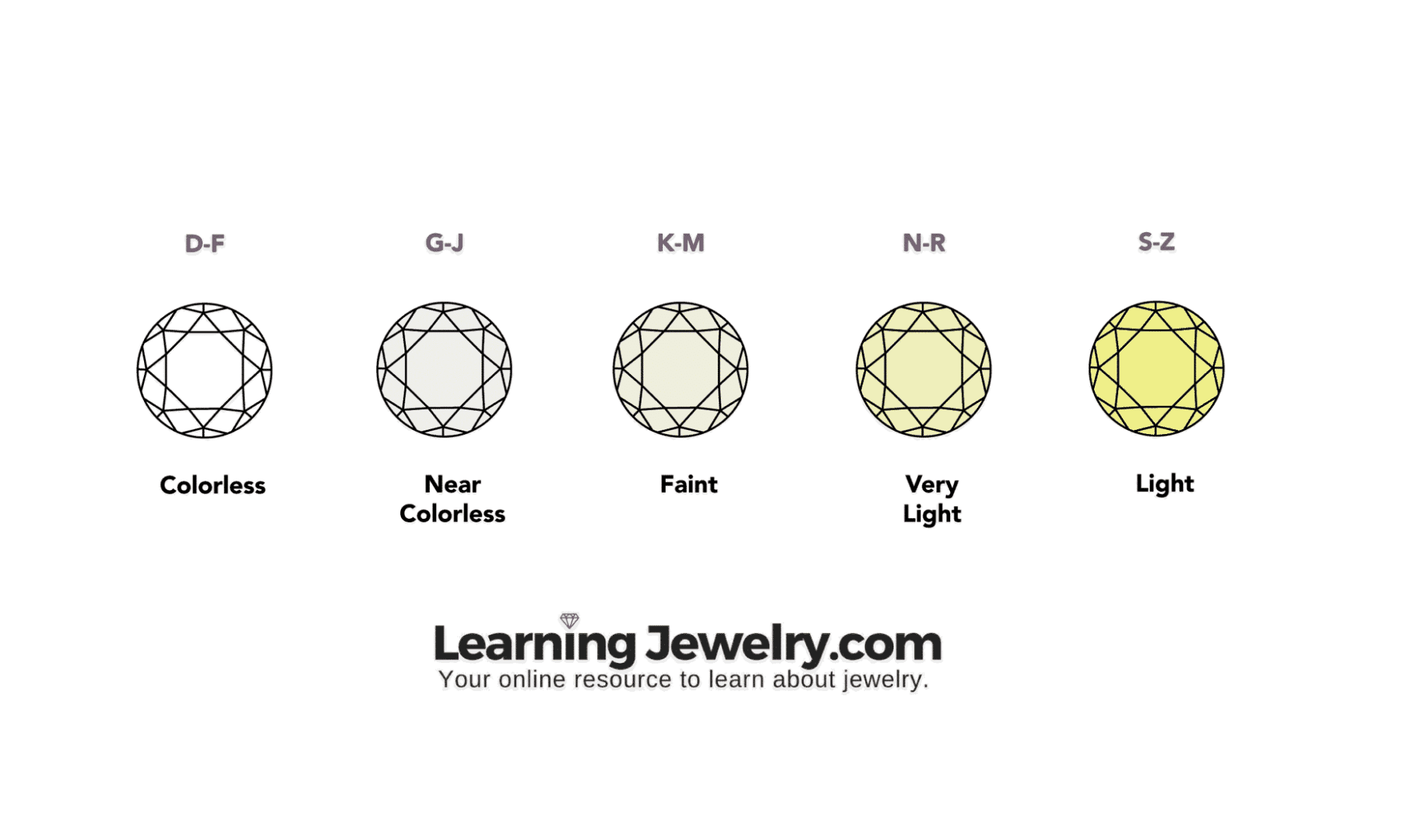
Diamond color measures the presence of a yellow or brown tint in white diamonds. The GIA scale runs from D (completely colorless) through Z (obvious tint).
| Grade Range | Classification | Appearance |
| D-E-F | Colorless | No visible tint |
| G-H-I-J | Near Colorless | Slight warmth, often invisible when mounted |
| K-L-M | Faint | Noticeable warm tint |
| N-Z | Very Light to Light | Obvious yellow/brown tint |
D color diamonds represent absolute colorlessness, the pinnacle of the scale, and are priced accordingly. But the practical reality: most people cannot distinguish D from G color once diamonds are mounted in settings.
Color grades affect appearance only, never durability or structure. A J color diamond proves just as strong as a D color diamond. The tint creates visual preference differences, not quality differences in the structural sense.

Yellow tint results from nitrogen atoms replacing carbon atoms during diamond formation. These impurities absorb blue light, creating perceived warmth. This natural tinting differs from fancy colored diamonds, which follow separate grading standards and actually gain value from strong color saturation.

How Clarity Affects Your Diamond
Clarity impacts both appearance and potentially durability.
Visibility Concerns
Low clarity grades (SI2 and below) may display inclusions visible during normal wear. Dark crystal inclusions near the table facet prove most noticeable. White feathers near edges often remain hidden.
The type, size, location, and color of inclusions matter more than the grade alone. An SI1 with a black crystal in the center looks worse than an SI2 with white feathers near the edge.

A rare vintage-cut diamond with timeless character and warm brilliance.
Durability Concerns
Severe inclusions in I2 and I3 diamonds can create structural vulnerabilities. Feathers reaching surfaces or large inclusions near edges may cause chipping if struck. Higher clarity grades eliminate these durability concerns entirely.
Price Impact
Clarity significantly affects pricing:
| Clarity Grade | Approximate 1ct Price Range |
| FL/IF | $9,000-$15,000 |
| VVS1/VVS2 | $6,000-$9,000 |
| VS1/VS2 | $4,000-$6,000 |
| SI1/SI2 | $3,000-$4,500 |
| I1/I2/I3 | $2,000-$3,000 |
Ranges assume G-H color and excellent cut. Other factors shift pricing.

How Color Affects Your Diamond
Color creates purely visual impact without structural implications.
Visibility Factors
Color visibility depends heavily on context:
Setting Metal: Yellow and rose gold masks warm diamond tones. White metals make any tint more apparent. A J color diamond appears whiter in yellow gold than in platinum.
Diamond Size: Larger diamonds show color more readily. A 2-carat J color displays more visible warmth than a 0.50-carat J color.
Diamond Shape: Round brilliants hide color best. Step cuts like emerald and Asscher reveal tint more obviously.
Viewing Conditions: Jewelry store lighting flatters diamonds. Natural daylight reveals color more accurately.

Price Impact
Color affects pricing, though less dramatically than clarity at equivalent grade jumps:
| Color Grade | Approximate 1ct Price Range |
| D | $8,000-$12,000 |
| E | $7,000-$10,000 |
| F | $6,000-$8,000 |
| G | $5,000-$7,000 |
| H | $4,000-$6,000 |
| I | $3,000-$5,000 |
| J | $2,500-$4,000 |
Ranges assume VS clarity and excellent cut. Other factors shift pricing.

A closer look at brilliance—where setting meets sparkle.
Color vs Clarity: Direct Comparison
| Factor | Color | Clarity |
| Affects Durability | No | Yes (at low grades) |
| Visibility Threshold | G-H appears white to most | VS2 guarantees eye-clean |
| Price Impact | Moderate | Significant |
| Shape Sensitivity | High (step cuts reveal more) | Moderate |
| Setting Influence | Strong (metal color matters) | Minimal |
| Personal Sensitivity | Varies widely | More universal |
| Safe Budget Grade | G-H | VS2-SI1 |
Which Should You Prioritize?
The answer depends on your specific situation.
Prioritize Clarity When:
- Choosing step-cut shapes (emerald, Asscher) that reveal inclusions
- Budget requires choosing between visible inclusions or slight warmth
- You examine jewelry closely and notice imperfections easily
- Purchasing larger diamonds where inclusions become more apparent

See how a classic solitaire looks at today’s price
Prioritize Color When:
- Setting a diamond in white metal (platinum, white gold)
- You notice color differences more readily than inclusions
- Purchasing step-cut shapes that also reveal color
- Side stones have high color grades, requiring center stone matching
The Balanced Approach (Recommended)
For most buyers, the optimal strategy balances both factors:
- Ensure eye-clean clarity first (VS2 minimum, SI1 with verification)
- Select color based on setting metal (G-H for white metals, I-J for yellow/rose gold)
- Maximize carat weight with remaining budget
This approach guarantees no visible flaws while accepting invisible color differences that save meaningful money.

Tips for Maximizing Both Color and Clarity Value
Getting Eye-Clean Diamonds at Lower Clarity Grades
Finding eye-clean SI1 or SI2 diamonds requires individual stone evaluation:
- Look for inclusions near the edges rather than the center table
- Prefer white or transparent inclusions over dark crystals
- Check if prongs will cover inclusion locations
- Use retailer 360° imaging to examine actual diamonds
- Avoid relying on clarity grade alone; verify each stone
Making Lower Color Grades Appear Whiter
Several strategies minimize visible warmth:
- Choose yellow or rose gold settings that complement warm tones
- Select round brilliant cuts that hide color best
- Avoid side stones with higher color grades than the center stone
- Consider solitaire settings, eliminating comparison points
- Prioritize excellent cut grades, as well-cut diamonds reflect more white light

Design your perfect ring—your diamond, your setting, your way.
Consider Lab-Grown Diamonds
Lab-grown diamonds typically offer better color and clarity at lower prices. The controlled laboratory environment limits inclusions and impurities compared to natural formation.
A lab-grown diamond with G color and VS2 clarity might cost 60-80% less than an equivalent natural diamond, allowing you to maximize both factors without trade-offs.

Shape-Specific Recommendations for Diamond Color vs Clarity
Different diamond shapes reveal color and clarity differently.
| Shape | Color Recommendation | Clarity Recommendation |
| Round Brilliant | H-I (hides color well) | SI1-VS2 (hides inclusions well) |
| Princess | G-H | VS2-SI1 |
| Cushion | G-H | VS2 |
| Oval | G-H | VS2 |
| Emerald | F-G (reveals color) | VS1-VS2 (reveals inclusions) |
| Asscher | F-G | VS1-VS2 |
| Pear | G-H | VS2-SI1 |
| Marquise | G-H | VS2-SI1 |
| Radiant | G-H | VS2-SI1 |
Step cuts (emerald, Asscher) require higher grades in both categories due to their large, open facets, revealing characteristics more readily.
Case Study: Nicole’s Color vs Clarity Decision
Nicole, a 30-year-old nurse from Denver, faced the classic trade-off:
“My budget was $8,000 for a round diamond around 1.25 carats. I wanted a white gold solitaire setting. Initially, I thought color mattered most since I wanted a ‘white’ diamond.
I compared options at Blue Nile:
Option A (Color Priority): 1.21ct, E color, SI2 clarity, $7,900. The SI2 had a visible dark inclusion near the center. Beautiful color, but I could see the flaw.
Option B (Clarity Priority): 1.18ct, H color, VS2 clarity, $7,600 Eye-clean, no visible inclusions. Slightly warmer but undetectable once mounted.
Option C (Balanced): 1.31ct, G color, SI1 clarity, $8,100. Eye-clean after verification, excellent size, near-colorless appearance.
I examined the SI1 carefully; the inclusion was a small feather near the edge, completely invisible without magnification. The G color appeared white in the setting.
I chose Option C. The larger size, eye-clean appearance, and near-colorless grade delivered the best overall result. Prioritizing just color would have given me a diamond with a visible flaw.
My fiancé proposed six months ago. Everyone comments on how beautiful and sparkly the ring looks. Nobody has ever mentioned color or clarity, because there is nothing visible to notice.”
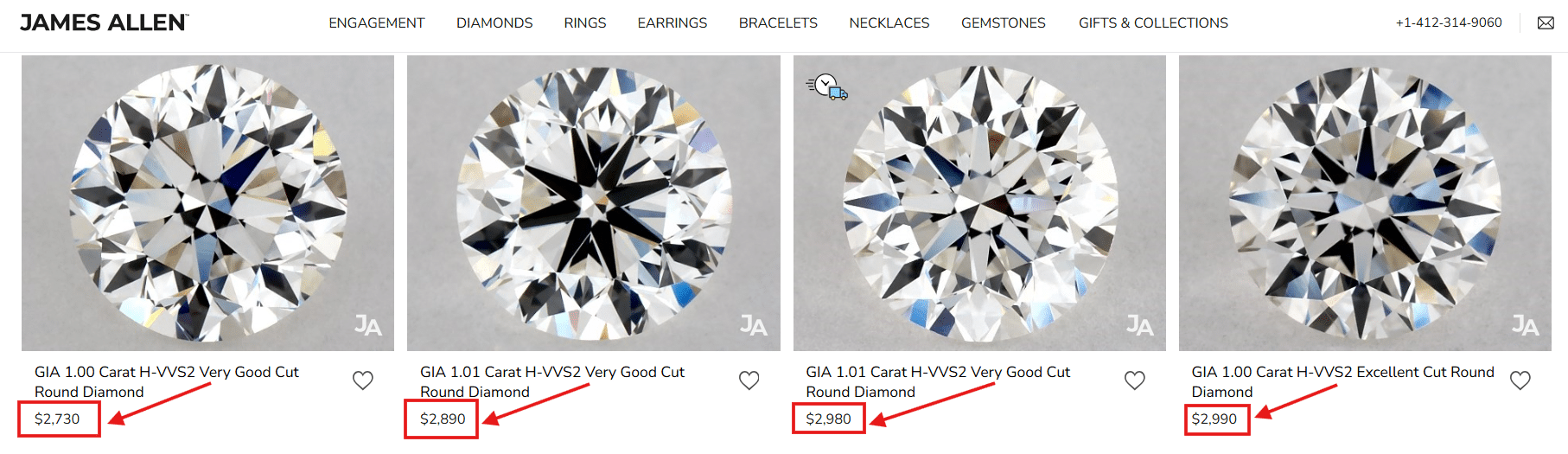
Same specs, different sparkle—cut quality makes the real difference.
Video Resource for Diamond Color vs Clarity
For visual comparison of color and clarity grades:
Frequently Asked Questions: Diamond Color vs Clarity
Is diamond color or clarity more important?
For most buyers, clarity matters slightly more because low clarity can create visible inclusions, while moderate color grades remain undetectable in mounted jewelry. However, both factors should be balanced, ensure eye-clean clarity first, then optimize color within remaining budget.
What is the best color and clarity combination for a diamond?
G-H color with VS2-SI1 clarity offers the best value for most buyers. This combination produces eye-clean diamonds appearing white in settings while saving significantly versus higher grades. Verify SI1 stones individually for eye-clean status.
Can you see the difference between G and D color diamonds?
Most people cannot distinguish G from D color once diamonds are mounted in settings. The difference becomes visible only under controlled comparison conditions with reference stones. G color offers excellent appearance at 15-25% lower cost than D color.
Does the diamond shape affect color and clarity visibility?
Yes, round brilliants hide both color and inclusions most effectively. Step cuts like emerald and Asscher reveal both characteristics more readily, typically requiring one grade higher in each category for equivalent appearance.
Should I choose a higher color or a higher clarity if I can only afford one?
Choose higher clarity. A diamond with visible inclusions bothers nearly everyone, while slight color warmth often goes unnoticed in mounted jewelry. Eye-clean appearance should be the minimum standard; color optimization comes second.
What clarity is considered eye-clean?
VS2 and higher grades guarantee eye-clean status. SI1 frequently achieves eye-clean results but requires individual verification. SI2 occasionally qualifies. I1 and below typically show visible inclusions.
For complete guidance on selecting the right diamond, return to our diamond buying guide.