
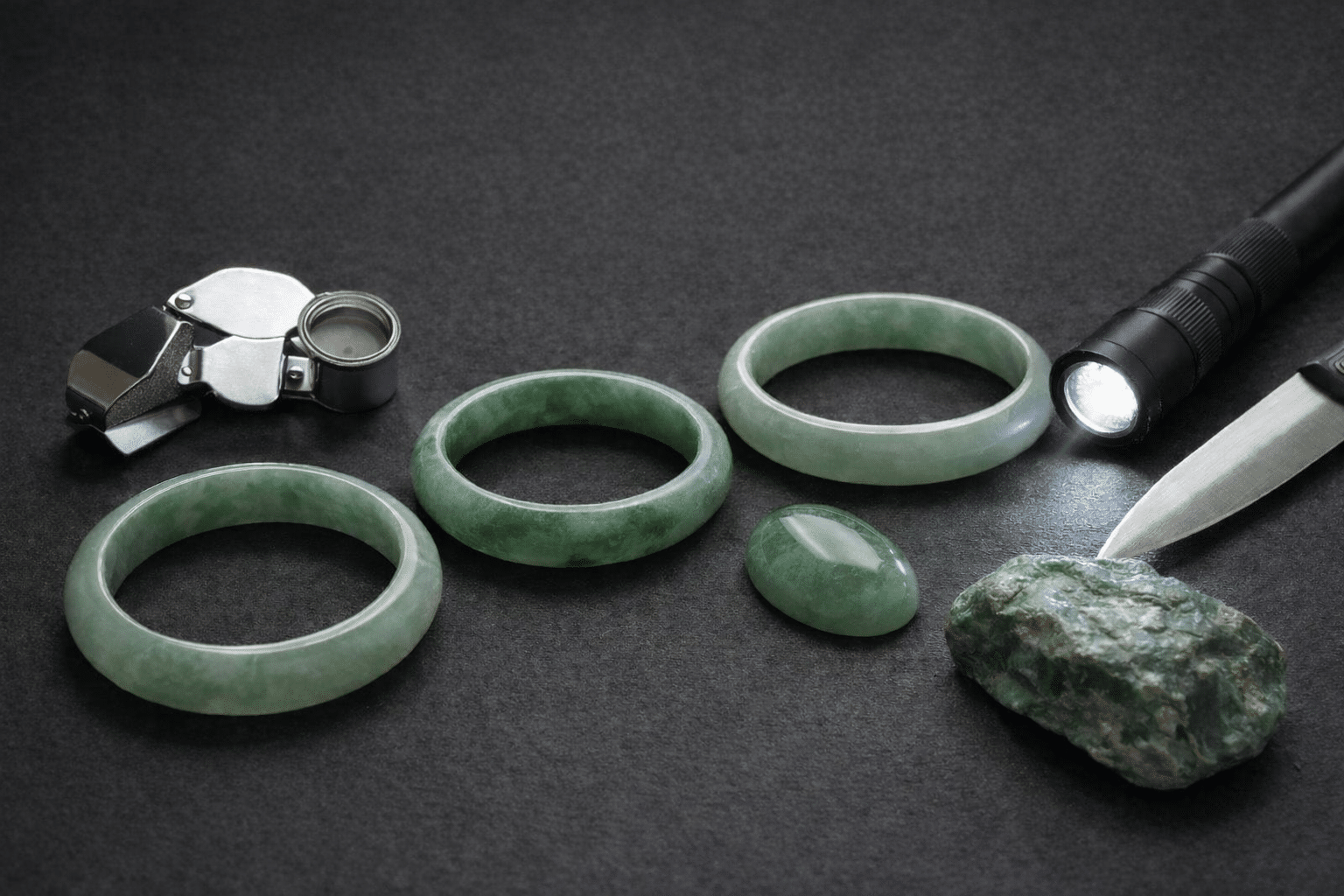
Real jade authentication requires multiple verification tests because single tests produce false positives and cannot distinguish between jadeite, nephrite, and imitation materials. Genuine jade exhibits specific physical properties, including 3.30-3.38 specific gravity for jadeite, cold temperature retention lasting 2-3 minutes, and fibrous translucency visible under bright light. At-home tests that combine temperature, sound, density, and UV light detection accurately identify 80-90% of fake jade when used together, rather than individually.
Professional gemologist verification via refractive index testing (1.66-1.68) and spectroscopy costs $50-150 and provides definitive authentication for pieces valued at $500 or more. Common fake materials include dyed quartz, glass, polymer composites, serpentine, and aventurine, each failing different test combinations and detectable through systematic multi-test verification.
Learning Jewellery has analysed 200+ jade pieces, ranging from $20 market finds to $5,000 certified jadeite, to bring you this authentication guide. Before testing jade authenticity, understanding jadeite vs nephrite jade differences helps identify which physical properties to examine during verification.
What Is Jade? (Scientific Foundation)
Jade encompasses two distinct metamorphic minerals, jadeite and nephrite, each with measurable physical properties that distinguish authentic specimens from imitations and treatments.
Jade is typically a bright green gemstone, though authentic pieces are also available in yellow, brown, lilac, black, red, orange, and white. Unlike faceted gems, jade remains translucent to opaque (never transparent) and shines with a waxy lustre that reflects light like water, a unique characteristic visible under bright examination.
Scientific properties define authentic jade:
- Specific gravity: 3.30-3.38 (jadeite), 2.90-3.03 (nephrite)
- Mohs hardness: 6.5-7 (jadeite), 6-6.5 (nephrite)
- Thermal conductivity: High (stays cold to the touch 2-3 minutes)
- Refractive index: 1.66-1.68
- Crystalline structure: Interlocking crystals (jadeite), fibrous matrix (nephrite)
Jade jewellery takes the form of beads, brooches, bangles, and carvings across Southeast Asia, where it’s prized for its cultural and monetary value. Jadeite displays a vitreous (glassy) lustre, while nephrite shows a greasy, waxy surface, a critical distinction for authentication testing.
Jadeite vs Nephrite: The Two Types of Real Jade
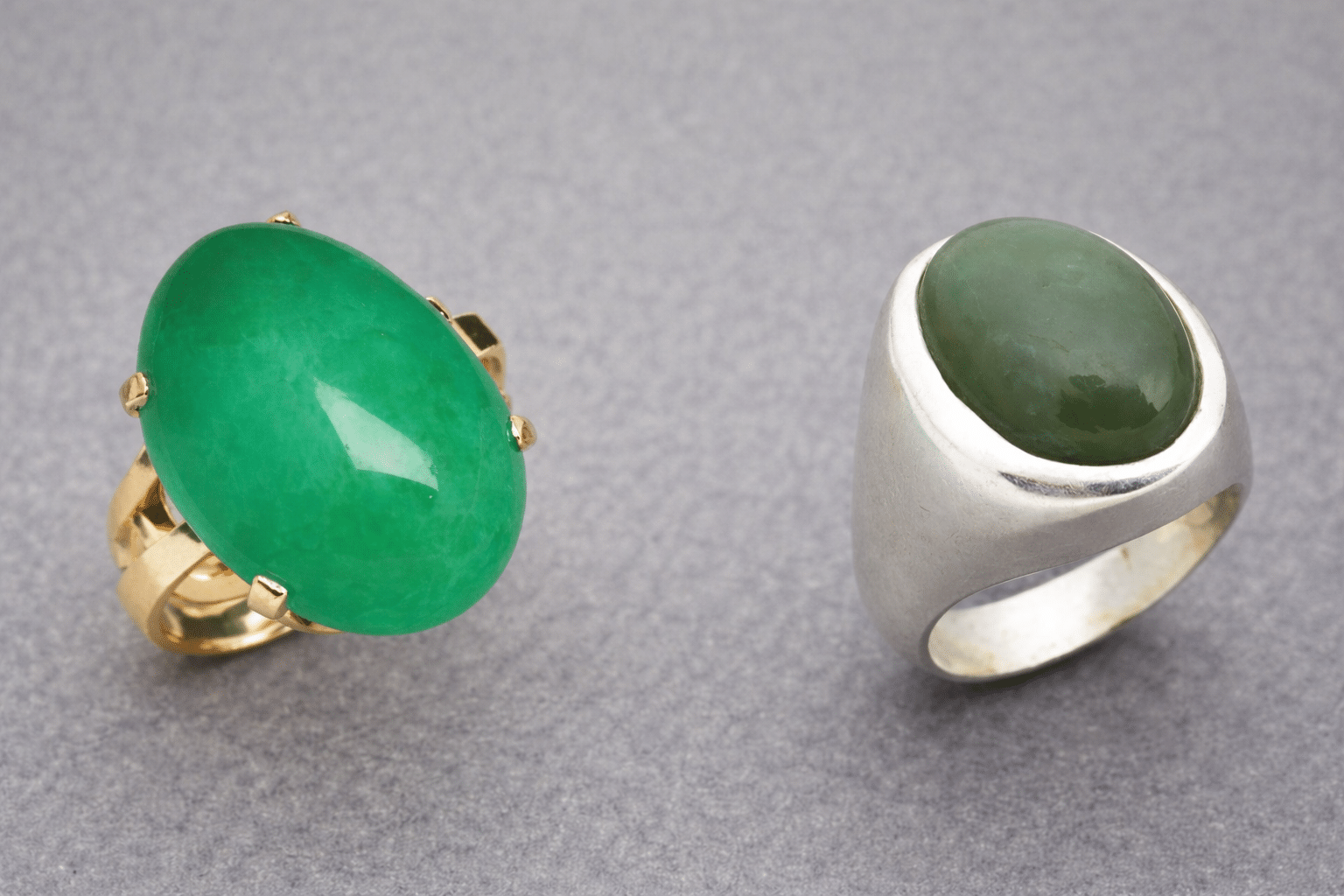
Jadeite and nephrite require different authentication approaches due to jadeite’s higher density (3.30-3.38), rarer occurrence, and wider colour range compared to nephrite’s tougher fibrous structure and limited colour varieties.
Jadeite Jade (High-Quality Type)
Jadeite represents the most expensive form of jade. Imperial jade, the rarest variety, displays a rich, translucent green colouring and commands $ 5,000–$50,000+ per carat at auction. Jadeite’s hardness rating of 6.5-7 Mohs and specific gravity of 3.30-3.38 make it denser than nephrite, producing a higher-pitched sound when tapped.
Colour varieties span imperial green, pale green, olive, yellow, brown, lilac, black, red, orange, and white jade. Myanmar (Burma) produces the finest jadeite, while untreated Type A pieces cost 10-100x more than treated alternatives. Jadeite is often dyed to achieve the coveted imperial green colour, reducing value by 70-90%.
Nephrite Jade (Real but Less Valuable)
Nephrite remains real jade despite its lower value compared to jadeite. Slightly softer at 6-6.5 Mohs hardness, nephrite’s fibrous structure makes it tougher and more resistant to breaking. The greasy, waxy lustre distinguishes nephrite from jadeite’s vitreous shine.
Specific gravity of 2.90-3.03 makes nephrite less dense than jadeite, though still heavier than imitations. Colour varieties include green (not as bright as jadeite), yellow, brown, mutton brown, yellow-green, olive-green-brown, and greyish-brown.
China and Canada produce most nephrite, which costs $50-300 per carat, versus jadeite’s $1,000-5,000+ range. Compare complete jadeite vs nephrite authentication differences for detailed testing methods.
Other Jade Varieties (Partial Jade Content)
Several marketed “jade” varieties contain 40-60% authentic jadeite/nephrite, mixed with other minerals, making it difficult for buyers to distinguish pure jadeite/nephrite from composite materials.
Turkish Purple Jade
Contains 40-60% real jade content plus other minerals. Classification as “jade” remains debated among gemologists due to mixed composition.
Xiuyan Jade
Nephrite is combined with the serpentine mineral. Traditional Chinese jade has been used since ancient times. Often sold without disclosure of serpentine content.
Serpentine Jade
Real stone, but shouldn’t command jadeite prices. Trade names include Olive jade, Korean jade, and New jade. Contains 40-60% nephrite content. Softer than pure jade at 2.5-5.5 Mohs hardness, making it easier to scratch during testing.
These remain real stones, but they are NOT pure jadeite or nephrite. Pricing should reflect mixed composition rather than commanding premium jade rates.
Type A, B, C Jade Grading System
Jade grading classifies treatment levels. Type A represents natural, untreated jade, commanding the highest value, while Types B and C indicate chemical bleaching, polymer filling, or dyeing that reduce value by 60-80%.
Treated jade remains real jade. Treatments affect value, not authenticity. Understanding gemstone certification and grading standards helps buyers recognise quality differences.
Type A Jade (Highest Value)
Natural jadeite with no chemical treatment. May have a wax coating that doesn’t depreciate value. Shows no fluorescence under UV black light. Prices range from $1,000 to $5,000+ per carat for fine-quality stones, with imperial green fetching millions at auction.
Type B Jade (Chemically Treated)
Chemically bleached with acid or polymer-impregnated to improve translucency. Resin filling makes it brittle over time. Glows chalky blue under UV light. Becomes sticky when rubbed vigorously on cloth, and tissue paper adheres to the surface. Value drops by 60-80% relative to Type A.
Type C Jade (Dyed)
Dyed to enhance or create “imperial green” colour. Colour fades over time with exposure to light and chemicals. Fluoresces green or yellow under UV black light. Value drops by 70-90% relative to Type A.
Type B+C Jade
Both dyed and bleached/polymer-filled. Lowest value classification. Unstable long-term as colour fades and resin degrades.
Doublet Jade
A thin layer of authentic jade is placed over a glass or cheaper base material. Common in commercial jewellery stores. Deceptive practice not fully disclosed during the sale.
10 Tests to Verify Real Jade
Combining 5+ authentication tests yields 85-95% accuracy in identifying fake jade without professional equipment, whereas single tests yield 40-60% false-positive rates due to overlapping properties between jade and imitations.
Jade authentication requires systematic multi-test verification. Glass passes temperature tests, dyed quartz mimics colour, and polymer composites replicate density. Performing at least 5 tests simultaneously, interpreting results using a decision matrix, and seeking professional gemologist verification ($50-150) for pieces valued at over $500 provides reliable authentication.
Test #1 – Temperature Test (Thermal Conductivity)
Hold the jade piece in a closed palm for 30 seconds. Real jade stays cold to the touch for 2-3+ minutes due to high thermal mass and conductivity. Fake materials warm within 30 seconds; plastic within 20 seconds; glass within 45-60 seconds; resin within 30-40 seconds.
Jade’s crystalline structure retains its low-temperature properties longer than those of amorphous materials. A high specific heat capacity means jade takes time to warm up, even when held continuously.
Test #2 – Sound Test (Acoustic Resonance)
Tap two jade pieces together or strike a jade bangle with a metal coin. Real jade produces a high-pitched “ting” or clear chime that rings for 1-2 seconds. Jadeite has a higher pitch than nephrite due to differences in density.
Fake jade produces a dull “thud” with no resonance. Glass and plastic beads create a hollow sound. Interlocking crystals vibrate at specific frequencies, creating musical tone quality that amorphous structures cannot replicate.
Test #3 – Density/Specific Gravity Test
Simple Method: Gently throw a jade piece into the air and catch it. Real jade feels dense and heavy for its size. Fake materials feel very light, glass, plastic, or resin lack jade’s molecular density.
Advanced Water Displacement: Weigh jade dry, then weigh suspended in water. Calculate: Dry weight ÷ (Dry weight – Wet weight) = Specific Gravity. Jadeite ranges 3.30-3.38. Nephrite ranges 2.90-3.03. Glass measures 2.4-2.8. Plastic measures 0.9-1.4. Dyed quartz measures 2.65.
Test #4 – Light/Translucency Test
Shine a bright LED flashlight through jade. Real jade exhibits a fibrous or granular texture with wispy patterns resembling cloud patterns in water. Natural variation includes darker and lighter zones, small blemishes, dents, or imperfections. Jade reflects light like water, a unique property visible under examination.
Fake jade displays air bubbles (indicating glass), perfect colour uniformity (indicating dye), or the absence of a fibrous structure (indicating quartz or plastic). If the piece looks perfect and costs under $100, it’s probably fake or enhanced.
Test #5 – Scratch Test (Mohs Hardness)
Use a steel tool (knife blade or scissors) on an inconspicuous area with gentle pressure. Jadeite at 6.5-7 Mohs hardness doesn’t scratch. Nephrite at 6-6.5 shows minimal to no scratching. Both resist steel (5.5 Mohs).
Serpentine (2.5-5.5 Mohs) scratches easily. Glass (5.5) scratches and leaves residue. Plastic scratches deeply.
Caution: This test can damage surface polish. Test hidden areas only.
Test #6 – Visual Observation Test
Examine the surface under a bright light and run fingers over the piece. Real jade exhibits waxy lustre (nephrite) or vitreous lustre (jadeite) with no air bubbles internally. Natural imperfections, pits, or rough spots appear acceptable. Texture differences across the surface feel slightly tacky rather than glass-smooth.
Fake jade shows air bubbles (glass indicator), is too smooth and perfect (plastic coating), has a plastic shine (artificial lustre), or has a glass gloss (wrong lustre type).
Test #7 – UV Light Test (Type B/C Detection)
Shine a UV black light on the jade in a dark room. Type A (natural, untreated) shows no fluorescence. Type B (polymer-filled) glows chalky blue from resin impregnation. Type C (dyed) fluoresces green, yellow, or purple depending on dye colour. Type B+C shows multiple fluorescence colours, indicating both treatments.
UV black lights cost $10-20 online. Organic polymers and dyes contain fluorescent compounds that react to UV wavelengths, while natural jade minerals don’t react.
Test #8 – Rubbing/Heat Test (Polymer Detection)
Rub jade vigorously on fur, wool, or thick cloth for 2 minutes to generate frictional heat. Real Type A jade shows no reaction, surface remains smooth with no stickiness. Type B/C jade (polymer-treated) becomes slightly sticky or tacky. Tissue paper adheres when touched to the surface.
Polymer resins soften with heat and friction, while the natural crystalline structure remains unaffected.
Caution: Can damage surface polish. Use as secondary confirmation only.
Test #9 – Professional Gemologist Verification
Testing Methods:
- Refractive index: 1.66-1.68 (jadeite), 1.60-1.63 (nephrite)
- Spectroscopy: Jadeite shows a 437nm absorption line
- Microscopy: 10x-60x magnification reveals fibrous/granular structure
- Hydrostatic weighing: Confirms specific gravity to 0.01 precision
When Needed: Purchase price exceeds $500; antique or heirloom pieces; imperial green colour; investment-grade jade; before resale at auction; insurance appraisal; estate settlement; or conflicting at-home test results.
Cost: Basic authentication $50-80. Detailed gemological report $100-150. Full GIA/AGS certification $150-300.
Test #10 – Price-to-Authenticity Analysis
Price reliably indicates authenticity probability. Jade bangles under $50 have a 99% probability of being fake or Type C-dyed. The $50- $500 range indicates Type B/C or nephrite. $500-$5,000 suggests Type A nephrite or lower-grade jadeite. Above $5,000 indicates Type A jadeite requiring professional certification.
How to Interpret Test Results (Decision Matrix)
Authentication accuracy improves to 95% when jade passes 5+ tests simultaneously, rather than relying on a single indicator, with specific failure patterns that identify exact fake materials.
Pass 5+ Tests = 95% Confidence Real Jade: Temperature + Sound + Density + Light + Scratch all pass. High probability of authentic jadeite or nephrite. Verify Type A/B/C using UV test. Consider professional verification if the value exceeds $500.
Mixed Results = Treatment or Specific Fake:
Passes Temperature + Sound BUT FAILS Density: Likely Type B polymer-filled nephrite. Polymer reduces the density measurement. Still real jade, but 60-80% less valuable. Confirm with UV test showing chalky blue glow.
Passes Density BUT FAILS UV Test: Likely Type C dyed jadeite. Real jade structure with artificial colour. 70-90% value reduction. Green/yellow fluorescence confirms the dye.
Passes Temperature BUT FAILS Sound + Density: Likely dyed quartz or glass. Not real jade. Specific gravity 2.4-2.8 (too low). Air bubbles are visible under light.
Fail 3+ Tests = Not Jade: Glass, plastic, or non-jade mineral. Do not purchase as “jade.” Common imitations include serpentine, aventurine, or amazonite.
Common Fake Jade Materials

Five materials account for 90% of fake jade: dyed quartz, glass, polymer composites, serpentine, and aventurine, each identifiable by specific test combinations that reveal differences in density, lustre, and internal structure.
Dyed Quartz: Uniform green colour without fibrous structure. Specific gravity 2.65. Fails UV test (fluorescence) and light test (no fibres).
Glass: Air bubbles visible under light. Lower density (2.4-2.8). Warms quickly (30-60 seconds). Most common fake material.
Polymer/Resin: Very lightweight. Specific gravity 0.9-1.4. Warms immediately (<30 seconds). Scratches easily. Sticky when rubbed.
Serpentine: Waxy lustre mimics nephrite. Softer (2.5-5.5 Mohs) scratches easily. Lower density (2.4-2.6). Sometimes contains 40-60% nephrite (“serpentine jade”).
Aventurine: Sparkly mica inclusions. Orange peel texture. Lower density (2.64-2.69). The trade name “Indian Jade” misleads buyers. Compare aventurine vs jade differences to identify this common imitation.
Chrysoprase: Green chalcedony often sold as “Australian Jade.” Contains zero jade content. Understand chrysoprase and aventurine differences to avoid confusion.
Misleading Trade Names for Fake Jade
Trade names containing “jade” often describe non-jade minerals, requiring buyers to recognise that Australian jade (chrysoprase), Indian jade (aventurine), and Mountain jade (dolomite marble) contain zero jadeite or nephrite content.
Contains 40-60% Nephrite:
- Xiuang Jade, New Jade, Korean Jade = Serpentine + nephrite mix
Contains ZERO Jade:
- Mountain Jade = Dolomite marble (dyed)
- Transvaal Jade = Grossular garnet
- Australian Jade = Chrysoprase
- Indian Jade = Green aventurine
- Malaysia Jade = Dyed chalcedony or quartz
Trade names make lesser stones seem valuable. Technically legal (descriptor + jade) but misleading. Any descriptor before “jade” requires caution. Always ask: “Is this jadeite or nephrite?” Demand a gem certificate specifying the mineral.
Red Flags When Buying Jade
The price-to-authenticity correlation indicates that jade bangles under $50 have a 99% probability of being fake or of being made from heavily treated Type B/C material, requiring verification through seller certification, testing, and return policies.
Price Too Low: $20 jade bangle = 99% fake or Type C. $50-200 = Likely Type B/C or nephrite. $500-2,000 = Type A nephrite or lower-grade jadeite. $5,000+ = Type A jadeite (verify professionally).
No Certification: Reputable dealers provide GIA, AGS, or independent gemologist reports. Type A/B/C classification disclosed. No certificate = high fraud risk.
Seller Avoids Testing: Refuses UV light testing, won’t permit a sound test, offers no return policy, or pressures an immediate purchase.
Perfect Colour Uniformity: Too perfect = dyed Type C. Imperial green at a low price = 99.9% dyed. No natural variation = suspicious.
Flea Markets/Tourist Areas: Sold without authentication capability, no business license, cash-only transactions, and no contact information for returns.
Purchase jade from certified gemstone dealers online that provide authentication documentation and transparent testing before finalising transactions.
How to Tell If Jade Is Real: Key Takeaways
Reliable jade authentication requires 5+ test combinations, professional gemologist verification for pieces valued at $ 500+, and an understanding that a price under $50 indicates a 99% probability of fake or heavily treated Type B/C material.
Multi-Test Approach (95% Accuracy): Never rely on a single test. Perform a minimum of 5 tests: Temperature + Sound + Density + Light + Scratch. Interpret results through the decision matrix. Seek professional help for conflicting results.
Type A Grading Standards: Type A = Natural untreated jade (highest value). UV test detects Type B/C treatments. Always request certification specifying Type A. Avoid Type B/C unless the price reflects a 60-90% discount.
Professional Verification Threshold: Gemologist examination costs $50- $ 150. Required for pieces with a value exceeding $500. GIA/AGS certification for investment-grade jade. Insurance appraisal for heirloom pieces.
Common Fake Materials: Dyed quartz (no fibrous structure), glass (air bubbles, low density), polymer composites (sticky when rubbed), serpentine (scratches easily), and aventurine (sparkly inclusions).
Price-Authenticity Correlation: Under $50 = 99% fake or Type C. $50-500 = Type B/C or nephrite. $500-5,000: Type A nephrite or lower-grade jadeite. Above $5,000 = Type A jadeite (verify professionally).
Next Steps for Jade Buyers: Start with temperature + sound tests (quickest, 70% accuracy). Use UV light if available (treatment detection). Calculate specific gravity for density verification. Seek professional verification for pieces exceeding $500. Buy from certified dealers with a Type A guarantee. Always request a gem certificate. Avoid flea-market and tourist-area sellers.
Learning Jewellery provides jade authentication guides and gemstone buying resources to help you invest in genuine Type A jade with confidence. Purchase from trusted online jewelry retailers offering certified authentication and transparent testing procedures.
Compare jade against other green gemstone authentication guides to understand verification methods across different minerals. For related gemstone testing, explore emerald authentication methods applying similar principles.
About Learning Jewellery: This article was written by jewellery researchers with hands-on experience analysing fine jewellery, gemstones, and precious-metal craftsmanship across leading global retailers. Learning Jewellery serves as your trusted resource for gemstone authentication, jewellery education, and buying guidance based on gemological standards and consumer protection principles.
Frequently Asked Questions
Can you test jade with a flashlight at home?
Yes, shine the LED flashlight through the jade. Real jade shows fibrous or granular internal structure with wispy patterns resembling clouds in water, while fake jade (glass) displays air bubbles or perfectly uniform colour distribution. This light test, combined with temperature and sound tests, provides 80-85% authentication accuracy for at-home verification.
Does real jade feel cold to the touch?
Real jade remains cold to the touch for 2-3 minutes when held due to high thermal conductivity and specific heat capacity, while fake materials (plastic warms in 20-30 seconds, glass in 45-60 seconds) reach room temperature quickly. The temperature test alone provides 70% accuracy, but requires a combination with density and sound tests for reliable verification.
How much does gemologist jade verification cost?
Professional gemological examination costs $50-150, depending on location and testing depth, and includes refractive index testing (1.66-1.68 for jade), spectroscopic analysis, and microscopic examination for definitive authentication. GIA certification ($150-300) provides written documentation valuable for insurance, resale, or estate purposes.
What are Type A, B, and C jade grading?
Type A is natural untreated jade (highest value), Type B is acid-bleached with polymer resin filling (60-80% value reduction), and Type C is dyed to enhance colour (70-90% value reduction). UV light test distinguishes types: Type A shows no fluorescence, Type B glows chalky blue, Type C fluoresces green/yellow.
How can I tell if jade is real with UV light?
Shine a UV black light on jade in a dark room. Type A (natural, untreated) shows no fluorescence. Type B (polymer-treated) glows chalky blue from resin impregnation. Type C (dyed) fluoresces green, yellow, or purple depending on dye colour. The UV test costs $10-20 and uses a black light, providing 85-90% accuracy for treatment detection.
What’s the difference between jadeite and nephrite jade?
Jadeite is rarer, harder (6.5-7 Mohs), denser (3.30-3.38 g/cm^3), and more expensive ($1,000-5,000+/carat), with a wider colour range, including imperial green, lavender, and white. Nephrite is tougher, slightly softer (6-6.5 Mohs), less dense (2.90-3.03), and more affordable ($50-300/carat) with limited green, yellow, and brown colours.