

If your jewelry is leaving marks on your skin, the type of gold finish may be to blame. Our gold-filled vs gold-plated breakdown clarifies what leads to these reactions.
You remove your favorite gold-plated ring after a long day and notice something alarming: a greenish stain circles your finger where the band sat. The ring itself shows no obvious damage, yet your skin bears evidence of some chemical reaction happening beneath that golden surface.
This green discoloration frustrates countless gold-plated jewelry wearers. The experience feels almost like betrayal; you bought gold jewelry expecting golden results, not green fingers, wrists, or earlobes.
The good news: green skin from gold-plated jewelry poses no health danger. The bad news: this reaction signals your jewelry’s protective gold layer has worn through, and the problem will likely worsen.
Juli “Jewels” Church, Certified Diamondologist at LearningJewelry.com, addresses this concern frequently: “Green skin from jewelry alarms people unnecessarily. The discoloration washes off easily and causes no lasting harm. But it does indicate your gold-plated piece has reached the end of its effective lifespan. The gold barrier between your skin and base metals no longer exists.”

Why Gold-plated Jewelry Turns Skin Green
Understanding the chemistry behind green discoloration explains why it happens and who experiences it most.
The Copper Connection
Most gold-plated jewelry uses copper or copper-containing alloys (like brass) as base metals. Copper provides an affordable, workable foundation for electroplating processes.
When the thin gold layer wears away, which happens inevitably with gold-plated pieces, copper contacts your skin directly. Your sweat contains acids, salts, and moisture that react chemically with exposed copper.
This reaction produces copper salts, primarily copper chloride. These greenish compounds deposit on your skin, creating that distinctive discoloration. The reaction accelerates with moisture, making sweaty conditions particularly problematic.

The Chemical Reaction
The specific process involves:
- Gold plating wears through at contact points
- Exposed copper meets skin moisture and acids
- Oxidation occurs, creating copper oxide
- Copper oxide combines with skin acids and chlorides
- Copper chloride (green compound) forms and transfers to the skin
This reaction happens faster in humid conditions, during exercise, or for people with naturally acidic sweat.
Factors That Increase Green Discoloration
Several variables determine how quickly and severely green reactions occur.
Factor | Higher Risk | Lower Risk |
Plating Thickness | Flash/thin plating | Heavy plating (2+ microns) |
Base Metal | Copper or brass | Sterling silver (vermeil) |
Skin Acidity | Acidic sweat pH | Neutral sweat pH |
Moisture Exposure | Frequent sweating, humidity | Dry conditions |
Wear Duration | Continuous wear | Brief wearing periods |
Activity Level | Exercise, manual work | Sedentary activities |
Body Products | Lotions, perfumes, under jewelry | Clean, dry skin contact |
Jewelry Age | Older, worn pieces | New pieces with intact plating |
Body Chemistry Variations
Individual body chemistry dramatically affects green discoloration. Some people wear gold-plated jewelry for months without issues. Others notice green staining within hours of first wear.
Factors influencing personal reaction include:
- Natural sweat acidity levels
- Medication effects on body chemistry
- Hormonal fluctuations
- Diet influences on sweat composition
- Genetic predisposition to acidic perspiration
If you consistently experience green skin from gold-plated jewelry while friends wearing identical pieces do not, your body chemistry likely runs more acidic than average.

Gold-plated vs Gold-filled: Green Skin Comparison
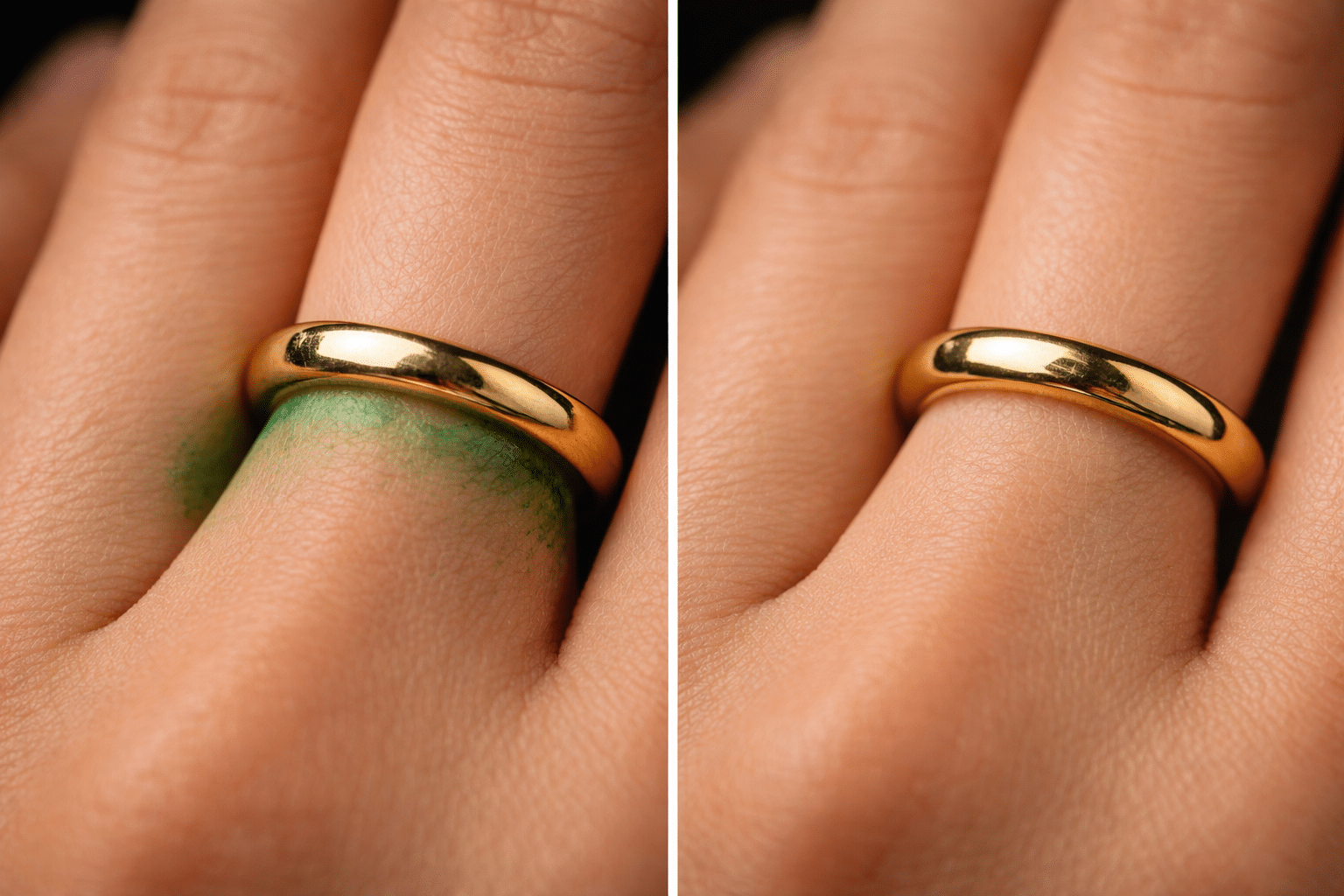
The green skin phenomenon highlights major quality differences between gold jewelry types.
Green Skin Factor | Gold-plated | Gold-filled |
Likelihood of Green Skin | Common | Rare |
Timeline to First Reaction | Weeks to months | Years to decades (if ever) |
Cause | Thin gold is wearing through | Unusual, requires extensive wear-through |
Prevention Difficulty | High | Low |
Frequency of Occurrence | Increases with wear | Stays minimal throughout lifespan |
Affected Body Areas | All contact points | Rarely any areas |
Gold-filled jewelry rarely causes green discoloration because the thick gold layer (50-100+ microns) maintains separation between copper-containing base metals and your skin throughout normal wear life. Learn how to tell gold-filled from gold-plated to avoid purchasing pieces prone to this problem.

Which Body Parts Turn Green Most Often?
Certain areas experience green discoloration more frequently due to wear patterns and moisture accumulation.
Fingers (From Rings)
Ring bands contact skin continuously while experiencing constant friction. Handwashing introduces moisture repeatedly throughout the day. This combination makes fingers the most common location for green discoloration from gold-plated jewelry.
The inside of the ring bands wears through fastest since that surface experiences the most friction and moisture exposure.
Wrists (From Bracelets and Watches)
Wrist jewelry traps moisture against the skin, especially during warm weather or physical activity. The underside of bracelets and watch bands commonly shows green transfer.
Tight-fitting pieces create more problems than loose ones; closer skin contact means more moisture trapping and friction.
Earlobes (From Earrings)
Earring posts and backs contact sensitive earlobe skin directly. Though earlobes experience less friction than fingers or wrists, the thin skin reacts quickly to exposed base metals.
People with pierced ears may notice green discoloration around the piercing holes where metal-to-skin contact remains constant.

Herringbone and rope chain layering set
Neck (From Necklaces)
Necklace chains and pendants resting against the chest or neck skin can cause green marks, particularly during exercise or in hot weather when sweating increases.
The back of the neck, where clasps rest, often shows discoloration first since clasps experience significant handling friction.
Is Green Skin from Jewelry Dangerous?

The green discoloration itself poses no health risk. Copper chloride, the compound causing green staining, washes off easily with soap and water and causes no lasting skin damage.
However, the reaction indicates potential concerns:
Allergic Reactions
While green discoloration alone proves harmless, some people develop actual allergic reactions to exposed base metals, particularly nickel, commonly found in gold-plated jewelry bases.
Nickel allergy symptoms include:
- Redness and inflammation beyond simple green staining
- Itching or burning sensations
- Rash or bumpy skin texture
- Blistering in severe cases
These symptoms indicate a true allergic response requiring you to stop wearing the offending piece immediately.

Classic 14K gold chain bracelets
Infection Risk (Earrings)
Earrings causing reactions in pierced ears create potential infection pathways. Irritated piercing sites become vulnerable to bacterial infection if wearing problematic jewelry continues.
If earrings cause green discoloration plus pain, swelling, or discharge, discontinue wear and consider medical evaluation.
Price differences in gold jewelry often stem from how each piece is made. This overview on gold-filled versus gold-plated jewelry explains the cost gap in practical terms.
You have seen gold-filled jewelry priced at $75-$150 while similar-looking gold-plated pieces cost $15-$30. That price gap makes you wonder: Is gold-filled jewelry actually worth the extra money, or are you paying for marketing hype?
This question deserves a straight answer. Gold-filled jewelry costs more because it contains significantly more real gold, and that difference translates directly into years of additional wear. For daily jewelry, gold-filled delivers genuine value. For occasional pieces, cheaper alternatives may suffice.
Classic 14K gold chain bracelets
Juli “Jewels” Church, Certified Diamondologist at LearningJewelry.com, addresses this question constantly: “I tell customers to think about cost-per-wear rather than purchase price. A $100 gold-filled bracelet worn 500 times over ten years costs $0.20 per wear. A $25 gold-plated bracelet, replaced annually after 50 wears, costs $0.50 per wear. Gold-filled wins the value calculation for anything you wear regularly.”
What Makes Gold-filled Jewelry Different?
Understanding gold-filled construction explains why it commands higher prices and delivers better value.
Gold-filled jewelry contains a thick layer of real karat gold (typically 12K or 14K) mechanically bonded to a base metal core using heat and pressure. By federal regulation, gold-filled pieces must contain at least 5% gold by total weight.

Everyday 14K gold bracelet styles
How to Prevent Green Skin from Gold-plated Jewelry
Several strategies reduce green discoloration likelihood, though none eliminate the underlying problem of thin gold plating wearing through.
Clear Nail Polish Coating
Applying clear nail polish to interior jewelry surfaces creates a barrier between the base metal and the skin. This temporary solution requires reapplication every few wears as the polish chips away.
Application method:
- Clean jewelry thoroughly and dry completely
- Apply a thin coat of clear nail polish to skin-contact surfaces
- Allow to dry fully before wearing
- Reapply when discoloration returns
Keep Jewelry Dry
Moisture accelerates the chemical reaction, causing green skin. Removing gold-plated jewelry before activities that cause sweating helps significantly.
Remove pieces before:
- Exercise and sports
- Showering or swimming
- Sleeping (nighttime sweating)
- Hot weather outdoor activities
- Stressful situations cause nervous sweating

Delicate everyday gold bracelet with a clean finish
Apply Jewelry to Clean, Dry Skin
Lotions, perfumes, and other body products can accelerate base metal reactions. Apply all products first, allow complete absorption, then add jewelry to clean, dry skin.
Rotate Jewelry Frequently
Giving skin breaks between wearings allows any minor reactions to resolve. Rotating between multiple pieces prevents continuous exposure to any single item.
Choose Higher Quality Pieces
Thicker gold plating lasts longer before wearing through. Vermeil (gold over sterling silver) eliminates copper-based green reactions entirely, though other tarnishing may occur.
Ultimately, switching to gold-filled jewelry solves the green skin problem permanently for regular-wear pieces.

Elegant huggie earrings with a subtle diamond drop
Removing Green Stains from Skin
Green discoloration removes easily with simple cleaning.
Basic Soap and Water
Most green staining washes away with regular hand soap and warm water. Gentle scrubbing removes surface deposits quickly.
Makeup Remover
Stubborn staining responds well to oil-based makeup removers. Apply, let sit briefly, then wipe away.
Rubbing Alcohol
Isopropyl alcohol dissolves copper compounds effectively. Apply with a cotton ball, wipe clean, then wash with soap and water.
Lemon Juice
Natural acid in lemon juice helps break down copper deposits. Apply, wait a few minutes, scrub gently, and rinse thoroughly.
Baking Soda Paste
Mix baking soda with water to create a paste. Apply to the stained area, scrub gently, rinse clean. The mild abrasiveness helps remove stubborn discoloration.

Case Study: Rachel’s Green Skin Solution
Rachel, a 31-year-old nurse from Atlanta, dealt with persistent green skin issues:
“My job requires constant handwashing, sometimes 50+ times per shift. Every gold-plated ring I tried turned my finger green within a week or two. I went through five different rings in one year, thinking I just had bad luck with jewelry.
Research revealed the problem: constant moisture exposure was destroying thin gold plating rapidly, and my slightly acidic body chemistry accelerated copper reactions once base metal became exposed.
I tried the nail polish trick. It helped briefly, but reapplying every few days proved impractical with my schedule. I tried wearing rings only on days off, but that defeated the purpose of having jewelry I loved.
Finally, I invested $75 in a gold-filled ring. That was three years ago. Same demanding work environment, same constant handwashing, same body chemistry, and zero green skin. Ever.
The thick gold layer in gold-filled construction handles moisture exposure that destroys gold-plated pieces within days. My gold-filled ring still looks beautiful after thousands of hand washings.
For anyone dealing with chronic green skin from jewelry, gold-filled eliminates the problem entirely. The extra cost pays for itself by actually solving the issue rather than requiring constant replacement and frustration.”

When Green Skin Signals Time for Better Jewelry
Persistent green discoloration indicates your gold-plated jewelry no longer functions as intended. The protective gold layer has failed, and no amount of nail polish barriers or careful wearing habits truly solves the underlying problem.
Consider upgrading to gold-filled when:
- Multiple gold-plated pieces cause green reactions
- Green staining appears within weeks of purchasing new pieces
- Your body chemistry consistently attacks thin gold plating
- You want daily-wear jewelry without constant maintenance
- Skin sensitivity makes base metal exposure uncomfortable
Proper care for gold-plated jewelry extends its functional lifespan, but cannot prevent eventual wear-through that causes green skin reactions.
Video Resource of: does gold-plated jewelry turn green
For a visual explanation of why jewelry turns skin green: