

L color diamonds sit in the middle of the faint color category on the diamond color scale, displaying warmth that most observers readily notice. These diamonds carry a visible yellow or brown tint that becomes part of their character, a soft, honeyed glow that appeals to buyers who appreciate vintage aesthetics or prioritize carat weight over colorlessness.
The faint color category spans K, L, and M grades. L color occupies the middle position, showing more pronounced warmth than K color diamonds while remaining less tinted than M color. For buyers who embrace warmth as a feature rather than a flaw, L color offers substantial value.
At LearningJewelry.com, our Certified Diamondologist Juli “Jewels” Church has observed varied reactions to L color during her six years at Kay and Zales: “L color diamonds polarize buyers. Some see the warmth and feel disappointed, they expected white and got golden. Others light up because it reminds them of their grandmother’s ring or antique pieces they love. L color suits specific tastes perfectly, but requires honest expectations. These diamonds are warm, and that warmth is visible.”
Understanding what L color actually looks like, and who genuinely appreciates it, helps you decide whether this faint color grade matches your preferences.
What Makes a Diamond L Color?
L color indicates a diamond graded as faint color by gemological laboratories, positioned in the middle of that category on the GIA scale. The faint color range includes K, L, and M, with L representing the moderate warmth option within this group.
Diamond color results from nitrogen atoms trapped within the crystal structure during formation. These nitrogen molecules absorb blue light, producing yellow or brown tints. L color diamonds contain enough nitrogen to create warmth that observers notice immediately, not subtle warmth requiring comparison, but a visible tint that defines the diamond’s appearance.
During grading, gemologists examine diamonds face-down against master comparison stones under standardized lighting. L color diamonds show clear warmth in this process, warmth that remains apparent when diamonds are mounted and viewed under any normal conditions.
| Category | Grades | Visual Characteristics |
| Colorless | D, E, F | Icy white, no tint |
| Near Colorless | G, H, I, J | White to slightly warm |
| Faint | K, L, M | Obvious warm tint |
| Very Light | N–R | Pronounced yellow/brown |
L color diamonds display warmth that cannot be hidden through strategic choices. Unlike near colorless grades where metal and shape selection minimize visible tint, L color’s warmth remains part of the diamond’s identity regardless of setting.
L color Compared to Adjacent Grades
Understanding how L color relates to neighboring grades clarifies its position on the spectrum.
L color vs K Color

K color sits one grade above L within the faint color category. Both grades display visible warmth, though K color shows slightly less pronounced tint than L color.
The difference between K and L is moderate, noticeable under direct comparison but not dramatic. Both grades benefit from yellow gold settings and brilliant cuts. Buyers who accept K color’s warmth will likely accept L color as well.
Price difference: L color costs 5-10% less than K color.
L color vs M Color
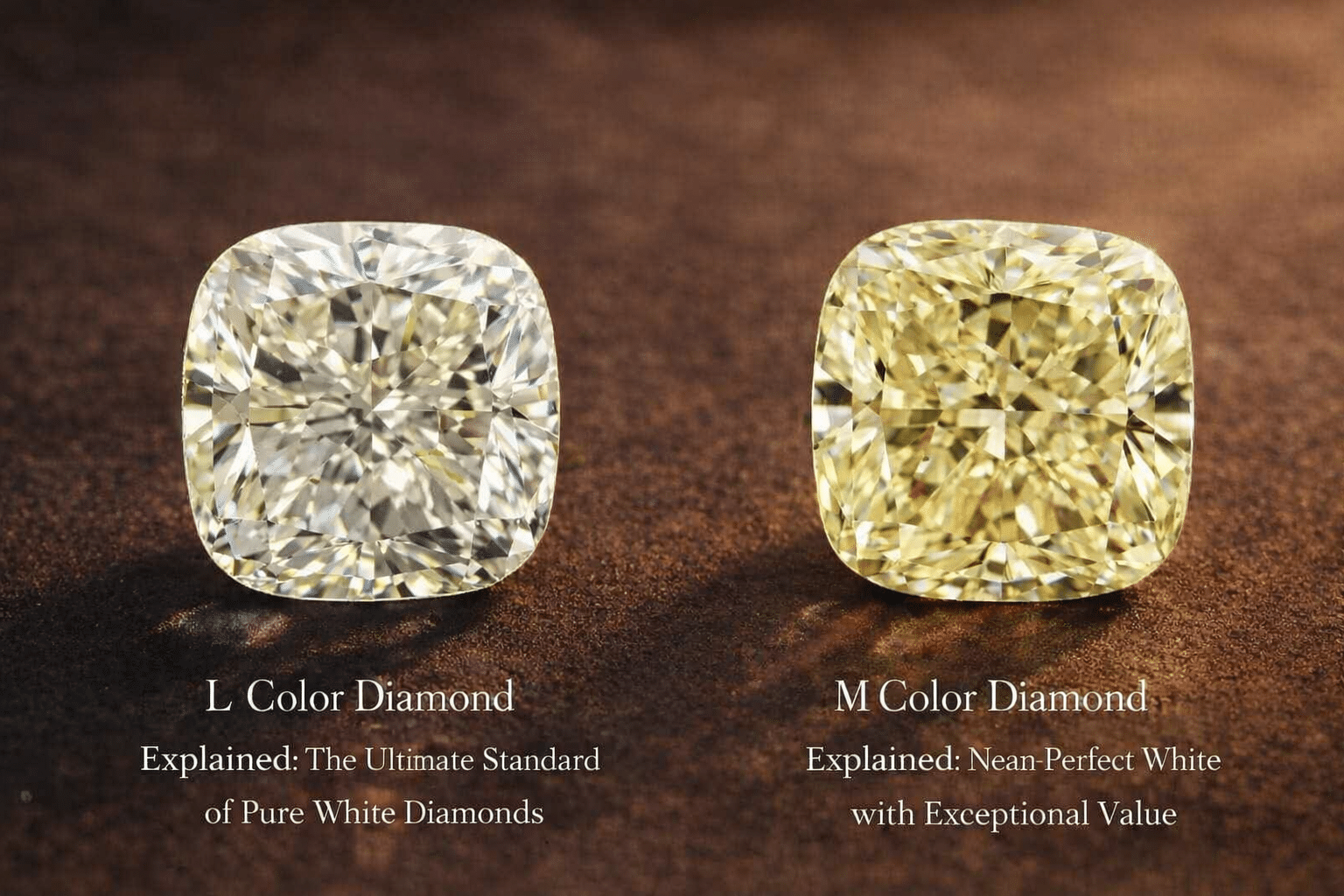
M color diamonds fall one grade below L, representing the warmest option in the faint color category before diamonds transition into very light color territory.
M color shows more pronounced warmth than L color. The step from L to M is noticeable, with M color appearing definitively yellow to most observers. L color maintains slightly more subtlety while still displaying obvious warmth.
Price difference: M color costs 5-10% less than L color.
L color vs H Color

H color represents a comfortable middle position within the near colorless range. The gap between L and H spans four grades, crossing from faint color into near colorless territory.
The visual difference is substantial. H color appears white in most settings with minimal detectable warmth. L color shows obvious warmth that defines its appearance. However, the dramatic price difference makes L color attractive for buyers who embrace warm aesthetics.
Price difference: L color costs 35-45% less than H color.
| Comparison | Visual Difference | Price Savings | Practical Assessment |
| L vs K | Moderate within the faint category | 5-10% | Both show visible warmth |
| L vs M | Noticeable | 5-10% | L is slightly less tinted |
| L vs H | Substantial | 35-45% | L trades whiteness for size |
L color Diamond Pricing
L color diamonds occupy a highly affordable price point that enables significant carat weight increases compared to near colorless or colorless grades.
Typical Price Ranges (VS2 Clarity, Excellent Cut)
| Carat Weight | L color Price Range |
| 0.50ct | $650 – $1,400 |
| 1.00ct | $1,700 – $3,200 |
| 1.50ct | $3,200 – $7,000 |
| 2.00ct | $6,000 – $12,000 |
Multiple factors beyond color affect final pricing: diamond shape, certification laboratory, fluorescence, and retailer type all influence cost. Round brilliant cuts command premiums over fancy shapes.
Lab-Grown L color Diamonds
Lab-created L color diamonds offer 60-80% savings compared to natural equivalents. A 1-carat lab-grown L color might cost $350-$800 versus $1,700-$3,200 for natural.
Laboratory environments typically produce higher color grades, making L color lab diamonds less common than colorless options. However, budget-focused retailers stock L color lab diamonds for buyers seeking maximum size at minimum cost.
When L color Makes Sense
L color delivers genuine value for specific buyer profiles and aesthetic preferences.
Vintage Aesthetic Appreciation: L color’s warmth authentically replicates antique diamond appearance. Historic jewelry frequently featured warmer stones, making L color ideal for vintage-inspired designs or matching heirloom pieces.
Yellow Gold Settings: Optimal pairing for L color. Yellow gold’s warm tones harmonize with the diamond’s warmth, creating a cohesive appearance. The metal makes L color appear lighter by providing a complementary rather than a contrasting background.
Rose Gold Settings: Similar benefits to yellow gold. Rose gold’s pink-warm tones complement L color effectively, enhancing vintage or romantic aesthetics.
Maximum Carat Weight Priority: Buyers who want the largest possible diamond find L color compelling. The 35-45% savings compared to H color can fund dramatic size increases, potentially doubling carat weight within the same budget.
Warm color Preference: Some buyers genuinely prefer warmer diamond tones. If colorless diamonds appear cold or clinical to you, L color’s golden glow may feel more appealing and personal.
Budget-Focused Purchases: L color offers real diamond beauty at prices that make substantial stones accessible. For buyers where visual impact matters more than technical colorlessness, L color delivers impressive size.
When Higher Grades Serve Better
Certain situations benefit from K color or above rather than L color.
White Metal Settings: Platinum and white gold create stark contrast against L color’s warmth, making the tint more pronounced and potentially unflattering. If white metal is non-negotiable, consider near colorless grades instead.
Traditional White Diamond Expectations: If your partner or recipient expects a classic white diamond appearance, L color will likely disappoint. Understand preferences before committing to faint color grades.
Color-Sensitive Perception: Some people perceive warmth as “yellow” rather than “warm glow.” If L color looks problematically yellow rather than charmingly warm to you, higher grades will satisfy your preferences better.
Step-Cut Shapes: Emerald and Asscher cuts display body color prominently due to large, open facets. L color in step cuts shows warmth that dominates the diamond’s appearance, generally unflattering regardless of metal choice.
Larger Diamonds Above 1.5 Carats: Body color intensifies with size. L color in diamonds above 1.5 carats displays pronounced warmth that may overwhelm other qualities. Consider K color for large diamonds if you want to moderate visible tint.
Case Study: Thomas’s Heirloom Recreation
Thomas, a 42-year-old history professor from Boston, wanted an engagement ring that honored his late grandmother’s ring, a warm-toned diamond in yellow gold that had been lost years earlier in a house fire.
“My grandmother’s ring had this beautiful, warm glow. Family photos show it clearly, definitely not a modern icy-white diamond. When I started shopping, colorless diamonds looked wrong. Too cold. Too modern. Not what I remembered.”
Thomas researched diamond color extensively and determined his grandmother’s diamond was likely L or M color based on the era it was purchased (1940s) and its appearance in photographs.
“I wasn’t trying to hide warmth, I was trying to find it. The jeweler at Blue Nile understood immediately when I explained. Most people want to minimize color. I wanted to maximize it within reason.”
He purchased a 1.28-carat L color, VS2 clarity, excellent cut round brilliant in 14k yellow gold with an antique-style cathedral setting for $3,600. When Thomas proposed, his fiancée, who had heard stories about his grandmother’s ring, immediately recognized the intentional aesthetic connection. The ring now carries multigenerational emotional significance.
Diamond Shape and L Color
Different cuts interact with color differently, making shape selection important for L color diamonds.
Shapes Where L color Works Best:
- Round brilliant, exceptional light return creates sparkle that makes warmth appear intentional
- Cushion brilliant, strong sparkle reduces harsh color perception
Shapes Requiring Caution:
- Princess cut, can concentrate color in corners
- Oval reveals warmth throughout, only for warm aesthetic enthusiasts
- Pear and Marquise, pointed ends display color noticeably
- Emerald and Asscher, step-cut facets reveal warmth prominently; avoid L color entirely
For L color diamonds, round brilliant shapes in yellow gold represent the optimal combination. This pairing embraces warmth as a feature while maximizing sparkle.
Making L color Appear Its Best
Several strategies help L color diamonds look their warmest and most appealing.
Embrace Yellow or Rose Gold: Rather than fighting L color’s warmth, complement it. Warm metals harmonize with the diamond, creating cohesive vintage appeal that looks intentional rather than deficient.
Prioritize Excellent Cut: Superior cut grades create sparkle that makes L color’s warmth appear as a glow rather than dullness. Cut quality matters enormously for faint color grades.
Consider Strong Blue Fluorescence: Medium to strong blue fluorescence can counteract yellow tint in daylight, potentially making L color appear lighter. This effect works particularly well for faint color grades; fluorescence that might create haziness in colorless diamonds often benefits L color significantly.
Choose Round Brilliant Shapes: Maximum light return in well-cut rounds creates brilliance that makes warmth appear intentional and attractive.
Use Complementary Colored Gemstones: Halo settings with colored gemstones (sapphires, rubies, emeralds) draw attention away from the diamond’s warmth while adding visual interest. The contrast makes L color appear lighter by comparison.
Where to Buy L Color Diamonds
L color diamonds are available from reputable retailers, though inventory may be smaller than near colorless grades.
James Allen carries L color inventory with 360-degree HD video showing actual warmth levels. Their imaging reveals how L color appears in reality, helping set accurate expectations before purchase.
Blue Nile offers L color options with competitive pricing. Their search filters help identify L color diamonds with blue fluorescence that may enhance appearance.
Brilliant Earth provides L color options in both natural and lab-grown diamonds with ethical sourcing.
Ritani enables diamonds to be sent to local jewelers for in-person inspection. Seeing L color warmth in person confirms whether you find the tint appealing before committing.
Helzberg Diamonds offers brick-and-mortar locations for viewing L color in various metal settings. Comparing L color in yellow gold versus white gold demonstrates dramatically how metal choice affects appearance.
Is L Color Right for You?
L color diamonds offer a distinct proposition: visibly warm diamonds at prices enabling dramatic carat weight increases. Whether this trade-off appeals depends entirely on your aesthetic preferences and honest assessment of what you find beautiful.
The diamond color grades across the faint range suit buyers who appreciate warm tones, vintage aesthetics, or maximum size within budget constraints. L color’s warmth becomes a feature when paired with yellow gold and round brilliant cuts, a vintage charm rather than a deficiency.
Consider K color if you want a faint color with slightly less pronounced warmth. Consider M color if additional savings matter, and you embrace an even more obvious tint. For buyers who see L color’s golden glow as beautiful rather than problematic, these diamonds deliver remarkable value and distinctive character.
Video Resource
For visual comparison of L color against K and M grades:
Frequently Asked Questions
What is an L color diamond?
L color indicates a diamond graded as faint color, the middle position within that category on the GIA scale. L color diamonds display warmth that most observers readily notice. The yellow or brown tint becomes part of the diamond’s character rather than a subtle undertone.
Do L color diamonds look yellow?
L color diamonds show visible warmth that appears as a yellow or golden tint. In yellow gold settings, L color can appear lighter and more harmonious. In white metals, warmth becomes more pronounced and potentially problematic for buyers expecting a white appearance.
Is L color good for an engagement ring?
L color can work for engagement rings when the wearer appreciates warm, vintage aesthetics. In yellow gold with round brilliant cuts, L color creates a charming antique-inspired appearance. However, if traditional white diamond expectations exist, L color will likely disappoint.
What setting works best for L color diamonds?
Yellow gold and rose gold settings work optimally with L color. Warm metals complement the diamond’s warmth, creating a harmonious vintage appearance. White gold and platinum reveal L color’s warmth starkly, suitable only if you embrace obvious warm aesthetics.
How much does an L color diamond cost?
A 1-carat L color diamond with VS2 clarity and excellent cut typically ranges from $1,700-$3,200 for natural stones. Lab-grown L color diamonds of equivalent quality cost $350-$800, representing substantial savings with identical grading classification.
Can L color diamonds look whiter?
Yellow gold settings make L color appear lighter by providing a warm background. Strong blue fluorescence can counteract a yellow tint in daylight. However, L color will show visible warmth regardless; these strategies improve appearance but cannot make L color appear colorless.