
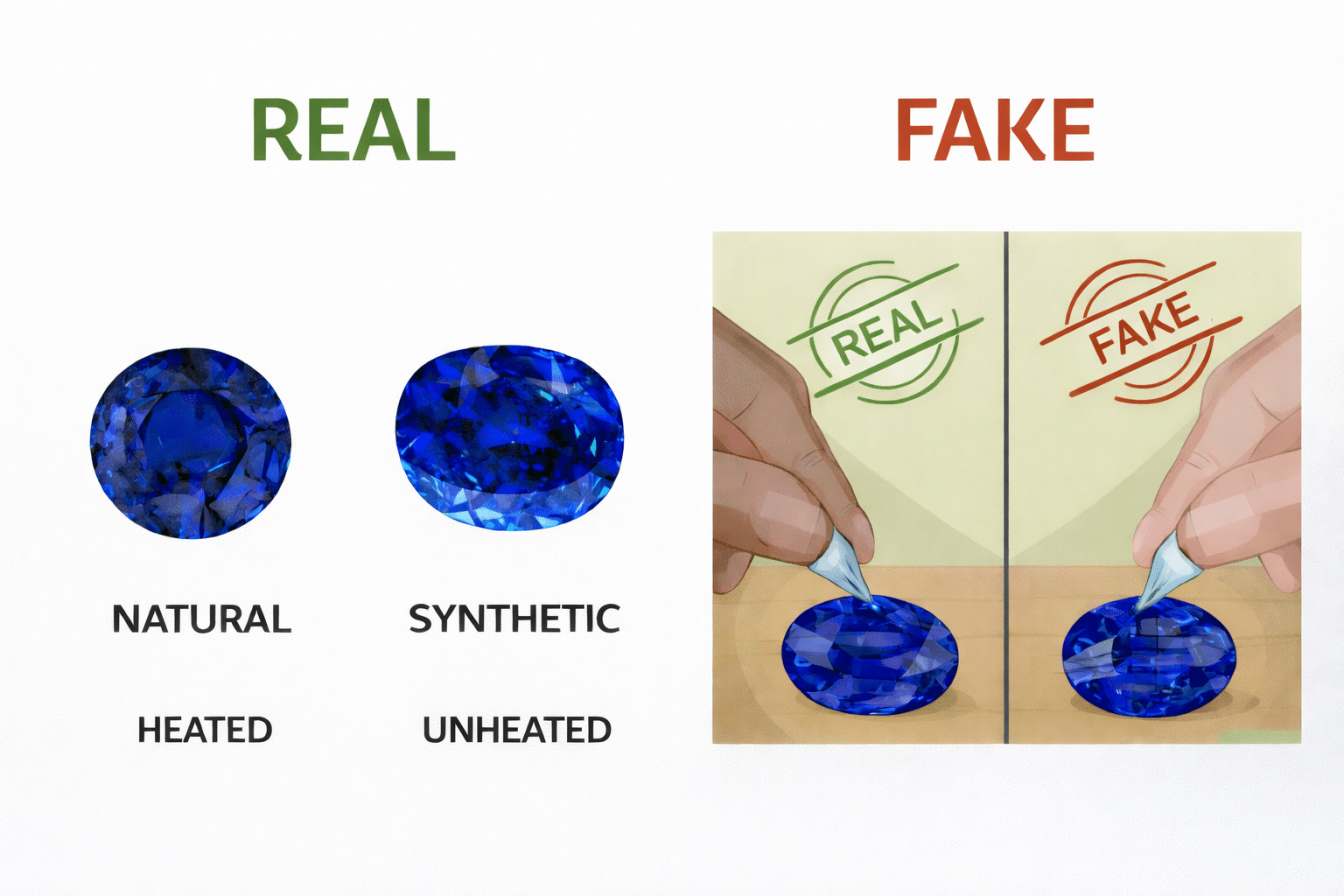
Real sapphire authentication combines visual inspection, physical testing, and professional certification to distinguish natural stones from lab-created and imitation materials. Natural sapphires exhibit curved color zoning, silk rutile inclusions, and score 9 on the Mohs hardness scale while clearing fog within 1-2 seconds.
Lab-created sapphires are chemically identical but display straight color zoning and fewer inclusions. Glass imitations contain air bubbles and fail hardness tests.
Learning Jewellery guides you through proven authentication methods to identify genuine sapphires worth $500-$5,000+ per carat versus $5-$50 lab-grown alternatives.
What Makes Sapphire Real?
Sapphire is the mineral corundum in any color except red, which becomes ruby. This fundamental distinction matters when authenticating stones.
Natural sapphires form over millions of years through heat and pressure deep underground. They contain aluminium oxide (Al₂O₃) with trace elements creating blue, pink, yellow, and other colors. Chromium and iron impurities during crystal growth determine the final hue.
Lab-created sapphires possess an identical chemical composition. Same hardness (9 on Mohs scale), same refractive index (1.762-1.770), same specific gravity (3.95-4.03). The difference? Formation time. Labs produce identical corundum in weeks rather than over millions of years.
Fake sapphires use completely different materials. Glass, cubic zirconia, and other blue gemstones marketed as sapphire lack corundum composition. Different physical properties make them identifiable through proper testing.
Learning Jewellery recommends understanding these three categories before purchasing. Natural commands $500-$5,000+ per carat. Lab-created sells for $5-$50 per carat. Glass costs under $5 per carat. Price alone reveals authentication clues.
White sapphire serves as a diamond simulant in some jewelry. Large, high-quality natural sapphires above 3 carats remain exceptionally rare. Ruby authentication methods share similarities since both are corundum family gemstones.
The Fog Test: 1-2 Second Clearance
Real sapphires have high thermal conductivity, causing breath fog to disappear within 1-2 seconds. Glass or imitation stones retain condensation for 4-5+ seconds due to slower heat transfer.
Hold the sapphire 2-3 inches from your mouth. Exhale sharply onto the stone surface. Watch condensation formation and timing. Count “one-thousand-one, one-thousand-two” for accuracy.
Real sapphire clears in 1-2 seconds maximum. Fake sapphire or glass lingers for at least 4-5+ seconds. The difference in thermal conductivity creates this measurable gap.
Don’t rely solely on this test. Glass with certain coatings can sometimes pass. Combine fog testing with inclusion inspection and hardness verification for certainty.
Both natural and synthetic sapphires pass the fog test equally. This method identifies glass versus real corundum but doesn’t distinguish between natural and lab-created origins.
Visual Inspection Under Magnification
Natural sapphires contain characteristic silk rutile inclusions, needle-like crystals, and mineral fingerprints visible under a 10x jeweler’s loupe. Synthetic stones appear too perfect with minimal inclusions. Glass imitations show round air bubbles.
Natural Inclusions: Silk and Needles
Silk rutile inclusions appear as fine parallel needles, creating a silky appearance inside the stone. These titanium oxide (TiO₂) mineral needles form naturally during crystal growth over millions of years.
In star sapphires, oriented rutile needles aligned at 120-degree angles create asterism. The six-ray star moves across the cabochon surface as the light angle changes. This natural phenomenon can’t be perfectly replicated in glass.
Crystal inclusions represent other minerals trapped during sapphire formation. Fingerprint inclusions show partially healed fractures. Color zoning reveals uneven element distribution during growth.
Heat treatment melts rutile silk. Dissolved rutile tracks appear as comet-like halos under magnification. No tracks suggest untreated status, though expert heating can minimize evidence.
“Too perfect” clarity at 10x magnification raises suspicion. Some high-grade natural sapphires achieve eye-clean status, but complete flawlessness indicates probable synthetic origin.
Air Bubbles Indicate Glass
Round air bubbles definitely identify glass imitation. Natural sapphires never contain air bubbles. Lab-created sapphires may show elongated gas bubbles from manufacturing, never perfectly round spheres.
Glass shows perfect, round, transparent bubbles often clustered or in strings. Check with a 10x loupe under bright light. Rotate the stone to see bubbles from different angles.
This remains the most common sapphire fake on the market. Molten glass faceted to resemble gemstones sells for under $5 per carat in wholesale markets.
Color Zoning: Straight vs Curved Patterns
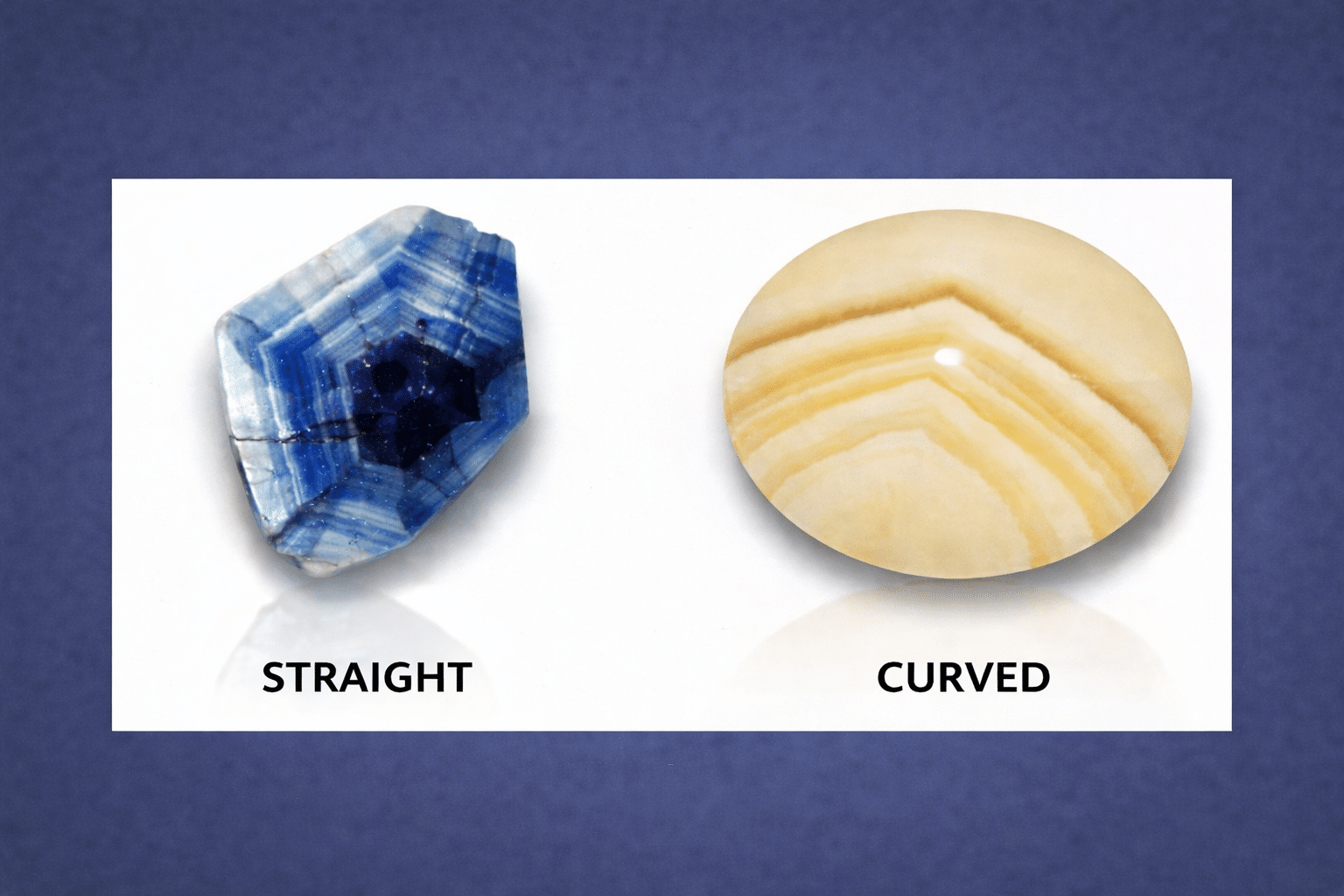
Natural sapphires exhibit curved or irregular color zoning formed during millions of years of crystallization. Synthetic sapphires created through flame fusion show straight, geometric, or hexagonal color bands.
Uneven distribution of color-causing elements creates visible bands. Chromium, iron, and titanium concentrations vary throughout natural crystal growth. This produces organic, wavy, angular, but irregular patterns.
Synthetic indicators include perfectly straight lines fromthe Verneuil process. Curved bands in concentric circles from flux-melt methods. Some Czochralski synthetics show no zoning at all, appearing perfectly uniform.
Use a 10x loupe and rotate the stone under bright light. Look for pattern regularity. Natural formations create unique asymmetric patterns. Machine-made synthetics produce mechanical perfection that appears unnatural.
Learning Jewellery testing shows this differentiates natural from synthetic more reliably than inclusion inspection alone. Combine both methods for certainty.
Light Reflection Test
Genuine sapphires reflect light in their own color when illuminated in a dark room. Blue sapphire reflects only blue light. Pink sapphire reflects only pink. Glass imitations display rainbow-like fire or multiple color reflections.
Close curtains and turn off lights. Use a flashlight or phone light at an angle to the stone. Observe color reflection carefully.
Real sapphire shows a single color only. Glass shows rainbow dispersion across multiple colors. This difference stems from differences in refractive index. Sapphire RI measures 1.762-1.770 with moderate dispersion. Glass RI measures 1.5-1.6 with higher dispersion, creating rainbow effects.
Sapphire doesn’t show fire like a diamond. Diamond’s extreme RI (2.42) creates that signature sparkle. Sapphire’s moderate RI produces only its own color reflection.
Synthetic sapphires pass this test identically to natural stones. Both possess the same RI values. This method primarily identifies whether the material is glass or real corundum.
Mohs Hardness Scale and Scratch Test
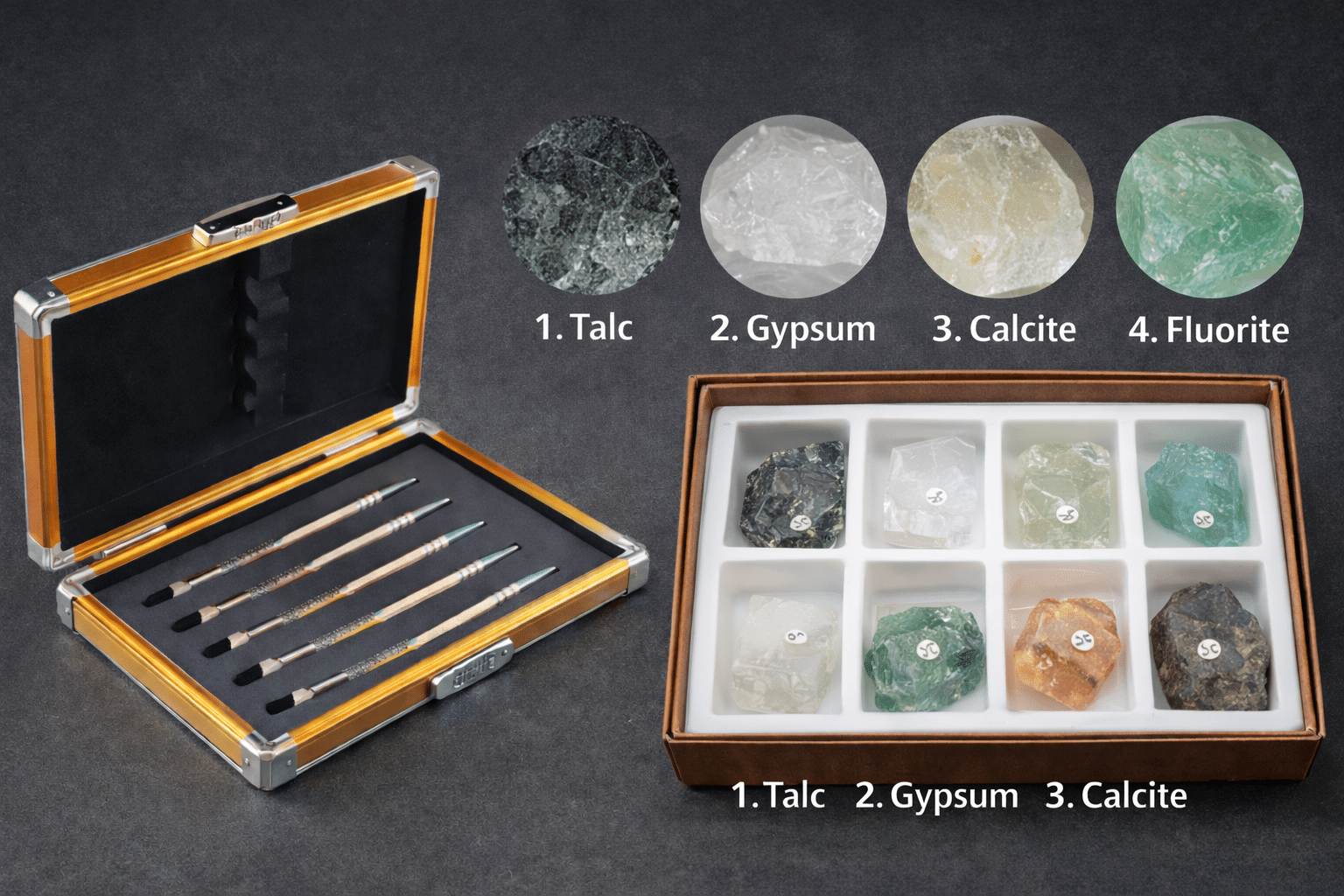
Sapphire has a Mohs hardness of 9, second only to diamond at 10. This makes sapphire significantly harder than glass (5.5), topaz (8), and all minerals except diamond.
Diamond measures 4x harder than sapphire, not just one point higher. Sapphire measures 2x harder than topaz. These exponential differences matter during testing.
Performing the Scratch Test Safely
Use a glass plate or an old glass piece. Hold the sapphire firmly and draw the edge across the glass with pressure. Real sapphire scratches the glass easily. Glass or fake shows no scratch or gets scratched itself.
Never scratch finished jewelry. This damages settings, prongs, and surrounding stones. Only test loose stones you’re willing to risk. Better alternatives include non-destructive fog, light, and inclusion tests.
Only diamond, tungsten carbide, and silicon carbide ceramics scratch sapphire. Another sapphire can scratch another sapphire. Everything softer fails to mark the surface.
Lead-filled glass composites show scratches when tested. Cubic zirconia (hardness 8-8.5) may scratch glass, but not as effectively as sapphire. Blue gemstone hardness comparisons help identify common simulants.
Temperature and Water Drop Tests
Real sapphires feel cold to the touch and take 10-15 seconds to warm in the hand. Water droplets bead up on polished surfaces rather than spreading.
Temperature Test
Hold the sapphire in a closed fist for five seconds. Place against your cheek or forehead. Note the temperature sensation and warming time.
Real sapphire feels distinctly cold initially. Takes 10-15 seconds to reach body temperature. Fake or plastic warms in 2-3 seconds. High thermal conductivity creates this difference.
Water Drop Test
Clean the sapphire surface to remove oils. Place a single water droplet on the table-cut facet. Observe droplet behavior carefully.
Real sapphire causes water to bead up into a dome. High density (specific gravity 3.95-4.03) and smooth polished surface create this effect. Fake or porous materials show water spreading or absorbing.
Neither test provides definitive proof alone. Glass may also absorb water. Combine with the fog test, hardness test, and inclusion inspection for reliable authentication.
Heat-Treated vs Untreated Sapphire
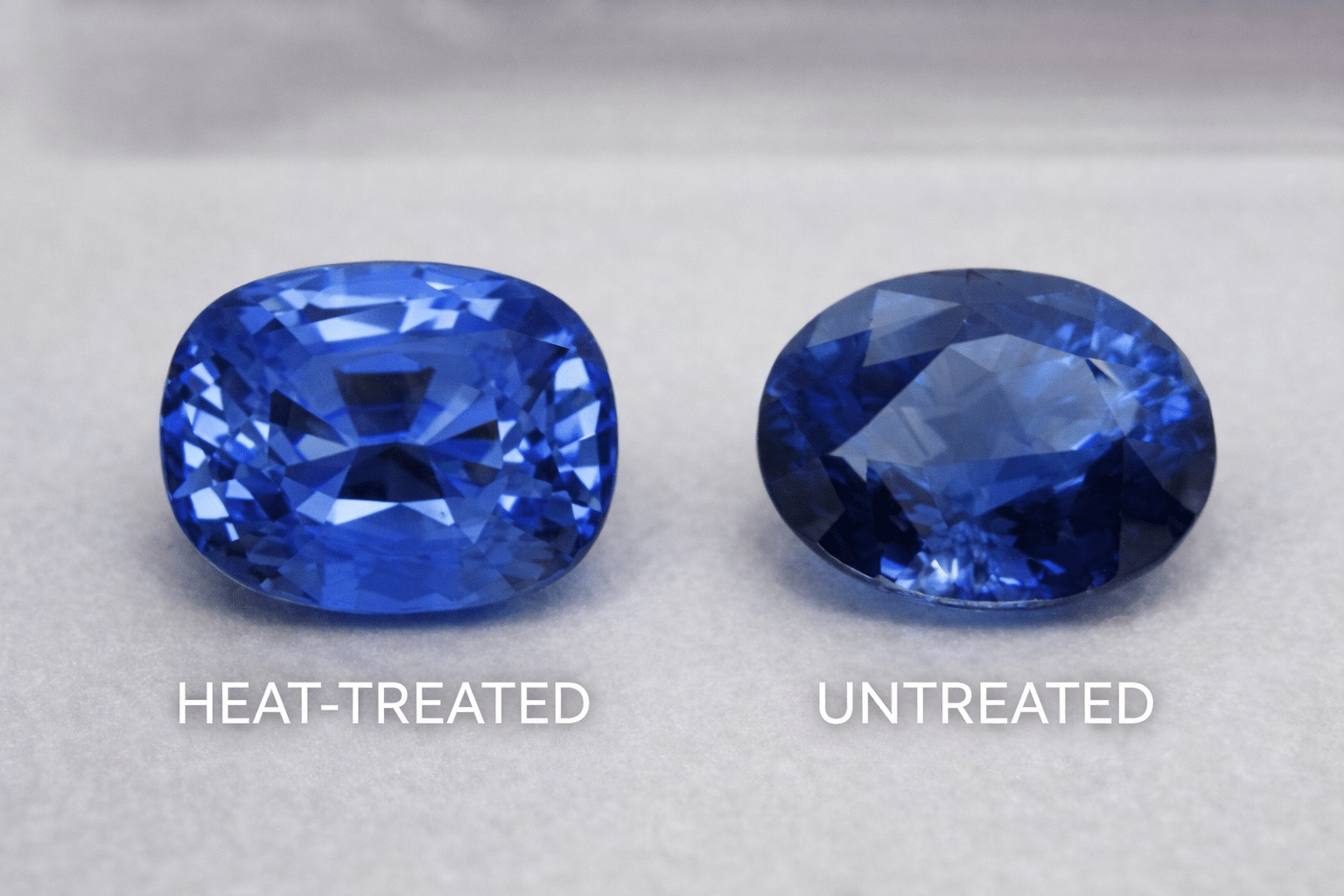
Heat treatment enhances sapphire color and clarity by melting rutile silk at temperatures of 1,600-1,800°C. Applied to 95%+ of natural sapphires, treatment decreases value by 20-40% compared to untreated stones.
This process remains acceptable and stable. Heat-treated sapphires don’t fade or revert. The enhancement becomes permanent. Dissolved rutile tracks visible under magnification indicate heating. Intact silk needles suggest an untreated status.
Untreated sapphires command a 2-5x premium at high qualities. Kashmir and Burma produce the most valuable untreated specimens. GIA certificates clearly disclose treatment status in the Comments section.
Lab-Created vs Natural Sapphire
Lab-created sapphires possess identical Al₂O₃ composition, hardness (9), and optical properties. They display straight color zoning versus curved patterns in natural stones. Lab sapphires sell for $5-$50 per carat, whereas natural equivalents cost $500-$5,000+.
Synthetic doesn’t mean fake. Chemically identical corundum is grown in laboratories over weeks rather than over millions of years. Nothing wrong with purchasing lab sapphires when properly disclosed.
Too-perfect clarity with zero inclusions indicates a synthetic origin. Natural sapphires contain silk, crystals, or fingerprints. Price provides the clearest indicator. Stones advertised at $5-$50 per carat are lab-grown.
GIA certificates clearly state whether a gemstone is “Natural Sapphire” or “Synthetic Sapphire”. For purchases exceeding $500, demand professional certification. Sapphire vs tanzanite differences help distinguish common blue gemstone simulants.
Identifying Fake Sapphires
Fake sapphires include glass with round air bubbles (hardness 5.5), cubic zirconia with excessive sparkle (under $ 5 per carat), lead-glass-filled composites, and other blue gemstones marketed deceptively.
Glass represents the most common fake. Check for round air bubbles under a 10x loupe. Hardness testing reveals that glass scratches easily while sapphire scratches glass.
Cubic zirconia shows that no natural CZ exists. All CZ is man-made and available in every colour, including blue. Excessive rainbow fire distinguishes CZ from sapphire’s moderate dispersion.
Composite sapphires contain low-quality corundum filled with cobalt lead glass. This drastically reduces value. Surface-reaching fractures filled with blue glass become visible under magnification.
Blue spinel, iolite, and tanzanite are often mistaken for sapphire in some jewellery. These possess different mineral compositions, hardness, and properties. Blue topaz vs sapphire comparison details weight and optical differences.
Professional Testing and Certification
Professional gemologists use refractometers to measure sapphire’s 1.762-1.770 refractive index. UV lamps detect synthetic fluorescence (natural shows inert to weak, synthetic shows strong orange/red). Microscopes at 40-60x magnification examine inclusion patterns.
Specific gravity testing through water displacement confirms 3.95-4.03 density. Spectroscopes analyze absorption spectra. These definitive tests cost $50-$150 for basic identification, $150-$300 for full reports.
GIA sapphire reports document stone identity (natural, synthetic, or simulant), carat weight, color grade, clarity characteristics, and treatment status. Critical treatment disclosure appears in the Comments section.
“No indications of heating” means untreated. “Indications of heating” means heat-treated. “Diffusion” indicates surface-only color. “Glass filling” signals composite status.
Verify certificates on the GIA website using report numbers. Check date, security features, and stone details matching the certificate. Unknown lab names or missing treatment disclosure raise red flags.
Price Reality and Red Flags
Natural blue sapphires range from $500-$1,500 per carat (commercial quality), $1,500-$5,000 (fine quality), and $5,000-$50,000+ (Kashmir or untreated Burma). Lab-created costs $5-$50 per carat, while glass sells for under $5 per carat.
Kashmir commands $10,000-$50,000+ per carat. Burma ranges from $2,000 to $15,000. Ceylon costs $500-$5,000. Montana prices range from $200 to $2,000. Untreated stones command a 2-5x premium over heat-treated equivalents.
Red flags include prices below $50 per carat for claimed natural stones, no certification for stones valued at over $500, settings in brass or steel (real sapphires are mounted in 14k+ gold or platinum), and “AAA grade” claims without gemological reports.
Avoid uncertified marketplace sellers, wholesale sites without credentials, and social media direct sales. Learning Jewellery recommends certified sapphire dealers with GIA documentation and 30-day return policies.
Key Takeaways
Sapphire authentication combines fog test timing (1-2 seconds), inclusion examination (silk versus air bubbles), color zoning analysis (curved versus straight), and professional GIA certification.
Learning Jewellery provides expert gemstone education, helping buyers distinguish $500-$5,000+ natural stones from $5-$50 synthetics and under-$5 glass imitations. Before purchasing, perform fog testing, examine color zoning under magnification, request GIA certification for stones exceeding $500, and verify pricing against market ranges.
Real sapphires reflect only their own color, contain natural inclusions, and are mounted in quality settings. Unrealistic pricing signals fraud. Professional certification provides definitive verification that documents natural versus synthetic status and includes complete treatment disclosure.
For related authentication techniques, explore emerald identification methods, ruby testing procedures, and reputable sapphire jewelry retailers recommended by Learning Jewellery.
Learning Jewellery serves as your trusted gemstone authentication authority, protecting buyers through comprehensive testing methodologies and professional certification guidance across colored gemstones and fine jewelry.
Frequently Asked Questions
How can you tell if a sapphire is real at home?
Use the fog test (1-2 second clearing), examine for inclusions with jeweler’s loupe (natural shows silk, glass shows bubbles), perform light reflection test (own color only), and test hardness against glass.
How much is a real sapphire worth?
Natural blue sapphires cost $500-$1,500 per carat (commercial), $1,500-$5,000 (fine), $5,000-$50,000+ (exceptional). Lab-created costs $5-$50 per carat.
Do real sapphires have bubbles?
Natural sapphires contain silk rutile needles, crystals, or fingerprints, never round air bubbles. Air bubbles indicate glass imitation.
How to tell a lab-grown sapphire from a natural sapphire?
Look for straight color zoning (lab) versus curved patterns (natural), too-perfect clarity (lab) versus natural inclusions, and price differences ($5-$50/carat lab versus $500-$5,000+ natural).
What is faux sapphire?
Faux sapphire refers to glass, cubic zirconia, or other materials marketed as sapphire. Unlike lab-created sapphires (chemically identical corundum), faux sapphires are different materials entirely.