
While there might be quite a few colorless gemstones that look diamonds, only a handful are actually sold and marketed as fake or faux diamonds.
Simulated and synthetic diamonds are common diamond alternatives because they look diamonds.
In this Learning Jewelry guide, we’ll go over the most popular types of fake diamonds you might run into within the fine jewelry industry.
Common Faux Diamond Types
White Sapphire
Sapphire isn’t usually the first gemstone that comes to mind when thinking about about fake diamonds. Sapphires are blue, right? Not quite. Sapphires come from the mineral corundum.
Every color of corundum is considered sapphire, except red. Red corundum is ruby.
Sapphires get their coloring from chemical impurities that have mixed with the corundum while forming. If no impurities are introduced, corundum remains colorless, also known as white sapphire.
In most jewelry stores or online retailers, white sapphire jewelry is a class all on its own. Natural white sapphire is very rare, so most everything you’ll find at a typical jewelry retailer is going to be lab created.
Lab grown white sapphires are incredibly affordable, making them a great gift idea for a new jewelry wearer, or even a child who wants to wear “diamonds”.
One of the cool things about white sapphire is that the price doesn’t really change in carat weight or size. Some retailers will measure sapphires in carats, but others will give the millimeter sizes. A round cut white sapphire measuring 6.5 mm is the equivalent of a 1 carat round sapphire.
To the average onlooker, white sapphires may be convincing as a real diamond. But if you look closely or have the two side by side, you’ll start to notice a couple differences. A natural diamond (lab created too) have a beautiful and sparkly brilliance. In a diamond, there is white light reflected through.
But in a white sapphire, the brilliance is more subtle and quiet, with silver light instead of white light refraction. When the light hits a white sapphire, it can look more silver than actually colorless. You’ll also know that white sapphires are usually eye-clean, with very little natural inclusions.
White sapphires do require some maintenance. They reach a 9 on the Mohs scale of mineral hardness. The hardness scale only tells us how scratch resistant a natural mineral is, not its durability or resistance to sharp blows.
Both mined diamonds and lab created diamonds alike reach a 10 on the mineral scale, making it the most scratch resistant mineral of all. Sapphires can get scratched, so make sure you’re cleaning and caring for your white sapphire.
Over time, white sapphires can be cloudy, due to a large amount of tiny scratches and dirt. The clouding of these stones is permanent and will have to be replaced.
This is why it’s important to clean white sapphire regularly.
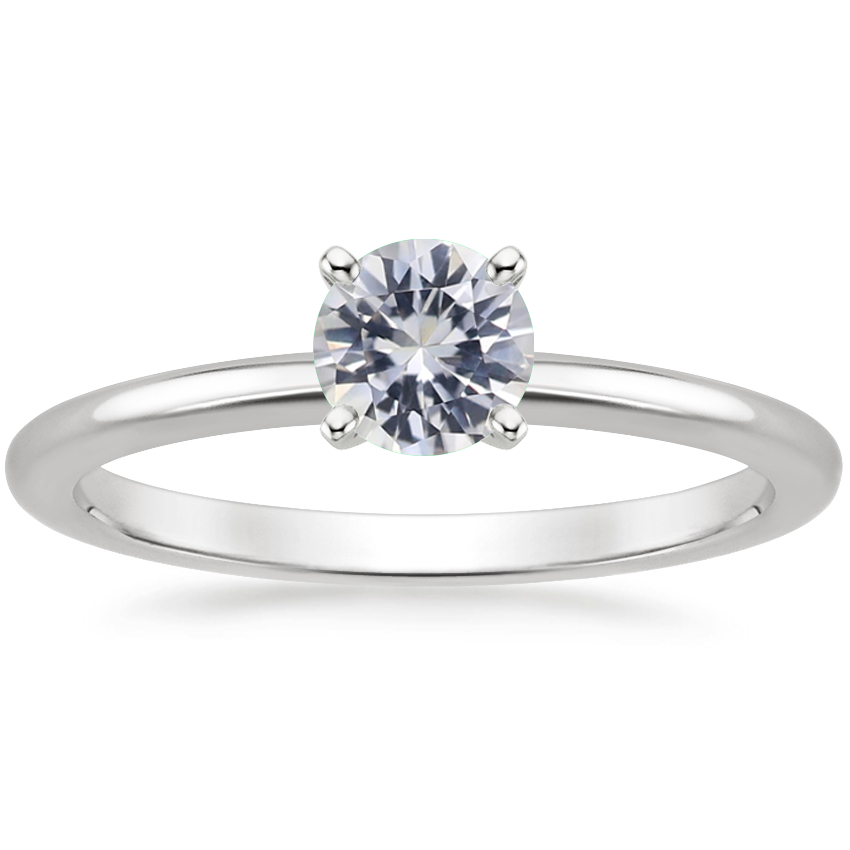
You’ll find great white sapphire rings in Brilliant Earth, and they look stunningly beautiful!
Cubic Zirconia
Cubic zirconia is usually what comes to mind when someone talks about fake or faux diamonds. Unlike other diamond simulants, it was intended to be an imitation diamond. Not only that, but…
CZ come in a variety colors, so they can simulate any colored gemstone.
If you’re going to get duped by a shady company with a fake diamond, it’ll most likely be cubic zirconia. Cubic zirconia is a completely man-made gemstone, really easy to make, and it’s super low cost. It’s the most common simulated diamond used in jewelry.
Read also: Cubic zirconia vs lab grown diamonds
When looking for genuine diamonds among places like Amazon or Etsy, make sure that you read entire descriptions. Some people throw a bunch of words like “white stone diamond” in the title and then you see the description and it says CZ or cubic zirconia.
If you put a diamond side by side with a cubic zirconia and really look at the way it sparkles in the light, you’ll notice the cubic zirconia has a high amount of dispersion.
Dispersion is what happens when white light passes through the stone and each of the colors go through it at different speeds and reflect separately out. That’s what causes the rainbow effect.
Gemstone dispersion is measured with a gemology tool called a refractometer.
The refractometer not only measures the rate of dispersion, but it can also tell you the refractive index of a gemstone. Knowing the refractive index of a stone can help a gemologist or jeweler distinguish a cubic zirconia from the real thing.
While diamonds refractive index is higher, the dispersion in lower compared to a diamond. A cubic zirconia has too much rainbow light next to a diamond.
It will also look very clear, where as you’ll most likely notice natural inclusions in a mined diamond. This isn’t a foolproof way of testing fake diamonds, because you can obtain eye clean diamonds from mines as well.

White Topaz
Topaz is another colored gemstone that comes in many different colors due to impurities while forming. And when no impurities are introduced to it, you have colorless topaz, more commonly known as white topaz.
White topaz is often used as a diamond substitute, but you’ll see it as accent stones rather than a center.
While a lot of diamond imitations have similar optical properties, topaz really can’t hold a candle to a diamond. There aren’t any real similarities when it comes to white topaz vs diamonds, only that they are colorless. You’ll find white topaz taking the place of pave stones or side stones, usually in sterling silver colored gemstone jewelry.
You won’t often see it as the center stone, except in birthstone jewelry. In order to keep April birthstone jewelry cost down, white topaz is usually subbed for diamond.
In most white gold, rose gold, and yellow gold gemstone jewelry, you’ll find companies use white sapphires as melee diamond imitations instead of white topaz. White topaz is usually used in cheaper gemstone jewelry that’s set in sterling silver.
The reason they use higher quality sapphires than topaz is because topaz doesn’t have great scratch resistance. On the Moh scale, topaz is an 8. You might think that 8 isn’t too far away from a diamond’s 10, but it’s a large different when it comes to mineral hardness. This is also another reason why you won’t see it as a centerstone very often.

Moissanite
Moissanite has become the most popular faux diamond. I’m hesitant to called moissanite a fake diamond, but in some circles, it can be. Moissanite is its own gemstone and is everyone’s favorite option when looking for a cheaper option to a diamond.
Natural moissanite is also rare, so you can expect that any moissanite for sale is lab-created. Gemologist believe that moissanite came from meteors to earth, thus giving itself the nickname Space Diamond.
Henri Moissan, the discoverer of moissanite initially thought he’d discovered a diamond in a huge crater in New York. But after further testing, he realized he’d uncovered a completely new gemstone altogether.
Unlike other non-diamonds, moissanite carries a heavier price tag. But it’s still nowhere near the cost of an eye clean diamond. Diamonds follow a grading system put forth by the GIA known as the 4Cs of Diamond Quality. These are four main factors that determine the overall quality of every diamond. They are cut, clarity, color, and carat.
Moissanite has its own grading, but it’s less complicated. Moissanite can come as it’s standard stone, it can be called Premium, and the highest quality moissanite is called Super Premium. Super premium moissanites have a color grade of DEF. Premium moissanites will have near colorless grades like GHI.
As far as inclusions go, every gemstone has inclusions of some sort, but you won’t see them in moissanite, except under a jewelers loupe or microscope. The best moissanite engagement rings will appear clearer than your average diamond, unless you’ve purchased VVS diamonds or even VS ones, which are of higher quality.
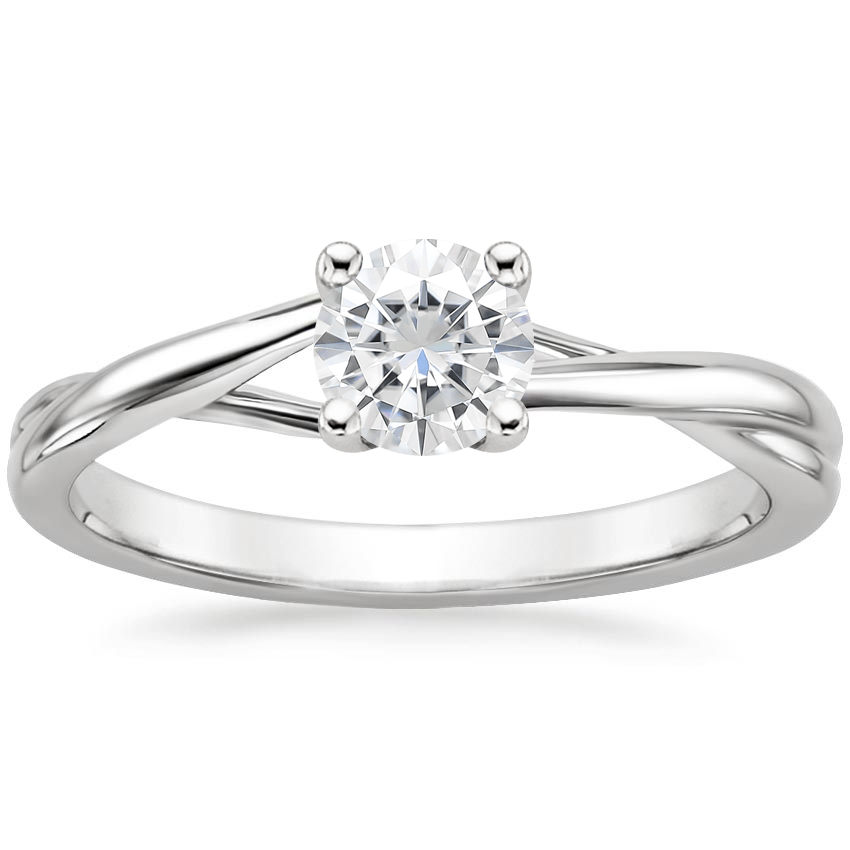
Like white sapphires, moissanite doesn’t increase greatly in cost as the carat weight or gemstone size gets bigger. It increases, but not the way a diamond would when you got up a carat size. With a diamond, the other grades have to go up with the carat weight, increasing the cost heavily. Check out this Grace Ring in Moissanite from Brilliant Earth.
You might be looking at those numbers and thinking they’re a bit expensive, closer to diamond prices. While that may be true, an eye-clean 1 carat natural diamond ring runs the average person about $5000.
It used to be said that sapphire was the second hardest mineral on the Mohs scale, so white sapphire made the most sense as a diamond substitute. But a moissanite actually reaches a 9.5 on the mineral scale, making it the second most scratch resistant.
The brilliance of a moissanite is similar to cubic zirconia, with lots of rainbow light. Moissanite can be considered too flashy for some, as its brilliance is often compared to that of a disco ball. It also becomes even more flashy in higher carat weights. And even though moissanite may be a colorless stone, in some lighting, it gives off a yellowish or brown tint, which isn’t something you can change.

Pros
- Make excellent gifts
- Keep adding on
- Removable charms
Cons
- Known to snag on fabrics
- Noisy
Zircon
Zircon is another gemstone that comes in a variety of colors, and its own colorless version called white zircon. Zircon is the black sheep of diamond substitutes because its reputation as a colored gemstone has been besmirched by cubic zirconia. Just because the word “zircon” is part of the word zirconia doesn’t make it the same stone. The two have entirely different physical and chemical compositions.
Zircon is actually the world’s first diamond imitation gemstone, and it was much more popular in early times than it is today. In fact, you may have difficulty finding white zircon jewelry as cubic zirconia products usually come up. But they are out there, usually in places like Amazon, Ebay, or Etsy.
Even though zircon’s taken a bit of a backseat to other fake diamonds like moissanite, white sapphire, and cubic zirconia, it still has the closest optical properties to a mined or synthetic diamond.
One of the key differences in the brilliance however, is that zircon has double refraction. Double refraction is when a ray of light going through a gemstone bends, slows, and splits before reflecting out of the gemstone in different directions. Double refraction can also be called birefringence. Be wary though, because birefringence can cause a clear stone to look fuzzy, so make sure you’re okay with the way the light hits the stone.
You won’t usually find white zircons as a large centerstone, but more as accent diamonds or even used as if they were rhinestones or crystals in small pieces, like children’s jewelry. October birthstone jewelry usually had rose zircon instead of opal. Small zircons are pretty cheap, usually costing $45-$400 per carat. You start getting into the higher prices when you start looking for the larger white zircons.

Spinel
If you’re seeking out spinel, it’s not usually the colorless version, also known as white spinel. But the truth is, this particular gemstone isn’t usually sought after anyway. Before the 19th and 20th century, most spinel was identified as corundum sapphire, but it was a different stone entirely.
Spinels are more often used to simulate colored gemstones in birthstone jewelry, children’s jewelry, and class rings, than to simulate a diamond with a white spinel. Unlike a lot of diamond imitations, white spinel is usually natural and doesn’t undergo any treatments.
White spinel is incredibly hard to find and cost will increase if you happen to find larger ones. Typically, colored spinels can cost upwards of a thousand dollars, but that’s due to their coloring. White spinel is just considered rare because spinels are almost always colored.
On the hardness scale, white spinel reaches the same scratch resistance as a cubic zirconia, which is an 8. However, cubic zirconias are used more often because they’re cheaper and in abundance.
Rutile
Rutile is another less common type of fake diamond, but it should be mentioned. However, unlike a lot of diamond imitations, you should be able to identify this stone from a real diamonds, whether you have any experience in diamonds or not.
When diamonds were first discovered, they weren’t cut very well, so they didn’t appear as clear and as brilliant as they do today. Back then, synthetic rutile was an early simulant in the 1940s.
Even though Marcel Tolkowsky brought us the perfect ideal cut diamond, only the extremely wealthy were able to afford such high quality diamonds. Other diamonds paled in comparison. That’s what made rutile a worthy imitation.
But now that we’ve perfected diamond cutting and optimizing the stone for its best brilliance, diamonds have left poor rutile in the dust. Now when compared, rutile stones look incredibly cloudy and yellowish.
Finding rutile as a diamond simulant today is unheard of. Most people known and appreciate rutile as a type of inclusion rather than a gemstone itself. Rutiled quartz is among the most fascinating jewelry and even better when used as a specimen or crystal tower. Rutile inclusions are actually wanted, unlike diamond inclusions.
Garnet
Garnet as a recommendation here may throw you through a loop, since you’re used to seeing the gemstone as an orangey red birthstone of January. But synthetic garnets can actually be colorless and Grossular garnets can be colorless too.
However, only two synthetic diamond imitations come from the garnet family, and only one of them really could be considered garnet. Gadolinium gallium garnet (GGG) comes from the garnet group. Yttrium aluminum garnet (YAG) may have the garnet name, but it’s actually unrelated to the garnet.
Nevertheless, these two synthetic garnet varieties were a commonly used diamond simulant before the synthesis of cubic zirconia gems in the 1940s. YAG stones were the first synthetic garnet in the jewelry market. As far as gemstone properties go, YAG stones hit the bottom of the barrel. Their dispersion is low, so they can’t really hold a candle to a diamond’s fire. This is the most off-putting as a diamond simulant.
GGG stones have a much higher dispersion, but they’re more expensive than YAG stones. GGG stones are also much softer, hitting a 6-6.5 on the hardness scale, like topaz. YAG stones have the same hardness as a CZ.
The dispersion of a GGG stone is comparable to the dispersion of a diamond, but it’s not commonly used as a simulant since cubic zirconia came out. Cubic zirconia made a lot of the less used diamond simulants practically not existence due to being able to create them cheaper.
Other Fake Diamond Options
If a seller is really trying to pull the wool over your eyes, they probably won’t use any of these gemstones at all. One of the most common stones used in deceptive jewelry practices aren’t even gemstones at all.
Gem cutters can actually facet and set glass as a gemstone. This is often done with colored glass to simulate colored gemstones, but is just as easily done with a clear glass. Most people who come across this issue are usually purchasing from private sellers or are uneducated tourists in other countries.
That’s not to say that every private seller or every countries gemstone market is deceptive, but that’s just where most people record bad experiences.
If you do happen to visit a gemstone’s country of origin, you should make sure you know some quick and easy ways to tell if a diamond is real or fake while you’re on the prowl for gemstones. The fog test is an easy one to do when you’re out and about as it only needs your breath.
Diamonds don’t retain heat well, so if you breathe on the stone like you would a window to draw on, it should fog and quickly disappear.