
Want to know how much lab-grown diamonds cost?
Perfect! You’re in the right place.
In this Learning Jewelry guide, we’ll get into the price points of lab diamonds and cover topics like:
- Why are lab-grown diamonds so cheap?
- How are lab-grown diamonds made?
- Who has the best lab-grown diamonds?
You’ll also find in-depth cost comparisons to:
- Natural diamonds
- Moissanite
- White sapphire
What is a Lab-Grown Diamond?
Lab-grown diamonds are all the rage these days, and there’s a number of reasons why. The biggest reason is because lab created diamonds are real diamonds that cost a lot less than a mined diamond of the same grades.
Other reasons are because of their origin and many people feel that De Beers and other big names in the diamond industry are unfairly pricing natural diamonds.
The main difference between a lab diamond and a mined diamond is how they are formed. They have the same general optical, physical, and chemical properties as mined diamonds.
Natural diamonds are formed deep within the earth under pressure and high temperatures and then eventually brought up to the surface by nature.
Lab-grown diamonds have two main processes, but they both involve diamond forming in a lab whose environment emulates the same pressure and temperatures to stimulate growth.
How are Lab Diamonds Made?
For those of you who want the Cliffnotes version, here’s the deal…
Making a lab diamond is a much quicker process than waiting for one to form. Lab diamonds can be fully formed and ready for faceting in less than month. Usually, around two weeks.
Lab diamonds are made using 1 or 2 processes. The first process is high pressure high temperature, also known as the HPHT method. The second method is called chemical vapor deposition, or the CVD method.
In HPHT methods, a diamond seed (fragment of a diamond) is placed under extremely high pressure and temperatures similar to how diamonds would grow if they were in the ground.
The diamond seed is placed into a chunk of carbon and put under these conditions. The carbon melts and becomes bonded to the diamond seed, creating diamond crystals after it cools.
In CVD methods, they take a piece of diamond seed (commonly an HPHT diamond) and place it in a chamber. They fill the chamber with carbon gases, which ionize into a plasma-like substance that breaks down bonded molecules. The leaves the carbon to form around the seed and begin to crystallize.
Why Are Lab-Grown Diamonds So Cheap?
Most of you probably know that lab-grown diamonds have a lower price than natural mined diamonds. Taking a quick look at some of the best online diamond stores will prove our point. The experts usually say lab diamonds are generally 20-40% cheaper than a mined diamond of the same grades.
However, lab diamond prices fluctuate. It’s not uncommon to find them 50%-70% cheaper than a natural diamond.
Natural diamonds start with a base price, and then a number of factors contribute to the cost. Main factors of course would be the 4Cs of Diamond Quality: Cut, Color, Clarity, and Carat. Others factors include diamond certification, retailer, specialty cuts, and diamond shape.
Lab diamonds follow the 4Cs as well, but they’re more likely to have better clarity and color, being in a controlled environment. They have inclusions and blemishes, but they are spindly looking and usually less noticeable than crystal inclusions. They don’t grow with other crystals, minerals, and impurities that insert themselves during the forming process of natural diamonds.


With a natural diamond, the excess diamond rough is discarded by diamond cutters when creating diamond shapes. Round diamonds only keep about 40% of the original diamond rough, which one of the reasons why they’re the most expensive diamond shape.
But the biggest reason why lab diamonds are so inexpensive is because they’re readily available.
Natural diamonds take billions of years to form, and then they have to be gem quality to actually be sellable. Most diamonds unearthed aren’t gem quality.
Lab-Grown Diamond Cost vs Natural Diamond Cost Comparison


There are minor differences between these two diamonds from James Allen, like the .03 carat difference.
Still, no grade of polish, symmetry, or fluorescence should be this big of a difference.
Yet, here we are.
It’s not hard to see why people are buying more lab-grown diamonds compared to mined.
Lab-Grown Diamond Cost vs Moissanite Cost Comparison
Even though quality factors and prices are vastly different between moissanite, many people find themselves between having a real diamond engagement ring and the ever-popular moissanite engagement ring.
Moissanites are graded differently and come in regular, premium, and super premium qualities.
They give off a disco ball rainbow light effect that is more overpowering than the brilliance of a diamond. Some people prefer it, while others think it looks like costume jewelry.
Here’s a cost comparison between a an ideal cut lab diamond and a super premium loose moissanite from Brilliant Earth.
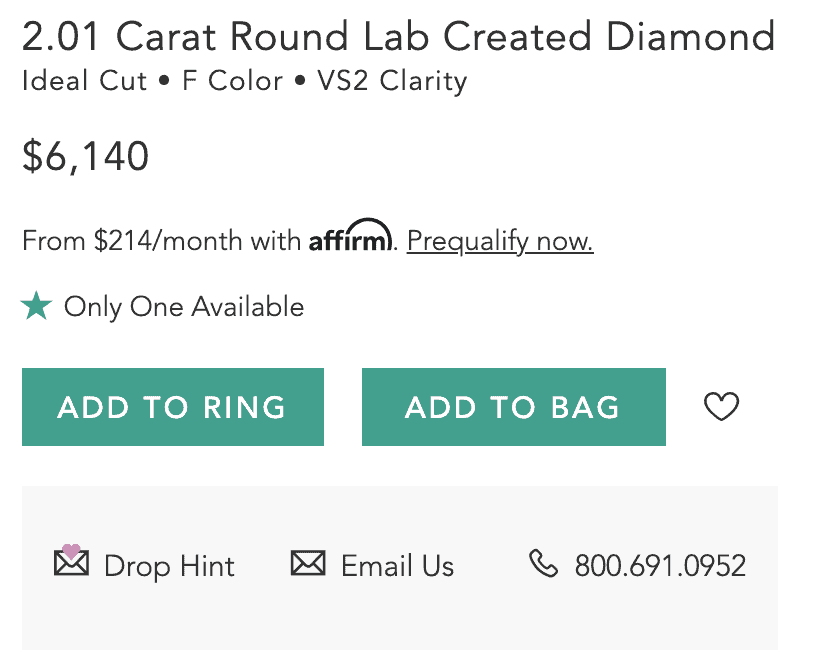

The price differences between a lab diamond and moissanite is huge.
Moissanites aren’t usually measured in carat weights. A 6.5 mm round moissanite should be the equivalent size of a 1 carat round diamond.

Moissanites aren’t graded by the 4Cs like diamond either. They usually come in standard, premium, and super premium. Super premium is top quality.
They’re usually colorless and almost always eye-clean, so I chose a lab diamond that is eye-clean and colorless as well. Lab diamonds are more expensive than diamond simulants.
Lab-Grown Diamond Cost vs White Sapphire Cost Comparison
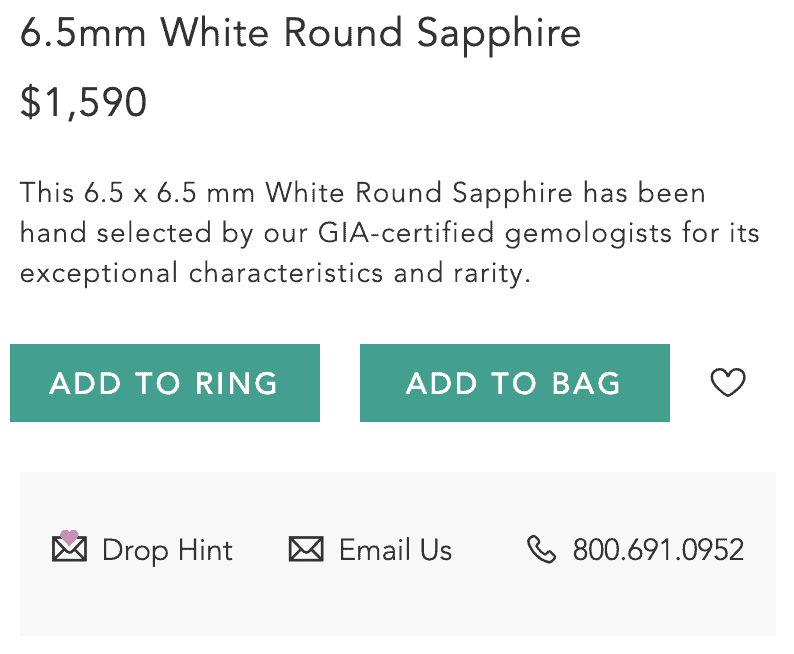
The quality factors between these two gemstones are very different. The sparkle is too. They tend to give off a silvery light instead of white and rainbow light like diamonds and moissanite.
White sapphire is usually sold as lab created because natural is more rare and more expensive.
You can find lab created white sapphire rings at places like Kay. Larger sizes are easy to come and cost under $150 when set in sterling silver.
The white sapphire above is a natural white sapphire from Brilliant Earth. These are more expensive, but still far from our lab diamond.
Read also: Lab-created white sapphire vs diamonds
Lab-Grown Diamond Advantages and Disadvantages
Pros
Here’s some of the best things about buying lab diamonds vs mined.
- Lab diamonds give you more bang for your buck — Lab diamonds are often found in higher carat size than 1 carat.
- Lab diamonds are 100% conflict-free — We only recommend retailers that sell conflict-free diamonds or traceable and recycled natural diamonds like Brilliant Earth. Some people still opt for lab diamonds to be sure.
- Lab diamonds use less energy than mined diamonds — The mining process uses a ton of energy that isn’t good for the environment. Lab diamonds don’t use as much energy and are considered better for the environment, but not green or sustainable.
- Lab diamonds have better clarity and color than mined diamonds
- Lab diamonds are much cheaper than mined diamonds — Of course, you already know this. But this is one of the biggest reasons to opt for lab diamonds instead of natural ones.
Cons
Here are a couple no-so-great things about lab diamonds. They may or may not apply to your situation.
-
- Lab diamonds have virtually no resale value — To be honest, even natural diamonds don’t have great resale value in general. However, many retailers like James Allen and Blue Nile offer lifetime diamond upgrades should you ever want to trade up for a better one. You can’t do that with lab diamonds. Beyond a return date, you’ll have to try a local online marketplace. Even then, there’s probably lab diamonds online cheaper than what you’re selling yours for, unless you heavily discount it.
<li “=”” style=”text-align: justify;” tve-droppable”=””>
Lab diamonds have been misrepresented by the diamond industry
-
- —
- There’s a lot of claims floating around the internet about the lab diamond market, so I want to address the biggest ones.
Lab-grown diamonds have gone by many names, but are usually called either lab-grown or lab created.
Before, they were more commonly called synthetic diamonds. That led to the belief and judgment that lab-grown diamonds aren’t real diamonds. Synthetic gemstones simply mean created in lab. Synthetic rubies, emeralds, and sapphires are all lab-grown gemstones and real versions of their natural gemstones.
I think it’s just something that natural diamond industry titled lab diamonds to give them a negative connotation and make them seem less appealing in name so they’d sell less of them.
A diamond imitation is a gemstone meant to resemble the look of a real diamond. They can also be called diamond alternatives or diamond simulants.
Sometimes these are meant to deceive a buyer on places like Etsy or Amazon. You’ll notice the name of the gemstone you’re looking for in the title or description, then find out it’s an imitated stone, like a cubic zirconia or a zircon. In the worst situations, it could be glass.
Thankfully, lab diamonds aren’t fake diamonds. Your best bet is to buy from a trusted retailer rather than on a personal sale site, just to be safe.
Lab-Grown Diamond Price FAQs
Here are some answers to popular questions about lab diamonds and their pricing.
Who has the cheapest lab-grown diamond prices?
James Allen almost always has the cheapest lab-grown diamonds and natural diamonds online. They will also price match comparable diamonds. They also give a free lifetime repair warranty on their ring settings.
Brilliant Earth specializes in ethical diamonds, including lab and natural. They focus on giving back to the community and other causes. They have some of the most beautiful ring settings for engagement rings.
Do lab-grown diamonds need a grading report?
You may or may not know that we tell everyone to only ever purchase natural diamonds with a GIA or AGS grading report or diamond certification.
But what about lab diamonds?
Before recent years, the Gemological Institute of America (GIA) didn’t get too involved with lab diamonds, so their grading reports weren’t as extensive as others. Now, the GIA has lab-grown diamond reports up to snuff and they are available at some retailers.
Other lab-grown diamond certifications that we recommend are IGI and GCAL.
I always want legitimate paperwork on something I’m making a purchase on, especially at this price. I think diamond grading reports are worth the cost.
If you’re not a skilled jeweler, it’s very difficult to distinguish your lab diamond from a regular diamond.

Should lab diamonds have high diamond grades?
A lot of people think that the best diamond requires you to have the biggest carat weight, the highest clarity and the highest color grades. While diamonds both lab and natural are rare in high grades and high carat weights, you don’t need them. This is especially true with lab diamonds.
If you are buying a round cut diamond that has been lab-grown, the cut grade should either be ideal cut or excellent cut.
For princess cut and other diamond shapes like pear shape, you should be looking at Very Good or higher, if the retailer sorts them that way. Officially, diamonds other than round cut have no actual cut grade. However, some retailers offer “ideal” princess cut and cushion cut diamonds that just fall under the best parameters for that shape.
The cut grade has a direct impact on the brilliance and durability of your diamond. I’d stay away from super ideal cuts unless you really really want them.
Here’s an example…
You don’t need a VVS2 lab-grown diamond. The VVS clarity tier is the last one before internally flawless. No, you just need an eye-clean diamond, or a diamond that has no visible inclusions or blemishes to the naked eye.
By the way, if the VVS acronym confuses you you might want to take a look at our article which explains what a VVS diamond is.

Eye-clean clarity grades are VS, VVS, IF, and F. In fact, if one of each of these were lined up in front of you, you wouldn’t be able to notice a differences except under 10x or more magnification.
And since lab-grown diamonds naturally have better clarity than mined diamonds, you really shouldn’t need the highest clarity. But if you do go that route, you’re getting it a fantastic price compared to how much a VVS or IF diamond of the same grades would cost.
With color, you don’t need to have a D color grade for your diamond to be colorless. It’s actually difficult to buy lab diamonds in lower clarity and color grades since better grades are easily affordable and they don’t usually have many.
You’ll notice that many lab diamond dealers don’t even carry I clarity diamonds because SI, and VS2 clarities are common for lab diamonds.
If you’re choosing a simple white gold solitaire engagement ring, I’d recommend a lab diamond with minimum H color and minimum VS2 clarity. If you can find an SI lab diamond that’s eye-clean, even better!
Conclusion
So that covers everything you need to know about the factors that play into the price of lab diamonds. And if you’re thinking about buying one, know that price alone shouldn’t be the only thing you consider before purchasing.
You’ll want to buy a real lab-grown diamond from a retailer you can trust. You can see our best lab diamonds review, which has helped dozens of folks choose the right LGD for their ring.